A row of single-story houses with dark siding and gray shingled roofs behind large deciduous trees, with a trimmed hedge in the left foreground and a mown lawn under an overcast sky.

Mini Split Installation in Woodbury, MN

Tell us about the job

Takes about a minute. No obligation.

New system or replacementMini-splitWashington County, MN
Step 1 of 2

What ZIP code is the job in?

Gas heats most homes here

About 8 in 10 homes in Washington County heat with utility gas. A mini split does not compete with that furnace for the coldest months. It takes over the mild stretches and handles cooling, so the furnace runs less and the ductwork carries less of the load.

What that means for a mini split job

A mini split does not need to tie into existing ductwork at all. That makes it a straightforward add to a gas-heated home, whether the goal is cooling a room the furnace and AC never handle well, or adding heat to a space with no ducts running to it.

8 months
October through May, your system heats
3 months
June through August, it cools
10°F
the average winter night it heats against
80°F
the average summer afternoon it cools against
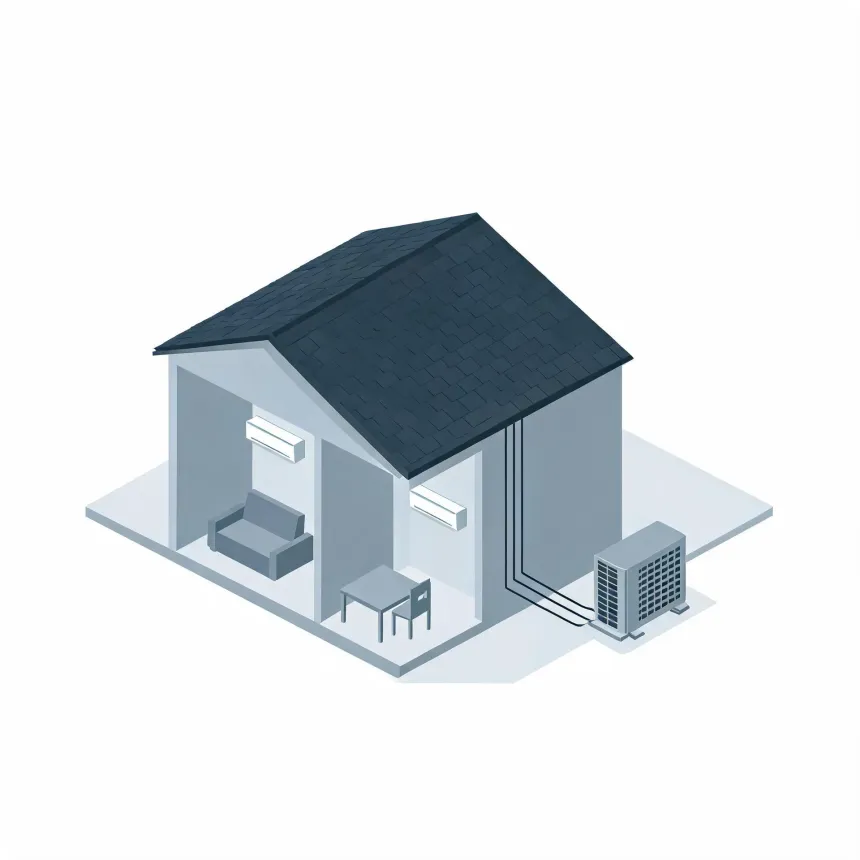
Isometric illustration of a cutaway house with a dark shingled gable roof, showing two wall-mounted indoor air handlers, a sofa, table and chair inside, and refrigerant lines running to an outdoor condenser unit beside the building.
Your system heats October through May and cools June through August.

NOAA nClimDiv, 1991–2020 normals

Cooling in Washington County runs June through August.

May is the month to get a mini split installed, before the first hot week puts it to work.

A standard mini split handles summer here without an upsize

Power costs 15.45 cents a kWh statewide
Cooling runs June through August
Summer afternoons average 80°F

Washington County sits in climate zone 6A, a cold zone with winters that run long. Any mini split installed here falls under the same federal rule as other split-system heat pumps. Units made from 2023 onward need to hit at least 14.3 SEER2 for cooling, with a matching minimum for heating. The standard does not set a lower bar for ductless systems. That rules out older or stripped-down models built to looser numbers, and it means two mini splits meeting the minimum will land in the same range on paper no matter what the brand name is. A federal tax credit is available for qualifying heat pump installations, worth checking against the specific unit before signing anything.

Summers here don't push a mini split hard

Three months of cooling, with afternoon highs averaging around 80, is not a hard season for any mini split to cover. The hail this county sees is a roof and siding problem, not a strain on a unit sized for summers this mild. A system here is not working to its limit, so a well-chosen standard model holds up without reaching for the top of the lineup.

Find a contractor
A man in a cap, gray long-sleeve shirt and tan pants climbs concrete steps toward a dark green front door, carrying a worn canvas tool bag.
A beige split-system air conditioner outdoor condenser unit mounted on metal wall brackets atop a stucco wall.

A light summer, year after year

Three summers a month short of year-round use is not much wear on a compressor. Pick a mini split for reliability and a good warranty, not for a cooling capacity this county will rarely ask for.

The number of zones sets the cost

A single indoor head paired with one outdoor compressor is the simplest job there is. Add another zone and the outdoor unit has to be sized for both together, and each indoor head adds its own line set, its own mounting, its own spot on the wall or ceiling. A one-zone system and a multi-zone system are not variations on the same job. They are different jobs.

The line set run is labor, not parts

Every indoor head connects to the outdoor unit through refrigerant lines and wiring that have to be run between them, usually through an exterior wall. A short, straight run through one wall is quick work. A run that has to go up through an attic, along a soffit, or across the house to reach the right spot takes longer and takes more material, and that labor is where a lot of the bid comes from, not the equipment sitting on the truck.

If this is replacing a window unit or an electric baseboard setup, that equipment usually just gets hauled off once the mini split is in and working. If the old system is a furnace staying in place for the coldest months, nothing about it changes. The mini split doesn't tie into the furnace or the ductwork, so there's no duct work to cap or rework and no gas line to deal with on that side. The only real decision is whether anything in the old setup is worth keeping as backup. A window unit pulled out for the season can sit in storage. A baseboard heater taken off the wall usually isn't worth reinstalling once a mini split is handling that room.

Installation starts outside, not in. The outdoor compressor needs a spot with clear airflow around it, set on a pad or brackets above ground level so it isn't sitting in standing water or buried once snow piles up. Indoors, the head goes on an exterior wall, usually up high, somewhere with nothing blocking it and a clean path back to where the line set will exit. Once both spots are picked, the crew drills through the wall and runs the refrigerant lines, the wiring and the condensate drain through that opening, then connects both ends. The lines get pressure tested, then the system gets evacuated to pull all the moisture and air out before refrigerant is released into them. That vacuum test matters more than almost anything else that happens that day. A line set with moisture left inside it causes problems months later, long after the crew is gone. Once it holds vacuum, the system gets powered on, checked for proper refrigerant charge, and run through both heating and cooling before anyone calls the job done.