Can a mini split cool a whole house in Blaine, MN

A white wall-mounted mini-split air conditioner indoor unit centered against a plain light gray background.
Hand it off

Can a mini split cool my whole house?

You've got a mini split, maybe one that cools a single room well, and you're wondering if it can take over for the whole house instead of running a separate central system. With a Blaine summer that's warm but not as heavy and humid as it gets further south, it seems like it should be able to keep up everywhere, not just the one room it was put in to handle.

Usually not with just one unit

A single mini split head is sized and placed to cool the room or open area it sits in. It won't push air down a hallway into closed bedrooms or across a two story layout the way a ducted system does. A multi-zone system, with one outdoor unit feeding several indoor heads, can cover a whole house, but that means a head in each room or zone that needs cooling, not one unit doing all the work. Most homes here already heat with gas, so a mini split setup for whole-house cooling is usually added alongside that furnace rather than replacing it. Getting the zones and sizing right for your layout is something a local installer works out room by room.

A white wall-mounted mini-split air conditioner installed high on a light gray interior wall below a white crown molding and ceiling with a recessed light.

One or two rooms, covered

A single mini split head can hold a room at temperature on its own, even on a hot July afternoon. The bedroom or living room it serves stays even because the unit only has to manage the air right there. Add a second head and you've got two rooms covered the same way.


A dusty, discolored white wall-mounted mini-split air conditioner unit installed on a plain beige interior wall below a molding strip.

The rest of the house, on its own

Walk past that same unit into a hallway or a back bedroom and the air changes. One or two heads can't push cooled air through a house the way a central system does, so rooms without their own head warm up as the summer goes on. More heads, placed room by room, is what closes that gap.

What does running a mini split through a Blaine year actually look like?

  • Cooling runs June through August

    Cooling here only runs June through August, so a mini split sized for whole-house cooling isn't working hard most of the year.

  • Heat runs September through May

    Heat is the real job here, September through May. That's nine months leaning on whichever system you pick to carry the house.

  • Power here costs 15.48 cents per kilowatt-hour

    At 15.48 cents per kilowatt-hour, running enough heads to cover the whole house costs something real if your plan depends on electric heat strips.

NOAA nClimDiv 1991-2020 · EIA-861 2025

Why one head isn't enough

A single mini split head is built to condition the room it sits in. It pulls warm air across its coil, cools it, and pushes it back into that same space. Air doesn't travel well on its own once it leaves the room, so a head in the living room does almost nothing for bedrooms down the hall or upstairs. Central air works because ductwork pushes cooled air to every room from one source. A mini split only does that if there's a head, or enough heads, in every room that needs one. Whole-house coverage from mini splits is a design question, not a power question. It's about placement, not how strong one unit is.

Sizing heads to the house

A contractor sizing a multi-zone system for whole-house cooling looks at square footage room by room, not just total square footage. A larger open space, like a kitchen that opens into a living room, might need a higher-capacity head than a closed-off bedroom half its size. Windows matter too. A room with west-facing glass holds more afternoon heat than one with none. Get the sizing wrong and a head either short-cycles trying to cool a space too small for it, or runs constantly and never catches up in a room too large for it. Done right, each room gets a head matched to what that room actually needs, not a generic number.

A woman with long light-brown hair in a gray knit sweater sits in a living room looking off to the side, with a sectional sofa, houseplant, lamp, wooden table and large windows behind her.
A woman in a chunky gray turtleneck sweater sits indoors looking off to the side, with a blurred dining table, chairs, pendant lamp and window behind her.
A woman in a cream knit sweater with her hair in a bun stands near a window, looking off to the side, with a gray sofa, houseplant and open kitchen with pendant lights blurred behind her.
A woman with long brown hair in a cream knit sweater stands near a window, looking to the side, with a white sofa, shelving, and a hallway visible behind her.
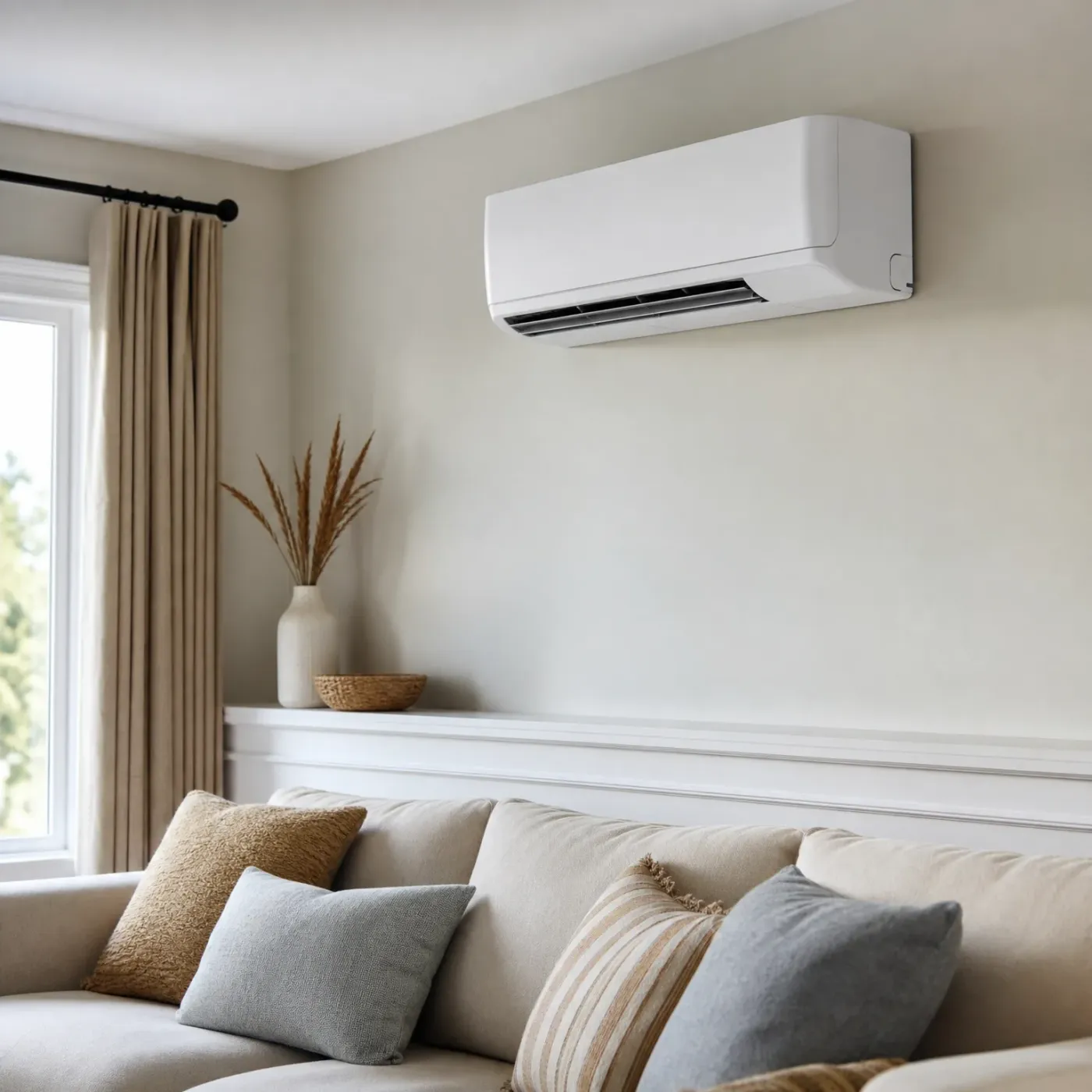
A white wall-mounted mini-split air conditioner on a pale wall above a beige sofa with assorted cushions, beside a window with long curtains and a shelf holding a vase of dried grasses and a woven bowl.

Done looking for a mini split pro

One installer gets your project, so there's no bidding war over it.

One request ends the search for a mini split installer.

Find a licensed mini split pro

No charge to send it. You decide if you hire them.

One System or Several Heads

One ducted system

  • One thermostat sets the temperature for the whole house, so no one is adjusting heads room by room.
  • A single return pulls air from the house and runs it through one coil, so every room gets conditioned air through the same ducts already in place.
  • Gas furnaces are the common setup here, so pairing central air with the furnace means one system handles distribution for both.
  • Air moving through ductwork reaches bedrooms and basements without depending on a door being left open.
  • Service calls deal with one piece of equipment instead of several heads and an outdoor unit split between them.

Multiple mini split heads

  • Each room gets its own head and its own setting, so a bedroom can run cooler than a living room at the same time.
  • Rooms without ducts, like a finished basement or a converted porch, can get a head run to them without opening up walls for ductwork.
  • A house with several heads still needs enough outdoor unit capacity to run all of them on a hot July day.
  • Every head installed is another line set and another unit that can need service down the road.
  • Heat pump heads still carry the cooling load alone in summer, but in winter they work alongside whatever heats the rest of the house.
A white wall-mounted mini-split air conditioner unit installed high on a plain beige wall near the ceiling, with empty wall space to the right.

The room you didn't cool

Say your mini split handles the living room and the primary bedroom. The hallway between them, the bathrooms, the kids' rooms down the hall, none of that air moves on its own. On a hot July afternoon those rooms sit warmer than the ones with a head, sometimes by several degrees. Whoever sleeps back there feels it at ten at night when the rest of the house has settled down and that room hasn't.

A white wall-mounted mini-split air conditioner indoor unit on a plain light-colored wall, with a beige curtain at the right edge of the frame.

What it means for your bill

Running two or three heads to chase whole-house cooling means two or three compressors cycling instead of one system built for the job. Each head draws power on its own schedule, and none of them are sized to carry rooms they weren't installed in. You end up paying to cool the rooms you have covered while the rest of the house still runs warm, which is the opposite of what a whole-house system gets you for the same electric rate.

A single mini split head cools the room it's in, not the house around it. If you want the whole house covered, that takes either a head in every room that needs one or a ducted system sized for the house, and the right answer depends on how your rooms are laid out. Blaine summers are short, June through August, but winter is the long job here, September through May, and most homes nearby run on gas for that. A mini split can carry either load well when it's sized and placed for the space it has to cover. Getting that sizing right, and deciding between more heads or a ducted setup, is a job for someone who installs these in houses like yours and knows what layouts actually work. A local contractor who does this work every season can look at your house and tell you what it would take to cover it, and you'd be working with just that one contractor on it.

A woman with her hair in a bun sits wrapped in a beige knitted blanket on a couch, holding a sleeping child against her chest in a warmly lit room with a lamp and houseplant in the background.
An older woman with short gray hair in a cream cable-knit turtleneck sweater smiles while looking to the side in a wooden kitchen, with a round loaf of bread on a board in the foreground and a lit candle by a dark window.

Mini Split Installation

It's off your list after this

A licensed installer who works in Anoka County gets your project.

A black-framed smartphone standing upright against a plain light gray background, its screen filled with solid green.
New system or replacementMini-splitAnoka County, MN
Step 1 of 2

What ZIP code is the job in?