How often to clean a mini split in Rochester, MN

Tune-up, service, or cleaningMini-splitOlmsted County, MN
Step 1 of 2

What ZIP code is the job in?

How often should I clean my mini split in Rochester, MN?

Mini splits run almost year round in Olmsted County, cooling through the sticky summer months and often carrying part of the heating load once it turns cold. That kind of use puts a lot of air through the indoor filters, and it's easy to lose track of when they were last cleaned. You want a number you can put on the calendar, not a vague reminder to check it sometime.

Clean the filters every two to four weeks, and have the full unit serviced once a year

The filters catch dust and pet hair every time the unit runs, and a mini split in this area runs for most of the year between summer cooling and winter heating. A filter that's clogged makes the unit pull harder to move the same amount of air, which shows up on your power bill given what electricity costs here. You can pull the filters yourself and rinse them, no tools needed. Beyond the filters, the coil and the condensate drain need attention that a filter rinse doesn't cover, and that's worth a yearly visit from someone who services these units. Skip it a year or two and the coil loses efficiency even with clean filters, since dust that never reaches the filter still settles on it over time.

A white wall-mounted mini-split air conditioner unit installed high on a beige interior wall below white crown molding, with a window and woven shade at the left edge showing green foliage outside.

Clean filters, clear coil

This is what a mini split should look like. Air moves through the filter and over the coil without resistance, so the unit pulls humidity out of the air in July and heats efficiently in January without working harder than it has to.

A dusty, stained white wall-mounted mini-split air conditioner indoor unit installed high on a plain off-white interior wall near the ceiling.

Dust means it's losing ground

A coil like this is caked with dust, and airflow is restricted on both sides of the wall unit. It still runs, but it uses more power to do the same job, and in a muggy Rochester summer that shows up fast on the electric bill.

A man in a navy sweater reclines with closed eyes in a beige armchair in a living room, with a lamp, wooden cabinet, bookshelf, potted plant, and a side table holding a newspaper and mug nearby.
A man in a blue henley shirt reclines on a leather chair with his eyes closed, beside a window, a houseplant, a side table with a newspaper and a dark mug.
A man in a gray sweatshirt reclines with his eyes closed in a dark leather chair, with a bookshelf behind him and a side table holding folded newspapers, a mug, and a potted plant by a window.
A man in a blue sweater leans back on a brown leather chair with his eyes closed and a slight smile, in a room with bookshelves, framed pictures, a potted plant by a window, a folded newspaper and a dark mug on a table.

Why does a mini split in Rochester need so much upkeep?

  • Cooling runs June through August

    Cooling runs June through August, so the filter and coil spend all three summer months pulling humidity out of sticky air.

  • Heat runs September through May

    Heat runs September through May, which means nine months where a dirty filter or coil makes the unit work harder than it should.

  • Power here costs 18.20 cents per kilowatt-hour

    Power here costs 18.20 cents per kilowatt-hour, so a mini split running inefficiently costs more here than in most places.

NOAA nClimDiv 1991-2020 · EIA-861 2025

A mini split has no ductwork to spread the dust out. Everything the filter misses lands straight on the coil behind it, inside the one indoor unit cooling or heating the room.

That is why the coil clogs faster than a furnace coil buried in a duct run ever does, and why skipping a cleaning shows up in the next power bill before it shows up as a breakdown.

A gray-haired man in a blue quarter-zip sweater sits in an armchair with his eyes closed, beside a large window with bare trees outside and a potted plant and lamp nearby.
A woman in a cream knit sweater sits in an armchair with her eyes closed and head tilted back, beside a window showing orange autumn foliage and a wooden side table with a mug.

Skip a season, lose capacity

A mini split with a dirty filter and coil can't pull humidity out of the air like it should. Rooms feel sticky in July even with the unit running.

I'm done searching

One call, done

Instead of searching for someone who services mini splits, calling around, and explaining the same thing twice, send one form and let a contractor reach out.

I'm done searching

Clean it yourself or call a contractor

Clean it yourself

  • Filters slide out for a rinse in most mini splits, and that part takes a few minutes with no tools involved.
  • You can see the filter is dirty just by pulling it and holding it to the light, so there is no guessing about timing.
  • The coil behind the filter is harder to reach and easier to bend if you push a brush or cloth into it the wrong way.
  • A home vacuum and soft brush handle dust on the filter, but they will not touch the grime that builds on the coil fins over a summer of cooling.
  • Washing the filter without checking the drain line and blower wheel leaves the parts that actually cause mold and odor untouched.

Call a contractor

  • A contractor cleans the coil itself, not just the filter in front of it, which is where the buildup that cuts cooling capacity actually sits.
  • The drain line gets checked too, so condensation keeps leaving the unit instead of backing up into the room during a humid July.
  • Servicing handles both the indoor head and the outdoor unit, including the parts a homeowner has no way to safely open up.
  • A technician spots a weak capacitor or a coil going bad before it fails outright in the middle of a stretch of 90-degree days.
  • One visit covers the filter, the coil, and the drain in the time it would take to track down a how-to video and the right tools.
A white wall-mounted mini-split air conditioner on a beige interior wall, with a window at left showing trees and a wooden fence, and dark wood flooring below.

A mini split that's kept up

This is what a clean unit looks like against the wall. The casing is free of dust, the louvers are clear, and air moves through the filter without resistance. A unit like this pulls moisture out of the air all summer and heats without strain all winter.

A white wall-mounted mini-split air conditioner indoor unit with dark louvered vents, installed near the ceiling on a beige wall below white crown molding.

A mini split that's been skipped

Dust has built up across the casing and into the louvers. Air has to push past that buildup to reach the coil behind it, and the coil picks up whatever the dirty filter let through. A unit in this shape is already working harder than it should, in every room it serves.

What does a dirty mini split look like in your house

Look at the louvers on the indoor unit. Dust on them usually means dust on the filter behind them too. Run your hand near the vent. Weak airflow even on high is a sign the filter or coil is clogged. Listen for it working harder than it used to, or notice the room staying sticky in July when the unit is running the whole time. Some units drip or smell musty when the coil and drain line haven't been cleaned. None of this means the unit is broken. It means air isn't moving through it the way it should, and the unit is spending more to do less, which shows up as a room that never quite feels right no matter how long it runs.

  1. Warm room air gets pulled in through the front filter first.

  2. The filter catches dust before air reaches the coil behind it.

  3. Air passes over the refrigerant coil and gets cooled or heated.

  4. A blower pushes that conditioned air back out through the louvers.

A white wall-mounted mini-split air conditioner indoor unit with visible dust and staining along its lower vent, installed on a plain pale wall.
Before you get your mini split maintenance
A white wall-mounted mini-split indoor unit installed high on a gray interior wall, with a window at left and part of a light gray sofa with a dark cushion at lower right.
After you get your mini split maintenance
A white wall-mounted mini-split indoor unit on a pale interior wall above a gray sectional sofa with cushions, next to a potted leafy tree and a floor-to-ceiling window showing green trees outside.

Finding a pro stops being your job

One form instead of hunting for a pro who does mini split tune-ups.

Send the request and finding a pro stops being your problem.

Hand it over

You only hire the pro if you want to.

A wooden table in the foreground holds a closed laptop and a ceramic mug of coffee, with a spindle-back wooden chair behind it, a beige wall with paneled wainscoting, a window at left, and a kitchen counter with a cutting board, bowl of fruit and greenery at right.

What skipping maintenance costs you in your own house

A clogged mini split shows up in your power bill before it shows up anywhere else. Power in Olmsted County isn't cheap, and a unit working against a dirty filter and coil pulls more of it to put out the same heat or cooling. You feel it in August when the bedroom won't cool down even with the unit running on high, and again in January when it's blowing air that isn't quite warm enough. Ignore it long enough and the system can ice up in winter or trip off on its own in summer, and now you're dealing with a repair instead of a cleaning.

Finding someone to service a mini split isn't like finding a furnace tech. Not every HVAC company in Rochester works on them, so you end up calling around, asking if they service your brand, waiting on a callback that doesn't come. Send the form on this page instead and that search is off your plate. You describe the unit once, not three times to three different companies, and the rest of finding someone is no longer something you have to do.

A wooden table holding a stone vase with a bare branch, two stacked books and a small dark bowl, beside a window with green foliage outside and a sofa in the dim background.
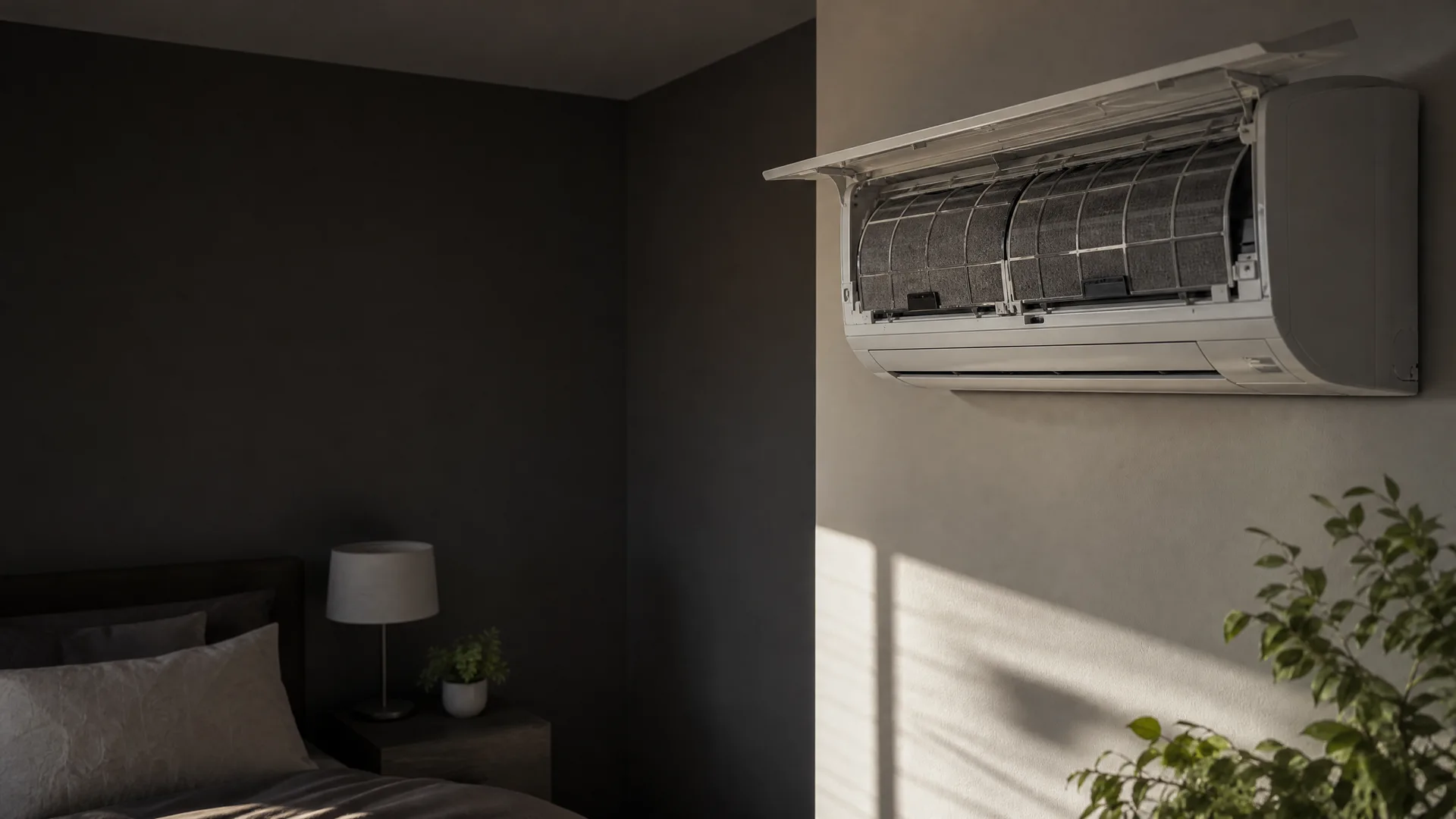
A wall-mounted mini-split air conditioner with its front cover open exposing the filters, in a dim bedroom with a bed, nightstand lamp and a potted plant.

It's a Saturday morning in April, sun coming in through the blinds. You've finally gotten around to the mini split in the bedroom, the one that ran nonstop last August and you never touched after. You pop the front cover up and slide the filter screen out, and it's grey, matted with a season's worth of dust. You hold it up to the window light and can't see through it at all. Outside, Rochester is still a few weeks from needing the thing for cooling, but you know summer shows up fast once it does, and you're standing there holding the screen, wondering how long it's actually been.


Cooling runs June through August

Three months of cooling means June, July and August are when your filter and coil take the hardest hit, pulling moisture out of sticky air day after day. The rest of the year gives the unit a break, which is the better time to get it cleaned before summer starts again.

NOAA nClimDiv 1991-2020

How often to clean it

  • Filters need a rinse every one to two months during the three summer months of cooling and the nine months of heating that follow.
  • A full cleaning of the coil and blower wheel once a year keeps a mini split in Rochester working the way it did on day one.
  • Weak airflow, a musty smell, or a coil that looks dirty when you check it are signs maintenance is already overdue.
  • Skipping a season shows up as higher power bills and rooms that stay sticky in summer or cold in winter.
  • A mini split with no ductwork puts everything the filter misses straight onto the coil, so upkeep matters more here than with a furnace.
  • Getting this on a schedule means you never have to call around, explain the unit again, and sort through quotes when a problem shows up.

The answer comes down to two schedules running at once. Filters get a rinse every one to two months, because a Rochester mini split barely stops working between the June cooling load and the long heating stretch that follows through May. The coil and blower wheel get a full cleaning once a year, on top of that filter rinse, since those two parts catch what the filter lets through and don't clear themselves. Skip either one and the unit doesn't fail outright. It just works harder for less, pulling more power to cool a sticky room in July or heat a cold one in January, and you end up paying for air you're not getting. The signs show up before the bill does: weak airflow out of the louvers, a musty smell when it kicks on, a coil you can see is coated with dust when you pull the cover. Any one of those means it's already behind. None of this is complicated once it's on a schedule. What's harder is getting to that point, calling around to find someone who actually services mini splits, explaining the unit and the symptoms again to each one, then sorting through quotes to figure out who's worth having out. Sending one form instead replaces all of that legwork with a single step, and the rest of the finding becomes someone else's job instead of yours.

Close view of a dark standing-seam metal roof with a stone chimney and metal flue cap, overlooking a wide river, trees, and flat farmland under a partly cloudy sky.

Let someone else find the pro

Fill out one form

Asking costs nothing, and the choice to hire stays yours.

A mini split that's never been cleaned is still cooling your room, just not the way it did when it was new. Send the request and skip the work of calling around Rochester for someone who services them. One form, and finding help is off your plate.