A row of illuminated two-story brick houses with front porches and mature trees photographed at twilight.

Mini Split Installation in St. Cloud, MN

Tell us about the job

Takes about a minute. No obligation.

New system or replacementMini-splitStearns County, MN
Step 1 of 2

What ZIP code is the job in?

Gas is the default here

Just over half of homes in Stearns County heat with utility gas. Most of the rest split between electricity and propane, with a small share on fuel oil. A mini split usually adds to that setup rather than replacing it, handling cooling and the milder stretches while the furnace covers the coldest weather.

What that means for a mini split

Since a furnace already carries most homes here through the cold months, a mini split can get sized for cooling load and mild-weather heating rather than for heating the house alone. Worth checking which fuel heats your home now before deciding how the two systems should work together.

9 months
September through May, your system heats
3 months
June through August, it cools
6°F
the average winter night it heats against
79°F
the average summer afternoon it cools against
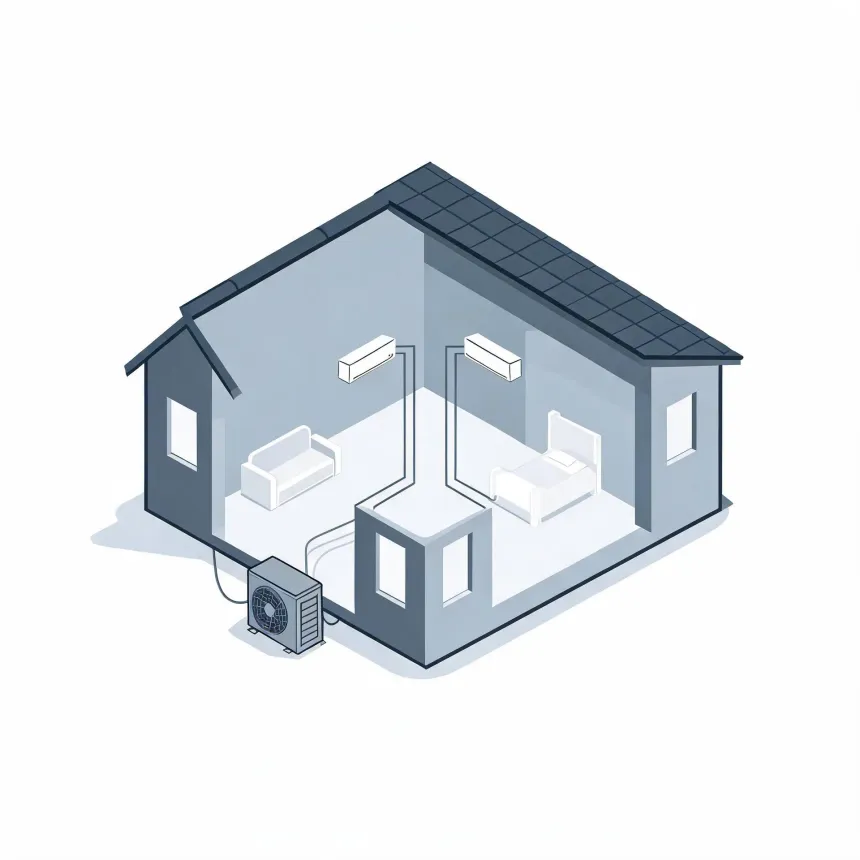
Isometric cutaway illustration of a small house showing two wall-mounted indoor air conditioning units connected by lines to a single outdoor condenser unit beside the building, with a sofa in one room and a bed in another.
Your system heats September through May and cools June through August.

NOAA nClimDiv, 1991–2020 normals

The efficiency number on a mini split is a ratio, not a fixed bill.

A unit sized and installed right will land closer to that number than one that's oversized or starved for airflow.

Three mild months of cooling, nothing more, is what sizing has to match here

Cooling runs June through August
Summer afternoons average 79°F
86 damaging wind events from 2015 to 2024
A standard mini split fits most homes hereMinnesota electricity ran 15.45 cents per kilowatt-hour in 2024, nothing that calls for an oversized or premium unit

Cooling runs June through August here, three months out of the year. May is the month to get a mini split installed, before the first hot stretch hits. Installers book up once the heat starts, and a system going in under pressure doesn't get the same attention to sizing and placement as one going in ahead of schedule. Getting it done in May also means it's tested and running before you actually need it, so any issue with the install shows up while there's still time to fix it without losing cool days.

Zone 6A sets the minimum. Get a system built for it.

Stearns County falls in climate zone 6A, and any mini split installed here has to meet the federal minimum of 14.3 SEER2 for cooling and 7.5 HSPF2 for heating. That rules out older or bargain units still sitting in some warehouses. A federal tax credit is available on qualifying equipment, worth asking about when you compare quotes.

Find a contractor
A white outdoor air conditioner condenser unit mounted on metal wall brackets against gray horizontal siding, with a blue sky and white clouds behind it.

Sized for the room, not rounded up

Sizing a mini split means matching its output to the room it serves, not rounding up for safety. A unit too big cools the air fast and shuts off, then starts again a few minutes later. It never runs long enough to pull moisture out of the air, so the room ends up cool but damp. A unit too small just runs and runs, straining to hold a setpoint it can't quite reach on the hardest days. Getting the size right takes a room by room look. Square footage matters, but so does ceiling height, how many windows face the sun, how much insulation sits behind the walls, and what else in that room already gives off heat. A tech works through that before naming a unit, because the number it lands on is the capacity the room actually needs, not the one that sounds impressive on a spec sheet.

Ask what's behind the wall, not just the unit

Every mini split has an outdoor compressor and one or more indoor heads connected by a line set carrying refrigerant and a drain line for condensate. Ask how many feet of line set the job needs and where it runs, because a longer run or extra elbows can change which equipment fits the job. Ask where the condensate drains to and how, since a line that dumps somewhere inconvenient becomes a problem later.

Ask how the quote handles a multi-zone setup

A single outdoor compressor can run more than one indoor head, but each zone draws against the same total capacity. Ask whether the quote is sizing the outdoor unit for the rooms running at once, not just adding up every head as if they'd all run full blast together. Ask how the system behaves if one zone calls for cooling while another calls for heat, since not every unit handles that the same way.

If a mini split is going in alongside an existing furnace or central air setup, the old equipment doesn't have to come out. A lot of homeowners just stop using the window units or space heaters that were patching things over, and those can go. If a central air condenser is being replaced outright, the old refrigerant lines get disconnected and the lineset usually gets reused or swapped depending on its condition, since running new line set through walls and framing is its own job. A furnace staying in place needs nothing done to it at all, it just keeps handling the coldest stretch while the mini split takes the rest. Ask what happens to the old condenser or units specifically, since hauling away a dead compressor isn't always included unless you ask for it.

Install day starts outside with the compressor. It needs a pad or wall bracket, a clear path for airflow, and some distance from anything that would block it or dump its own exhaust right back at it. Running the line set comes next, through a wall with as short and straight a path as the layout allows, since every bend and extra foot is something the refrigerant has to move through. Once the indoor head goes up and the lines connect, the system gets evacuated with a vacuum pump before any refrigerant moves, which pulls out moisture and air that don't belong in a closed system. Skip that step and the system can run, just worse, with ice where it shouldn't be or a compressor working harder than it should. After that comes the charge, the condensate drain test, and running the unit through both cooling and heating to see that it responds the way it should. A tech who rushes the vacuum or eyeballs the charge is cutting the part of the job you can't see afterward, which is exactly why it is worth asking how they handle it before the day it happens.