Gas heats most homes here
Utility gas heats 71.5% of occupied homes in Olmsted County. Electricity comes in second at 18.1%, with LP gas making up most of the rest.
Takes about a minute. No obligation.
Utility gas heats 71.5% of occupied homes in Olmsted County. Electricity comes in second at 18.1%, with LP gas making up most of the rest.
A mini split installed here is usually going in alongside a gas furnace, not replacing the only heat source. That changes the job. It's often about adding cooling or heating a room the furnace doesn't reach well, rather than sizing a system to carry the whole house through a Minnesota winter on its own.
NOAA nClimDiv, 1991–2020 normals
Minnesota homes paid 15.45 cents per kilowatthour in 2024.
A mini split sized right for the room it serves keeps that cost predictable, and there's no reason here to size it any other way.




Summer here is short, three months of cooling from June through August, with afternoons averaging 79 degrees. That's a mild load. A mini split sized to the room it's cooling handles those afternoons without trouble, and there's no case for sizing up. The wind and hail that show up in the numbers for this county are a roofing and siding concern, not a reason to change how the unit itself is sized. The outdoor unit still needs to be mounted and secured properly, which any licensed installer here already knows how to do.
Olmsted County falls in climate zone 6A, and any mini split installed here, ductless units included, has to meet the federal minimum of 14.3 SEER2 for cooling and 7.5 HSPF2 for heating. That's the floor a licensed installer is working from before anything gets sized for the room. A federal tax credit is available on qualifying equipment, worth checking against before you decide what goes in.
Find a contractorSizing a mini split is a room by room calculation, not a guess based on square footage alone. A contractor doing it right walks the room, checks the windows, counts exterior walls, looks at the ceiling height and the insulation, and works out how much heat that room gains in summer and loses in winter. Too big and the unit short cycles, running a few minutes at a time, cooling the air fast but never running long enough to pull the moisture out, so the room feels cold and damp at once. Too small and it runs flat out on the hottest and coldest days and still can't keep up. Either way the compressor wears against a load it wasn't matched to. The right size is the one that runs long, steady cycles on a normal day, which is also what keeps the indoor coil and the compressor lasting as long as they're built to.
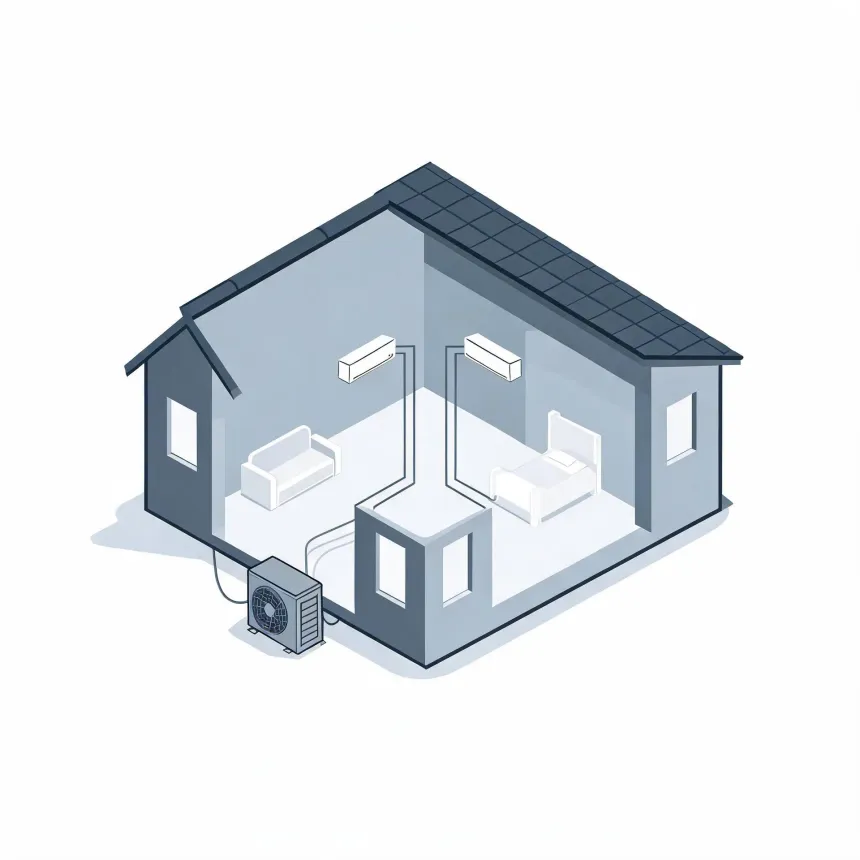
Every indoor head needs its own line set run to the outdoor unit, and its own spot on the wall or ceiling picked for even airflow and a clean path back out. A single zone system is a simpler job than a multi zone system covering several rooms off one outdoor unit. More heads means more line set, more mounting work, and more time deciding where each one goes.
The refrigerant lines and wiring have to get from the outdoor unit to each indoor head, usually through an exterior wall. Where that wall is, what's behind it, and how far the lines have to run all affect how much work the installer does before the system ever gets charged with refrigerant and tested.
If a furnace or central AC is coming out as part of this job, someone has to deal with the old equipment, and that's a separate task from the mini split install itself. Refrigerant in an old outdoor condenser can't just be vented, it has to be recovered before the unit is disconnected and hauled off. A furnace coming out means capping or rerouting the gas line and dealing with the old ductwork if it's not staying in use. None of that is part of mounting an indoor head and running a line set. Worth asking upfront whether removal and disposal of the old system is included in the quote or billed separately, since it's a different kind of work from the installation itself.
Installation day itself follows a set order. The outdoor unit goes in first, set on a pad or bracket with enough clearance around it for airflow, then the indoor head gets mounted and leveled. The installer drills through the wall for the line set, connects the refrigerant lines to both ends, and runs the condensate drain so water has somewhere to go besides the floor. Once everything's connected, the system gets pulled down to a vacuum to clear out air and moisture before any refrigerant moves through the lines. Skip that step or rush it and moisture left in the line set turns to acid over time, which is how a compressor fails early. After the vacuum holds, the lines get charged, and the installer runs the system through both heating and cooling to check it's pulling the right temperature split before calling the job done.