A quiet suburban street at twilight featuring two-story brick homes with illuminated windows and large trees lining the sidewalk.

Mini Split Installation in Owatonna, MN

Tell us about the job

Takes about a minute. No obligation.

New system or replacementMini-splitSteele County, MN
Step 1 of 2

What ZIP code is the job in?

Most homes here run on gas

Utility gas heats 70.0% of occupied homes in Steele County. A mini split is not there to replace that furnace. It takes over one room, or it covers the whole house for cooling, while the furnace keeps doing the job it already does.

That changes what the install is for

Since gas already handles the coldest stretch for most homes, a mini split here usually gets asked to do one thing cleanly. Cool a room the main system struggles to reach. Add heat to a space that never got ductwork, like a garage or a finished attic.

9 months
September through May, your system heats
3 months
June through August, it cools
10°F
the average winter night it heats against
79°F
the average summer afternoon it cools against
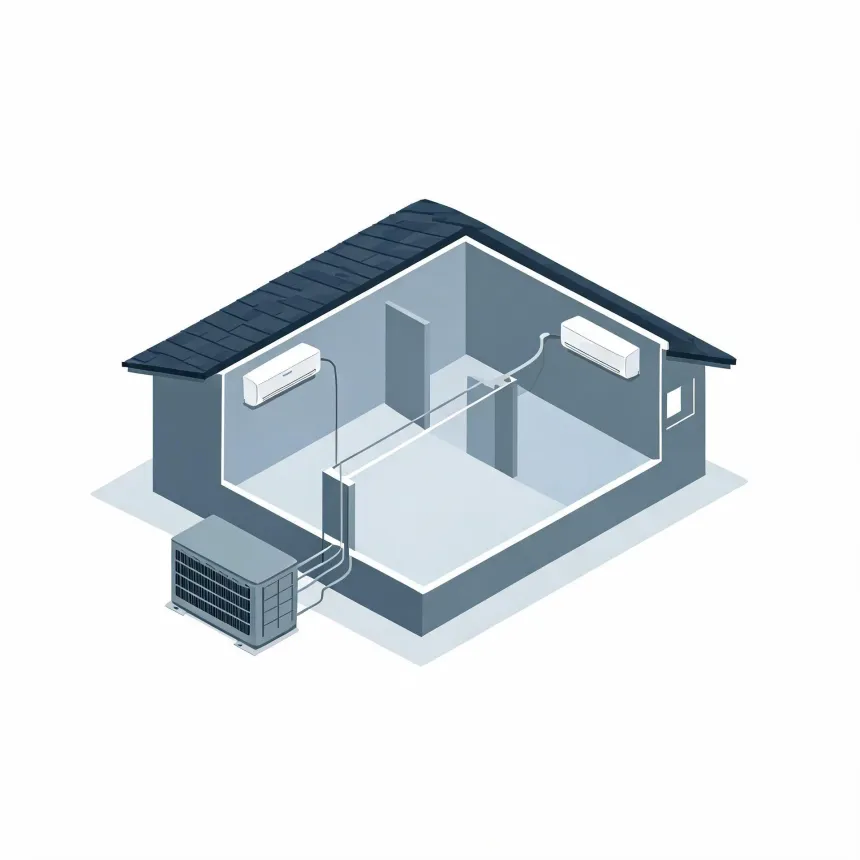
Isometric illustration of a cutaway house showing two wall-mounted mini-split indoor units connected by line sets to a single outdoor condenser beside the exterior wall.
Your system heats September through May and cools June through August.

NOAA nClimDiv, 1991–2020 normals

Cooling here runs June through August.

May is the month to get a mini split installed, before the first hot week puts you on a waiting list.

Three months of cooling a year. Build for that, not for extreme heat.

Cooling runs June through August
Summer afternoons average 79°F
17 hail events from 2015 to 2024

Half the homes in Steele County were built in 1975 or earlier, half in 1975 or later. That split doesn't change much about sizing a mini split. What matters is the room it's going into, how many windows it has and which way it faces, not the decade the house went up. A correctly sized unit for a bedroom is the same unit whether the house is older or newer. There's no case here for oversizing to cover some local quirk in construction. A standard efficiency rating and a standard size, matched to the space, is what the job calls for.

Any unit installed here has to meet zone 6A minimums

Owatonna sits in climate zone 6A, so a mini split going in has to hit at least 14.3 SEER2 for cooling and 7.5 HSPF2 for heating under the federal standard. That's the floor, not a goal to aim for. A federal tax credit is available for qualifying equipment, which is worth factoring in before you pick a unit.

Find a contractor
A white mini-split air conditioner outdoor condenser unit mounted on metal brackets against a beige stucco exterior wall, with a blue sky and scattered clouds in the background.

Light duty, most of the year

Three months of cooling, afternoon highs averaging 79, means the outdoor unit isn't working against extreme heat the way it would further south. You don't need to chase the highest SEER2 number on the shelf. Meeting the zone 6A floor is enough for what this unit will actually be asked to do here. Put the money you'd spend chasing a higher rating toward the install itself, or toward a unit with a solid track record for reliability instead.

How many rooms it has to reach

A single zone, one indoor head tied to one outdoor unit, costs less than a multi-zone system. Once a second or third room needs coverage, the job needs more indoor heads, more line set run, and an outdoor unit sized to handle all of them at once. Each zone added is another set of materials and another place the line set and wiring have to reach.

What it takes to get the line set there

The outdoor unit and each indoor head connect through a line set that has to run through a wall, and often through framing or siding to reach outside. A straight shot through one exterior wall is the simple case. A longer run, one that has to cross a floor, go up through a soffit, or snake around framing to reach the room, takes more time and more material, and that shows up in the install.

If a mini split is going in to cover a room that already has something else doing the job, like a window unit or an electric baseboard, that old equipment usually just gets left alone or pulled out, not folded into the new system. A mini split doesn't tie into ductwork and it doesn't share a thermostat with a furnace, so there's nothing to connect it to. If the old equipment is a window air conditioner, it comes out of the window once the new indoor head is up and running. If it's a baseboard heater, it can often stay in place as backup, or get shut off at the breaker if it's not needed anymore. Removing an old unit is a separate job from mounting the new one, and it's worth asking whether that haul-away is included before the work starts.

Install day starts outside with the outdoor unit, mounted on a pad or brackets against the wall, far enough from the house to let air pull through the coil. Inside, the indoor head goes up on the wall first, usually high, so the line set has a clean path to the hole drilled through to the outside. That hole is small, just wide enough for the refrigerant lines, a drain line and the electrical whip to pass through together. Once everything is connected, the lines get pulled down to a vacuum to clear out moisture and air before any refrigerant moves through them. Skip that step and the system can corrode from the inside or lose its charge early. After that it's a pressure test, a check on the refrigerant charge, and then it's running. Most of the day is spent on the line set and the wall penetration, not on the units themselves.