Most homes here run on gas
Utility gas heats 67.2% of homes in Chisago County, with LP gas covering another 16.2%. A mini split isn't replacing that furnace. It's adding cooling, or heat in rooms the furnace doesn't reach well.
Takes about a minute. No obligation.
Utility gas heats 67.2% of homes in Chisago County, with LP gas covering another 16.2%. A mini split isn't replacing that furnace. It's adding cooling, or heat in rooms the furnace doesn't reach well.
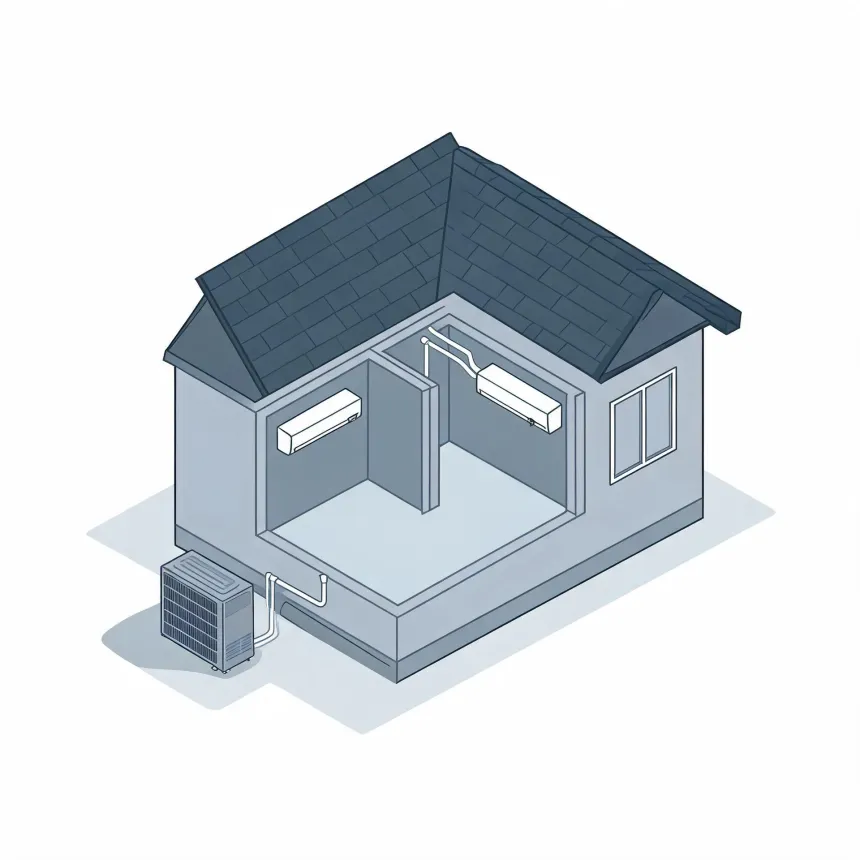
Pairing a mini split with an existing gas furnace means the installer is adding a new system alongside one that already heats the house, not swapping one for one. Where the indoor and outdoor units go depends on your layout, worth walking through before the quote.
NOAA nClimDiv, 1991–2020 normals
Cooling in Chisago County runs June through August.
May is the month to get a mini split installed, before the first warm stretch puts it to work.



Summers here are short. Three months of cooling, June through August, with afternoon highs around 80°F. That's a mild load compared to what a mini split handles in a lot of other places. You don't need the biggest unit or the top efficiency tier to keep up with that. A mid-range system sized right for the rooms it's covering will do the job without strain. Where the wear comes from here is wind and hail, not long stretches of hard running, so what matters more is a solid install and an outdoor unit that can take a Minnesota winter.
Chisago County sits in climate zone 6A, and the federal standard treats a ductless system the same as any other split-system heat pump. Units made from 2023 on have to hit 14.3 SEER2 for cooling and 7.5 HSPF2 for heating, no separate rule for ductless. A federal tax credit is available on qualifying equipment. That narrows the field before you even start comparing brands.
Find a contractorThree months of real work a year doesn't ask much of a mini split. June through August, afternoon highs around 80, then the outdoor unit sits through a long Minnesota winter doing little or nothing for cooling. That's not a system you need to oversize or chase the top efficiency tier for. Put the budget toward a tight install and an outdoor unit built to take the wind and hail this county sees. That's what it'll actually be up against most of the year.
Since this one is going in alongside the furnace rather than replacing it, there's no equipment coming out. The job is about running the refrigerant line and wiring to a new outdoor unit, not disconnecting an old system.
A mini split installation doesn't touch the existing heating system. The furnace keeps running the way it always has. The new unit is a separate system added on top, not something that changes what's already there.
A few questions sort the real differences from the sales talk. Ask how many indoor heads the outdoor unit can run, and whether it's a dedicated single-zone system or a multi-zone. A multi-zone gives you flexibility to cover more than one room later, but each head gets a share of the total capacity, so adding zones can mean less output where you need it most. Ask what the turndown range is, how low the compressor can throttle on a mild day, since that affects comfort as much as raw output. Ask what happens to heating capacity as the temperature drops outside, because every heat pump loses some, and the spec sheet should show the number at a low outdoor temperature, not just at mild conditions. And ask who's responsible for the line set insulation and the condensate drain, since a sloppy line hidden behind a wall is the kind of thing you only find out about later.
Installation day starts outside. The outdoor unit needs a spot on a pad or wall bracket with clearance on all sides for airflow, and the installer will think about where snow piles up or runoff drains before picking the spot. Inside, mounting the head means finding wall studs or framing that can hold it level, then drilling through the wall for the line set, wiring, and condensate drain, usually one hole for everything. The refrigerant lines get connected at both ends and the system is pressure tested before anything is charged, since a leak found after the fact means opening the wall back up. Once the lines hold pressure, a vacuum pump pulls moisture and air out of the system, because either one left behind will damage the compressor over time. Only after that does the refrigerant get released from the outdoor unit into the lines. The last steps are powering it on, checking that the indoor head is actually cooling and heating, and confirming the drain line is clearing condensate instead of backing up.