A nighttime street view of several illuminated two-story red brick homes with front porches, flanked by a large tree.

Mini Split Installation in Long Prairie, MN

Tell us about the job

Takes about a minute. No obligation.

New system or replacementMini-splitTodd County, MN
Step 1 of 2

What ZIP code is the job in?

Propane and gas split the market here

LP gas heats 33.2% of homes in Todd County and utility gas heats another 29.6%. Electric heat accounts for 19.4%. A mini split installed here is usually going in alongside a furnace, not replacing the only source of heat.

That changes what the installation needs to do

If your home already has a furnace, the mini split's job is cooling and shoulder season comfort, with the furnace carrying the coldest months. Sizing and placement should reflect that split, not treat the mini split as a whole-house heating system on its own.

9 months
September through May, your system heats
2 months
July through August, it cools
5°F
the average winter night it heats against
78°F
the average summer afternoon it cools against
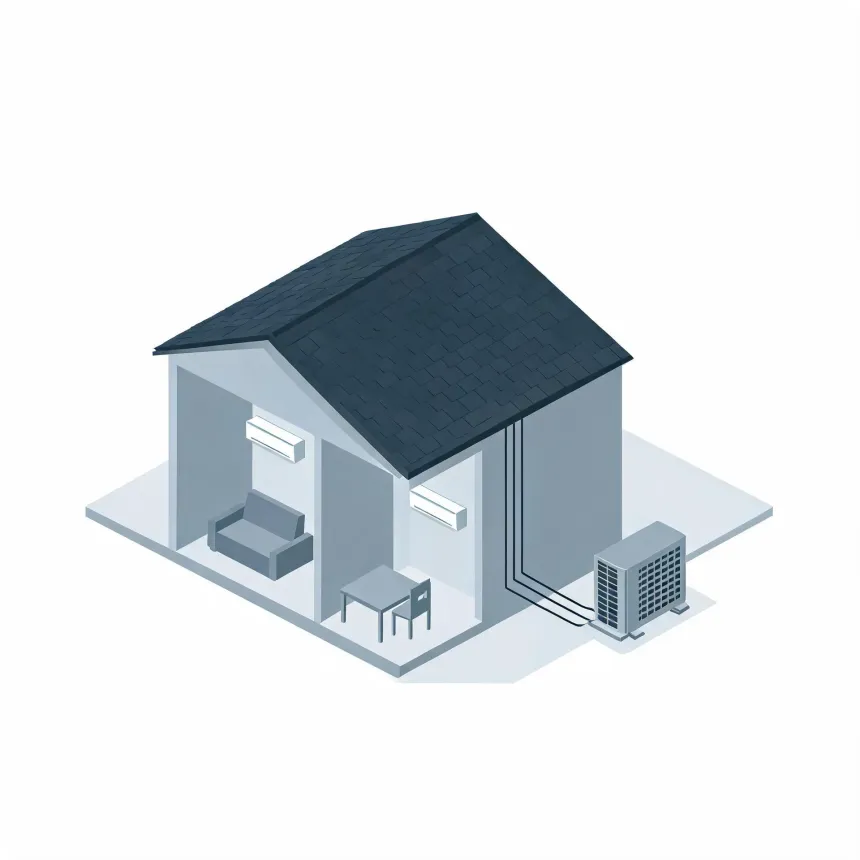
Isometric illustration of a cutaway house with a dark shingled gable roof, showing two wall-mounted indoor air handlers, a sofa, table and chair inside, and refrigerant lines running to an outdoor condenser unit beside the building.
Your system heats September through May and cools July through August.

NOAA nClimDiv, 1991–2020 normals

Cooling runs about two months a year here, July and August.

A mini split in Todd County earns its keep on comfort and shoulder-season heat, not on carrying a long cooling load.

A standard mini split handles this climate without upsizing

Half the homes here were built by 1975
Cooling runs July through August
Summer afternoons average 78°F
A standard mini split handles Long Prairie fineMinnesota homes paid 15.45 cents per kilowatthour in 2024, and a correctly sized unit is what keeps that bill reasonable.

Cooling in Todd County starts in July, so June is the month to get a mini split installed. That gives the contractor time to size the unit, run the line set, and schedule around weather instead of around a heat wave already underway. Wait until July and you're asking for installation at the same time everyone else with a struggling window unit or an aging system is calling around. A mini split going in now also means it's tested and running before the two hottest months hit, not on day one of the first hot stretch.

Any new system here has to meet zone 6A minimums

A mini split installed in Todd County has to meet 14.3 SEER2 for cooling and 7.5 HSPF2 for heating, the same split-system floor that applies everywhere in zone 6A. That's the baseline, not a ceiling, so it narrows the field to units built for this. Some installations also qualify for a federal tax credit, which is worth asking about before you settle on equipment.

Find a contractor
A beige split-system air conditioner outdoor condenser unit mounted on metal wall brackets atop a stucco wall.

Two months of work a year

Two months of real cooling load a year is not much wear on a compressor. The rest of the time, a mini split in Todd County is either idle or doing light shoulder-season duty, heating or cooling a room by a few degrees. A unit built to the zone 6A minimum holds up fine under that kind of use. There's no case for paying more for a higher-tier system here on the promise that it'll last longer under strain, because the strain this climate puts on it is already light.

Sizing comes from a room by room heat loss and gain calculation

A contractor measures each room, checks window area, wall exposure and ceiling height, then works out how much heat that room loses in winter and gains in summer. That number, not the size of the room by eye, is what points to the right unit. Skipping this step and sizing off square footage alone is how the wrong unit ends up on the wall.

Oversized and undersized both cause problems, in different ways

A mini split that's too big cools the room fast and shuts off before it pulls moisture out of the air, so the room feels cold and damp rather than comfortable. One that's too small runs constantly, trying to reach a setpoint it can't hold, and wears out faster for the work it's doing. The right size runs long enough to dehumidify and cycles off before it overshoots.

If the old system is a window unit or a wall unit tied to this room, it usually just comes out. There's nothing to reclaim or decommission, it unplugs and leaves with the installer. If what's being replaced is a central air condenser, that's different. The old refrigerant gets recovered, not vented, and the condenser and line set get removed once the new system is in. A furnace staying in place for heat doesn't get touched at all. The mini split's indoor and outdoor units are new equipment on their own line set, so there's no tie-in to the existing ductwork or furnace wiring to undo. The old thermostat, if it only ever ran a furnace, usually stays right where it is.

Installation day starts outside, not in. The outdoor unit needs a spot with clearance on all sides for airflow, mounted on a pad or brackets, away from where snow slides off a roofline. Inside, the wall-mounted head goes up first, then the crew cuts a small hole through the exterior wall for the line set, the refrigerant lines, power cable and condensate drain, all bundled together and run through that one penetration. Once the indoor and outdoor units are connected, the line set gets evacuated with a vacuum pump to pull out all air and moisture before refrigerant is released into it. That vacuum step matters more than anything else that day. Any moisture left in the lines turns to acid over time and eats at the compressor from the inside. After that, it's a pressure test, a check of line set insulation where it runs outside, and a run cycle in both heating and cooling before anyone calls it done.