Gas heats most homes here
Utility gas heats 57.3% of homes in McLeod County, more than any other fuel. Most of those homes have a furnace and ductwork already in place.
Takes about a minute. No obligation.
Utility gas heats 57.3% of homes in McLeod County, more than any other fuel. Most of those homes have a furnace and ductwork already in place.
If your home has a gas furnace, a mini split is usually brought in for a room or addition the ducts don't reach well, or to add cooling where there isn't any. Check what your home already has before deciding what you need.
NOAA nClimDiv, 1991–2020 normals
Minnesota homes paid 15.45 cents per kilowatt-hour in 2024.
A standard mini split sized right for the room keeps that cost in check. There's no reason to size up here.



If this is replacing a window unit or an old ductless system, the old equipment has to come out before the new lines go in. The indoor head and outdoor condenser get disconnected, and the line set that runs between them gets removed from the wall. A contractor will recover the refrigerant from the old unit rather than release it, that's standard practice. If the old mounting holes don't line up with the new unit, the wall gets patched. None of this adds much time to the job, but it's worth asking whether removal and disposal of the old equipment is included before the work starts.
McLeod County gets June, July and August of cooling, with afternoons averaging around 80°F. That's a short season for a mini split to work against. A properly sized standard unit handles that load without strain, so there's little reason to pay for a higher tier of efficiency here.
Find a contractor
That efficiency number on the label is a ratio. It compares the heat the unit moves against the power it draws to move it. A higher number means more heat moved per unit of electricity. It says nothing about how big a room the unit can handle, and it won't fix a unit that's the wrong size for the space. The rating is also measured under set conditions, a certain line length, a clean vacuum on the lines, a correct refrigerant charge. A longer line run or a charge that's slightly off pulls real performance below what the label promises. None of that shows up on the sticker. It shows up as a room that takes too long to cool or a unit that cycles on and off more than it should. Use the rating to compare one unit against another. Don't expect it to describe how the unit will actually run once it's installed.
A mini split that's too large for the room cools fast and shuts off before it pulls the moisture out of the air. The room ends up cold and clammy instead of comfortable. The right size runs longer, steadier cycles and actually controls humidity along the way.
Sizing starts with the floor area, but it doesn't stop there. Ceiling height, window area, which way the room faces, and how well it's insulated all change how much heat the unit has to move. Rooms that look alike on paper can call for different equipment once those factors are weighed.
Comparing mini splits usually comes down to brand names and price, but the better questions are about the installer's work. Ask how they size the system for the room rather than quoting a number off a chart. Ask what line length the quote assumes, since a longer run between the indoor head and outdoor condenser changes what the unit can actually deliver. Ask whether they pull a vacuum on the lines before charging the system, because trapped air and moisture in the lines is one of the most common reasons a new unit underperforms. Ask what happens to the old equipment if one is being replaced. A contractor who answers these without hesitation has done this enough times to get it right.
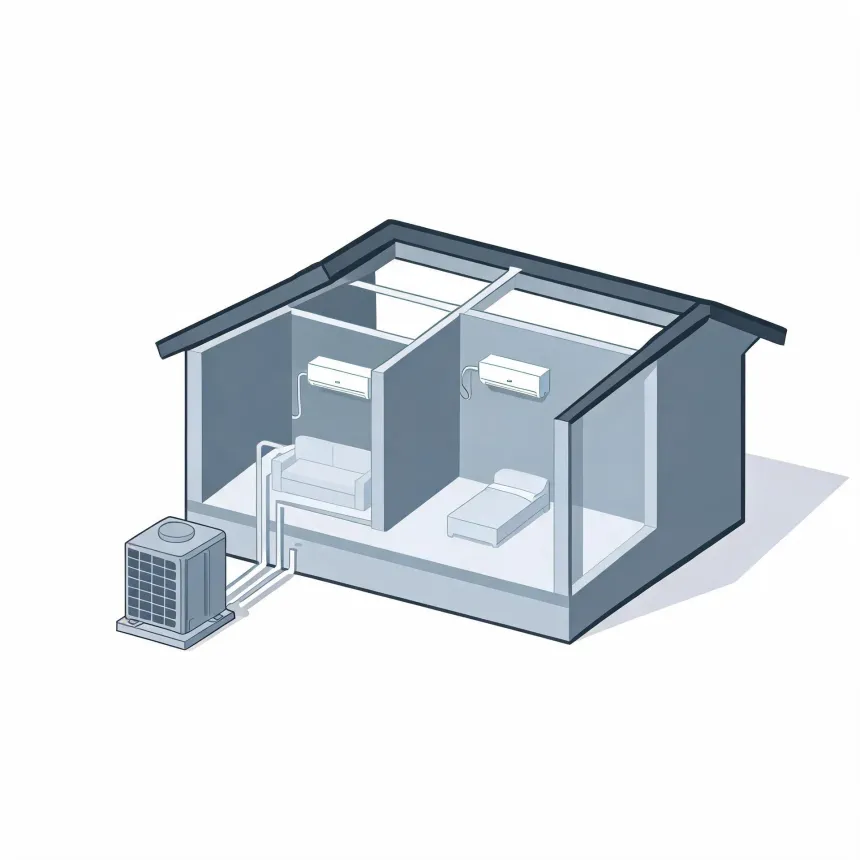
The equipment itself is only part of what you're paying for. Line length matters, since every extra foot between the indoor head and outdoor condenser means more refrigerant, more insulated copper, and more labor to run it cleanly through a wall or along an exterior. Where the condenser sits matters too. A straightforward mount on an exterior wall near the indoor unit is simple work. A run up through multiple floors, around corners, or across a longer distance takes more time and more material. Electrical matters as well. If there's already a dedicated circuit nearby, that's less work than running new wire back to the panel. The number of indoor heads changes things too, since a multi-zone system means more line sets, more mounting points, and more time spent on each connection. None of this shows up on a spec sheet. It shows up when someone actually looks at the walls, the panel, and the distance between where the unit goes and where the power and refrigerant lines need to run.