





A row of dark-sided single-story houses with gray shingled roofs behind a trimmed hedge, with mown lawn and large deciduous trees under an overcast sky.

Mini Split Installation in Grand Rapids, MN

Tell us about the job

Takes about a minute. No obligation.

New system or replacementMini-splitItasca County, MN
Step 1 of 2

What ZIP code is the job in?

Utility gas heats 40.6% of homes in Itasca County, more than any other fuel. Bottled or LP gas covers another 27.4%, and most of the rest burn fuel oil or run on electric heat already. Most homes here were built around a furnace and ductwork, not a system that needs neither. A mini split runs on electricity alone, with no gas line or vent to tie into, which makes it a straightforward way to add cooling or heat a room the furnace doesn't reach well. In a home already heating with electricity, a mini split can serve as the main system instead of backing one up.

9 months
September through May, your system heats
1 months
July through July, it cools
1°F
the average winter night it heats against
76°F
the average summer afternoon it cools against
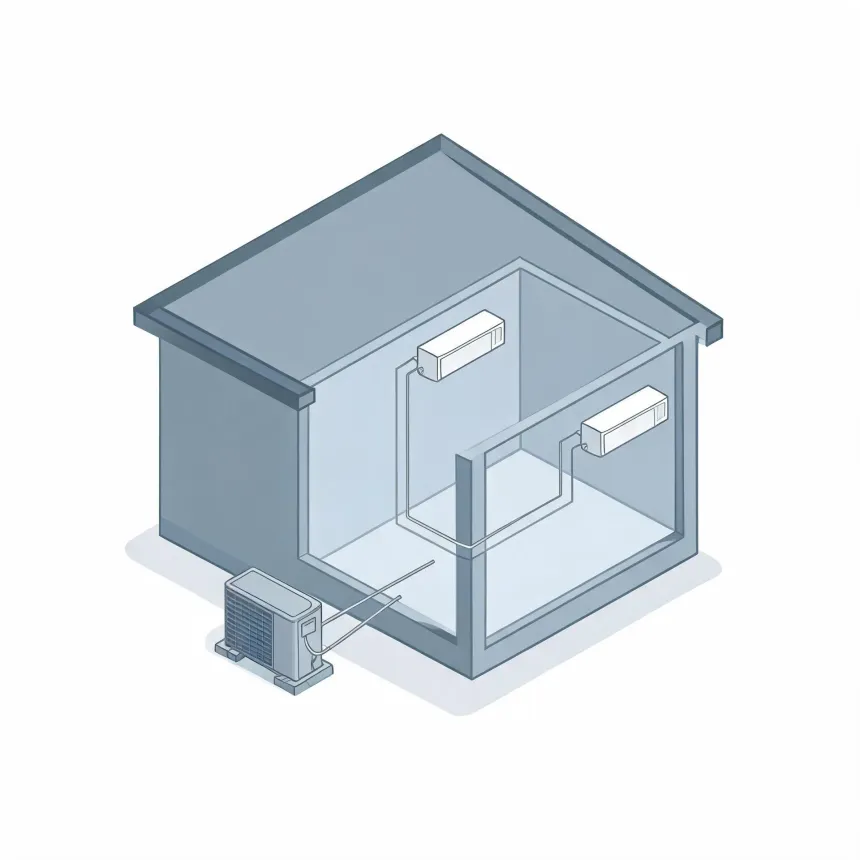
Isometric line illustration of a cutaway building interior with two wall-mounted indoor air conditioning units connected by piping to an outdoor condenser unit on the ground outside.
Your system heats September through May and cools July through July.

NOAA nClimDiv, 1991–2020 normals

Cooling here runs one month a year, July.

Get a mini split installed by June and it's ready before the only month it has to work.

One month of real cooling load, so a mini split here barely has to work for its keep

Cooling runs July through July
Summer afternoons average 76°F
108 damaging wind events from 2015 to 2024
Cheap power changes the mathMinnesota electricity ran 15.45 cents a kilowatt-hour in 2024, so the payback on the most efficient model stretches out.

That rating on the label tells you how much heat the system moves for the electricity it uses, nothing more. A higher number means it gets more heat out of a room, or into it, per unit of power, so it costs less to run over a season than a lower-rated system of the same size. It says nothing about how big a space it can handle. A unit sized wrong for the room will run longer and less efficiently no matter what the label says, so sizing matters as much as the rating itself. The rating also assumes the outdoor unit and indoor head are matched as a set. Pair the wrong parts together and you lose the efficiency you paid for, even if each piece carries a good number on its own.

The right size for this county, nothing more

Itasca County sees its share of wind, hail and winter storms, but none of that changes what a mini split needs to do here. A standard size, matched and rated for one month of cooling load, is enough. There's no reason to pay for bigger or more than this place asks for.

Find a contractor
A white outdoor air conditioner condenser unit mounted on metal wall brackets against gray horizontal siding, with a blue sky and white clouds behind it.

Sized for the room, not the label

Sizing a mini split means matching the outdoor unit to the heat loss and heat gain of the space, not to the square footage alone. Ceiling height, window area, insulation and how many walls face outside all factor into the load calculation an installer runs before picking equipment. A unit sized too big cools the room fast, shuts off, then starts again a few minutes later. That short cycling never lets it run long enough to pull moisture out of the air, so the room ends up cool but clammy. A unit sized too small runs constantly during the hardest part of the season and still can't hold the temperature you set. Either mistake wears on the compressor more than correct sizing ever would, since a compressor built to run in full, steady stretches wears better than one kicking on and off all day. The right size runs longer at a lower output and holds steady, which is the quiet, even running a mini split is supposed to deliver.

How many zones, and what controls them

A mini split system can run one indoor head off one outdoor unit, or several heads off a single outdoor unit, each with its own thermostat. Ask whether the quote is for a single zone or a multi-zone setup, because a multi-zone system lets each room run at a different temperature, but the outdoor unit has to be sized for the combined load of every head running at once, not just the biggest room.
Where the outdoor unit and line set will go

The outdoor unit needs clearance on all sides to pull in air and release it, and the line set connecting it to the indoor head has a maximum length before the system loses efficiency. Ask where the installer plans to mount both pieces and how long the line set will run between them. A longer run than the system is rated for means less heat moved per unit of power, no matter what the labels on the equipment say.

A few things push the price of a mini split job up or down more than the equipment itself. How many indoor heads the outdoor unit has to feed matters, since each head needs its own line set, its own mounting spot, and its own path for that line set to travel through a wall or soffit. Where the outdoor unit ends up matters too. A straight run to an exterior wall near the indoor head costs less to install than one that has to snake through a finished ceiling or down multiple floors. The electrical side counts as well. Some homes already have a circuit sized for a unit like this, others need a new one run from the panel, and that work depends on how far the panel sits from the install location. None of this shows up on the equipment label. It shows up in how much cutting, routing and wiring the job actually takes.

If the mini split is going in alongside a furnace, the furnace doesn't go anywhere. It keeps heating the house the way it always has, and the mini split just takes on the room or the season it's suited for. Nothing about adding one requires pulling out what's already there. If a mini split is replacing an older system entirely, whoever installs it handles getting the old equipment out, draining and disposing of it properly, since refrigerant can't just be vented into the air. An old outdoor unit also means an old disconnect box and old electrical whip running to it, and those get swapped along with everything else rather than left connected to a unit that's gone.