A lit brick residential street at dusk showing a row of two-story homes with covered porches and mature trees.

Mini Split Installation in Faribault, MN

Tell us about the job

Takes about a minute. No obligation.

New system or replacementMini-splitRice County, MN
Step 1 of 2

What ZIP code is the job in?

Gas heats most homes here

Utility gas heats 65.2% of occupied homes in Rice County. A mini split works alongside a gas furnace rather than replacing it. The furnace covers the coldest months and the mini split handles cooling and the shoulder seasons.

What that means for the install

If your home already has gas heat, a mini split is an addition, not a swap. The contractor sizes the unit for the rooms or zones it will actually serve, not for the whole house's heating load.

9 months
September through May, your system heats
3 months
June through August, it cools
10°F
the average winter night it heats against
80°F
the average summer afternoon it cools against
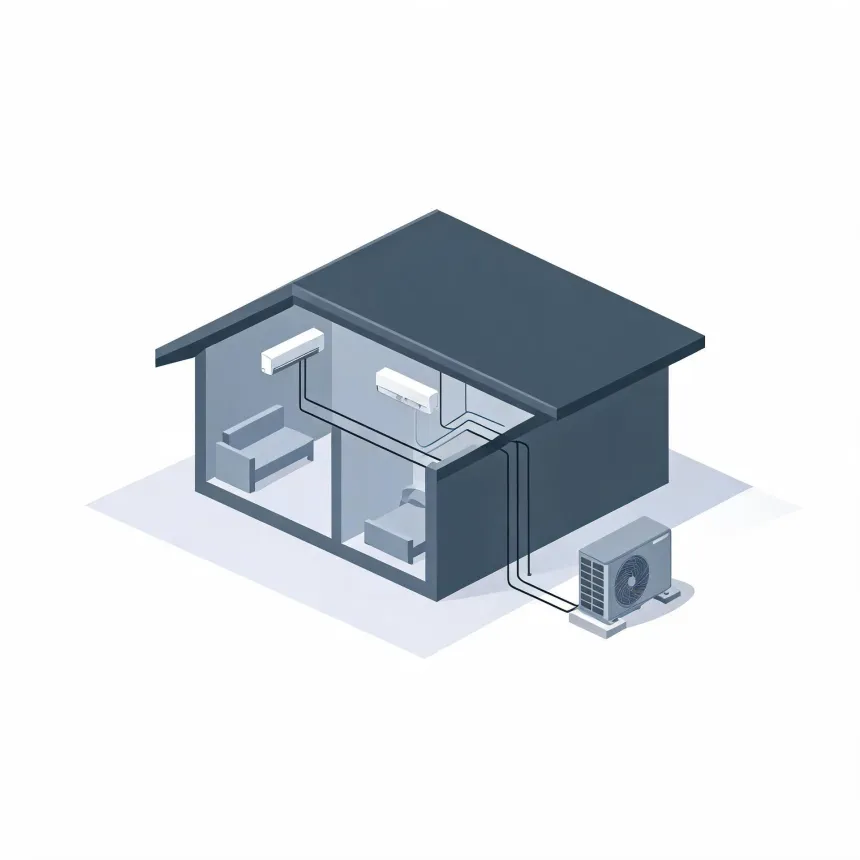
Isometric illustration of a cutaway house showing two wall-mounted mini-split indoor units connected by line sets to an outdoor condenser on a pad outside.
Your system heats September through May and cools June through August.

NOAA nClimDiv, 1991–2020 normals

Cooling here runs June through August, with afternoon highs around 80°F.

A mini split isn't working against months of heat, so a mid-range unit holds up fine without paying for the top efficiency tier.

May is for installing, June is for cooling

Cooling runs June through August
Summer afternoons average 80°F
36 damaging wind events from 2015 to 2024

A standard mini split fits this county

Half the homes in Rice County were built in 1978 or earlier, half in 1978 or later. That split doesn't call for special sizing either way. A contractor sizes the unit for the rooms or zones it serves, not for the age of the house. Given the summers here, a standard size and a mid-range efficiency tier are enough to get the job done.

Find a contractor
A man in a tan jacket, cap, and work boots carries a canvas tool bag up wooden porch steps toward a dark green front door of a house with light horizontal siding and a potted shrub.
A white outdoor air conditioner condenser unit mounted on metal wall brackets against gray horizontal siding, with a blue sky and white clouds behind it.

Three months of work, not a hard three months

Three months of work a year, June through August, and the afternoon high over that stretch is only about 80. That's not a system fighting to keep up all day. Get a mid-range mini split installed right, and the hours it actually runs here won't be what wears it out.

The old equipment it's replacing stays put

If you've got a window unit or a space heater doing the job now, nobody's required to haul it out. A mini split can go in alongside what you already have, and you decide later whether to keep the old equipment as backup or get rid of it.

A mini split being removed is a different job

If this install is replacing a failed mini split, the old indoor and outdoor units both come down, and the line set gets pulled or capped. The refrigerant in the old system has to be recovered properly, not vented, so that part of the job falls to whoever's licensed to handle it.

The SEER2 number on a mini split tells you how much cooling it delivers for the power it draws, measured over a full season rather than at one moment. A higher number means lower operating cost for the same cooling output, but it's not a measure of how strong or how fast the unit is. A unit with a lower rating can still cool a room just as well as one with a higher rating, it just costs a little more to run while it does it. That gap in running cost only shows up once the system is actually working, so a unit that sits idle most of the year won't earn back the difference the way one running steadily would. There's also a separate rating for heating, HSPF2, worth checking if the mini split is going to carry any part of the heating load instead of just cooling.

Installation starts outside with the spot for the condenser. It needs clearance on all sides for airflow and a solid, level pad underneath, so a contractor will walk the exterior before touching anything indoors. Inside, the indoor head gets mounted high on a wall or ceiling, and a small hole gets drilled through to run the line set, the refrigerant lines, drain line and power wire bundled together. Once both ends are set, the lines get connected, the system gets evacuated to pull out air and moisture, and then it's charged with refrigerant. The last step is checking the charge and airflow with the system actually running, not just wiring it up and walking away. A clean install shows in how the line set is routed and secured, not just whether the unit turns on.