Three illuminated two-story brick houses on a tree-lined residential street photographed at twilight, with warm window light and landscape uplighting visible against a deep blue evening sky.

Mini Split Installation in East Gull Lake, MN

Tell us about the job

Takes about a minute. No obligation.

New system or replacementMini-splitCass County, MN
Step 1 of 2

What ZIP code is the job in?

Propane is the fuel most homes here already use

Bottled, tank or LP gas heats 43.6% of occupied homes in Cass County, more than any other fuel. Utility gas and electricity make up most of the rest. A mini split works alongside a propane furnace rather than replacing it.

That changes what the mini split is for here

In a home already heated by propane, a mini split usually handles cooling and takes the load off the furnace during the milder months, while the furnace still carries the coldest stretches. Whoever sizes the install needs to know what's heating the house now.

9 months
September through May, your system heats
2 months
July through August, it cools
3°F
the average winter night it heats against
77°F
the average summer afternoon it cools against
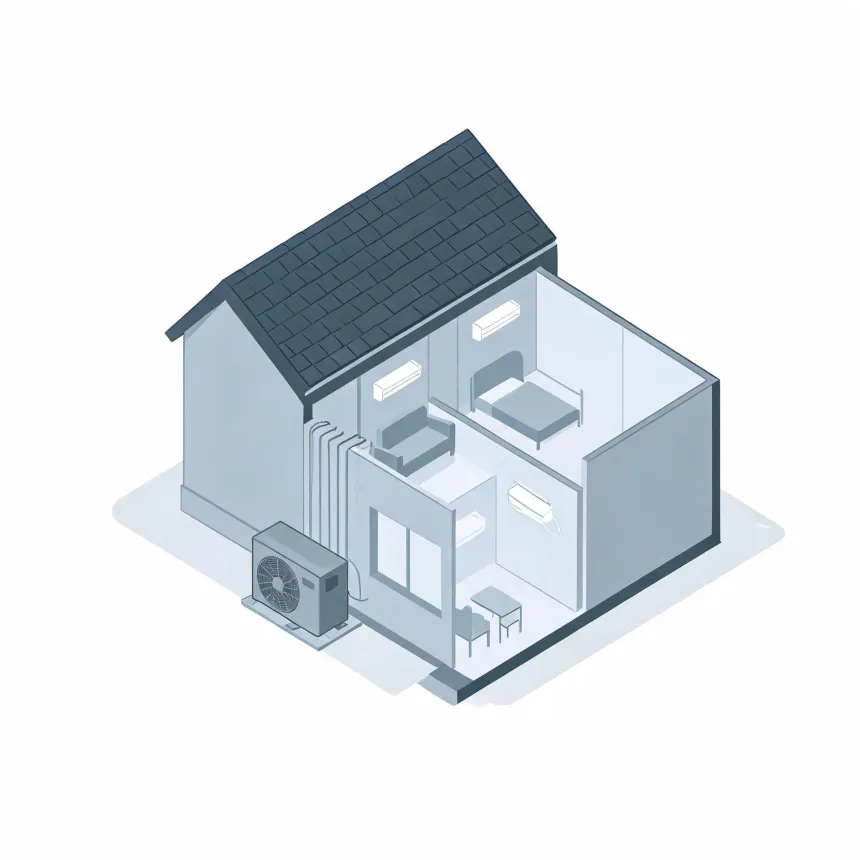
Isometric illustration of a cutaway house with a dark shingled gable roof, showing interior rooms with a bed, chairs and table, three wall-mounted mini-split indoor units connected by line sets to an outdoor condenser unit on a pad outside.
Your system heats September through May and cools July through August.

NOAA nClimDiv, 1991–2020 normals

Cass County sees damaging wind, hail and winter storms most years here.

None of that calls for a bigger or pricier mini split, just a standard one mounted and run correctly.

Two months of cooling a year is not a hard job

Cooling runs July through August
Summer afternoons average 77°F
107 damaging wind events from 2015 to 2024
Electricity here runs cheapMinnesota homes paid 15.45 cents per kilowatt-hour in 2024, so a mini split earns its keep on comfort more than on savings

Cass County sits in zone 7, the coldest tier in the energy code. Any mini split installed here falls under the same federal rule as other split-system heat pumps. It has to hit at least 14.3 SEER2 for cooling and 7.5 HSPF2 for heating. There's no separate ductless category that lets a unit come in lower. That floor holds whether the mini split is doing light work, like cooling, or carrying heat on its own. A unit meeting these minimums is a standard install, not an upgrade.

June is the month to put this in

Cooling here only runs July and August. Get the mini split installed in June and it's ready before the first hot day, with no rush on the work itself.

Find a contractor
A white outdoor air conditioner condenser unit mounted on metal wall brackets against gray horizontal siding, with a blue sky and white clouds behind it.

Light use all around

Two months of real cooling work a year is light duty for a mini split. That short season is the reason to size for the job in front of it, not for some worst case that doesn't happen here. A unit that clears the federal minimum will keep this house comfortable in July and August without strain. Put the install budget into mounting it right and running the line set clean, not into a bigger or higher-tier unit than two months of work calls for.

Sizing comes from a room by room load calculation

A contractor measures each room, checks the windows, and figures out how much heat it gains in summer and loses in winter. That number, not the square footage alone, decides which indoor head goes where and what capacity it needs. Skip this step and the unit is a guess.

Oversized cools the room but not the air in it

A mini split that's too big blasts cold air, hits the thermostat setting fast, and shuts off before it pulls the moisture out of the room. The space feels cool but damp. The right size runs longer, steadier cycles and actually dries the air while it cools.

If the mini split is going in alongside the propane furnace rather than replacing anything, there's no old system to deal with. It's an addition, not a swap. But if this is replacing an older ductless unit or a window AC, whoever pulls it handles it from there. A window unit just comes out. An old ductless system means capping or reclaiming the refrigerant line, patching the wall sleeve, and taking down the outdoor pad or bracket. The furnace itself isn't touched. It keeps carrying the coldest stretches exactly as it did before, and the only thing that changes is where the cooling comes from in summer.

The outdoor unit gets mounted on a pad or bracket first. From there the line set runs to each indoor head through a small hole drilled in the wall, not through ductwork. That line carries the refrigerant lines, a drain line, and electrical wiring together, usually wrapped and run along the outside wall or tucked through a chase. Before any refrigerant goes in, the system gets evacuated with a vacuum pump to pull out air and moisture. Skipping that step is the usual reason a new mini split fails early. Once it's charged, the installer checks refrigerant pressures against the line length and runs each indoor head on its own to confirm it heats and cools. A clean install looks simple from inside the house. One small line hidden well, and a head that just works when you turn it on.