A snow-covered residential street at twilight with illuminated houses, bare trees, and an orange horizon glow beneath a deep blue sky.

Mini Split Installation in East Grand Forks, MN

Tell us about the job

Takes about a minute. No obligation.

New system or replacementMini-splitPolk County, MN
Step 1 of 2

What ZIP code is the job in?

Gas is the common fuel here

Utility gas heats 41.7% of homes in Polk County, more than any other fuel. Bottled or LP gas heats another 23.1%. A mini split is rarely the only source of heat in a house like that. It usually works alongside the furnace, covering rooms the ducted system struggles with or taking over during the months a furnace barely needs to run.

What this means for sizing the job

If your home already has a furnace, the mini split only needs to handle part of the heating and cooling load, not all of it. That changes how many zones you need and where the indoor units go. A contractor sizing the system has to know what's already heating the house before deciding what the mini split should pick up.

9 months
September through May, your system heats
2 months
July through August, it cools
2°F
the average winter night it heats against
78°F
the average summer afternoon it cools against
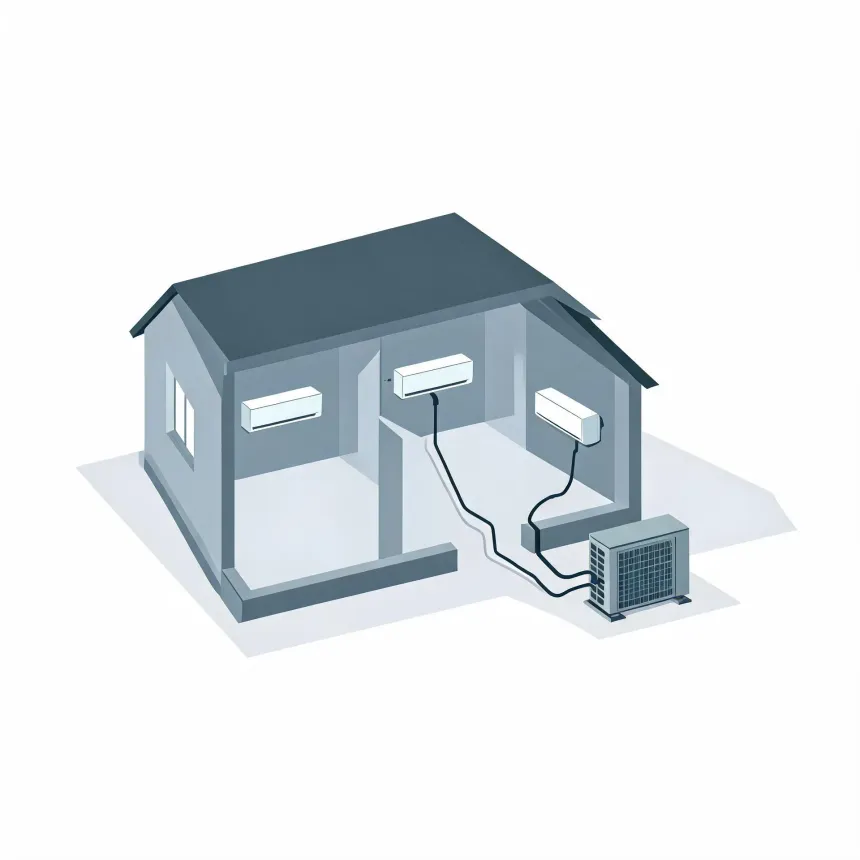
Isometric illustration of a cutaway single-story house with three wall-mounted indoor air conditioning units connected by lines to an outdoor condenser unit on the ground outside.
Your system heats September through May and cools July through August.

NOAA nClimDiv, 1991–2020 normals

Polk County recorded 353 severe weather events between 2015 and 2024, mostly wind and winter storms.

A mini split installed to the manufacturer's specs holds up through that without sizing up.

Half the homes here were built by 1971. A mini split has to work with the house that's already standing

Half the homes here were built by 1971
Cooling runs July through August
Summer afternoons average 78°F
A standard system is sized to run on that rate, not against itMinnesota homes paid 15.45 cents per kilowatthour in 2024

Cooling here only runs July and August, and even then the afternoon high averages 78°F. That's a short, mild stretch for a system to work against. A mini split sized for this house doesn't need to be built for extreme heat, because extreme heat isn't what it's up against. What it does need to handle is the wind and hail that show up in Polk County most years. A unit installed to spec holds up fine through that without sizing up for a cooling load that was never really there.

Have it installed before July

Cooling in Polk County starts in July and runs about two months. Putting a mini split in before June ends means it's set up and running before it ever has to carry a load, not during the first hot week of summer.

Find a contractor
A white outdoor air conditioner condenser unit mounted on metal wall brackets against gray horizontal siding, with a blue sky and white clouds behind it.

Two months of work a year

Two months of cooling a year against a 78°F average does not put much strain on a system. Sized correctly, a mini split here spends most of its life barely working. The wear that matters more comes from wind and hail, not from the compressor running hard on a hot afternoon, because that afternoon rarely gets that hot.

The number of zones sets the price

Every indoor head needs its own line set and its own run of wiring back to the outdoor unit. One zone is a straightforward install. Add a second or third head, especially in rooms far apart or on different floors, and the labor stacks up fast. The outdoor unit has to be sized for the combined load too, which pushes you into a bigger compressor.

Where the outdoor unit goes changes the labor

A mounting pad close to the wall where the indoor head will sit keeps the line set short and the job simple. Run it across the house, up through a second story, or around tight framing, and the install takes longer and needs more refrigerant line, more wall penetrations, and more care sealing each one against air and water.

If this house already has a furnace or baseboard heat, that system stays right where it is. A mini split gets added alongside it, not in place of it, so nothing about the existing heat source needs to come out or get disconnected. The old system keeps doing what it was doing, and the mini split picks up the rooms or the months where it makes more sense to run than the furnace does. Over time some homeowners lean on the mini split more and the furnace less, but that's a choice made later, not something the install forces on day one. Nothing about adding a mini split requires removing or replacing what's already heating the house.

Installation starts outside with the outdoor unit going up on its mounting pad or bracket, leveled and set far enough off the wall for air to move through the coil. Inside, the installer runs a line set from that spot to each indoor head, usually through a single small hole drilled through the wall rather than anything major. That line set carries refrigerant, a drain line for condensation, and the wiring, all bundled together and sealed where it passes through. Once the indoor head is mounted and connected, the system gets evacuated to pull all moisture and air out of the lines before refrigerant goes in. That step matters more than people expect, because any air left in the line can keep the system from running the way it's supposed to. After that it's a pressure test, a charge, and then running the unit through both heating and cooling to make sure every head is actually doing what it should before the installer leaves.