




A row of dark-sided single-story houses with gray shingled roofs behind a trimmed hedge, with mown lawn and large deciduous trees under an overcast sky.

Mini Split Installation in Albert Lea, MN

Tell us about the job

Takes about a minute. No obligation.

New system or replacementMini-splitFreeborn County, MN
Step 1 of 2

What ZIP code is the job in?

Utility gas heats 64.8% of homes in Freeborn County, most of them. A mini split works differently. It runs on electricity, and it heats as well as it cools, so it can take over the job a furnace does now or just handle part of the house. Some homeowners add one to a room an existing system does not reach well, like a bonus room or a garage. Others use it to replace an aging furnace outright. Either way it does not need gas piped to it, which matters if you are putting one somewhere the gas line does not already run.

9 months
September through May, your system heats
3 months
June through August, it cools
10°F
the average winter night it heats against
79°F
the average summer afternoon it cools against
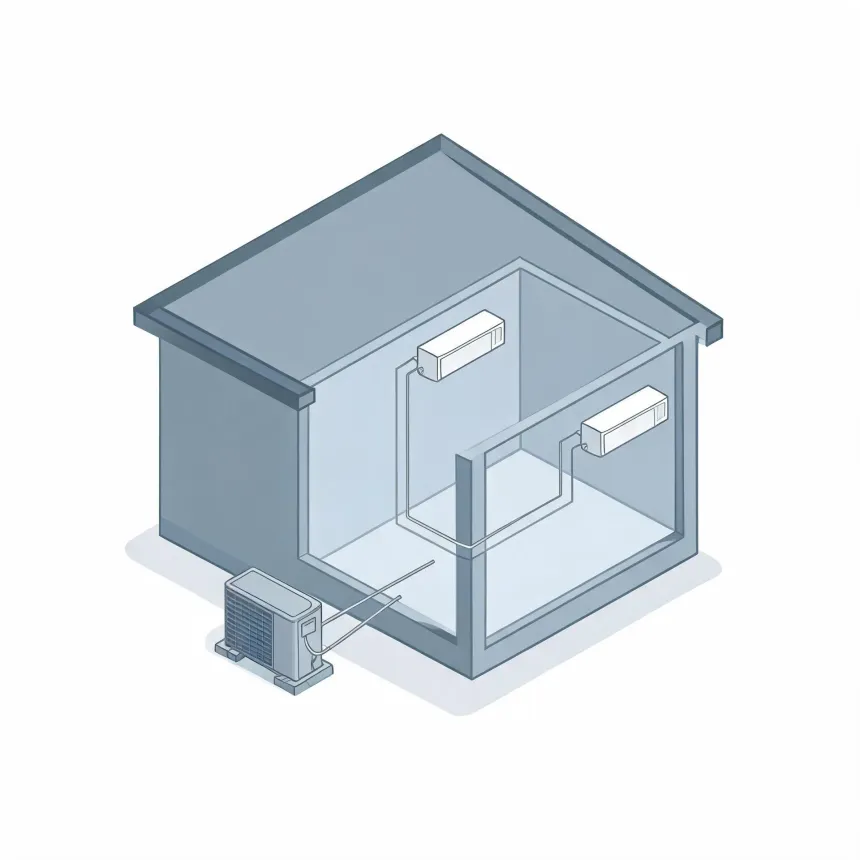
Isometric line illustration of a cutaway building interior with two wall-mounted indoor air conditioning units connected by piping to an outdoor condenser unit on the ground outside.
Your system heats September through May and cools June through August.

NOAA nClimDiv, 1991–2020 normals

Cooling here runs June through August.

Get the mini split installed in May and it's running before the first hot day, not in the middle of one.

Half the homes here were built by 1959, so the mini split has to work with the house, not the other way around

Half the homes here were built by 1959
Cooling runs June through August
Summer afternoons average 79°F

Freeborn County is zone 6A under the 2021 energy code, a cold zone with winter running long here. Any mini split installed has to meet the federal split-system minimums, 14.3 SEER2 for cooling and 7.5 HSPF2 for heating, whether it's new ductless equipment or a replacement for something else. The standard doesn't carve out a separate rule for ductless systems, so a unit sold here has to clear the same bar as any other heat pump. With winters this long, the HSPF2 number is the one worth paying attention to, since the system leans on its heating side far more than its cooling side most years. A unit that meets these minimums may also qualify for the federal tax credit on qualifying equipment, worth checking before you settle on one.

A standard mini split, properly sized, is what this job needs

A mini split sized and rated to the federal minimums runs well here. Minnesota electricity runs 15.45 cents per kilowatt-hour, and the cost of running one shows up on that line, not in the size or model you pick. There's no reason tied to this county to size up or pay for a higher-end unit than the job calls for.

Find a contractor
A man in a cap, work shirt and tan pants, seen from behind, carries a canvas tool bag up concrete steps toward a dark green front door, with a potted shrub to the right.
A white outdoor air conditioner condenser unit mounted on metal wall brackets against gray horizontal siding, with a blue sky and white clouds behind it.

Three months of cooling a year, long winters otherwise

Three months of cooling, June through August, with afternoon highs averaging 79. That's not a lot of heat for a mini split to push against. The heating side carries the bigger load here over a long cold season, but even that is steady, ordinary work, not a system straining against extremes. A mini split sized to the federal minimums holds up fine under that kind of use. What shortens its life is more likely to be a storm. Freeborn County sees damaging wind and hail most years, and the outdoor unit sits outside through all of it, so where it's mounted and how it's protected matters as much as how hard it runs.

Most systems get replaced, not torn out first

If a furnace or central AC is on its way out, the old equipment can stay in place while the mini split goes in, then come out once the new system is running. That avoids a gap where the house has no heat or cooling at all during the switch.
A working gas furnace can still stick around

Some homeowners keep the furnace as backup and let the mini split handle part of the house or the milder months, especially if the furnace still has life left in it. There's no rule that says the old system has to go just because a new one showed up.

A few questions sort the real options from the noise. Ask how many zones the system supports and whether the outdoor unit can run them all at once at full output, not just on paper. Ask about the minimum output at low temperature, since that number tells you how the unit performs on the coldest nights, not just the mild ones. Ask where the line set routes and how long it runs, because a longer line set between indoor and outdoor units can affect performance and isn't always obvious from a quote. Ask what happens to the old equipment during the swap and whether the house goes without heat or cooling at any point. Ask who services the brand locally, since a mini split needs a tech familiar with its controls and refrigerant type down the road, not just at install.

Installation starts outside with where the outdoor unit goes, usually a mounting pad or wall bracket set away from the house so air can move through the coil freely. From there a tech runs the line set, the refrigerant lines and electrical connections that link outdoor to indoor, through a small hole drilled in the wall. That hole is the only real opening into the house, nothing like the ductwork a furnace swap involves. Each indoor head gets mounted high on a wall or ceiling, leveled, and connected back through that same penetration. Once everything's in place the lines get pressure tested and pulled into a vacuum to clear out air and moisture before refrigerant ever goes in, a step that protects the compressor for the life of the system. Last comes the startup check, running each zone, confirming airflow and temperature at the head, and making sure the outdoor unit cycles the way it should.