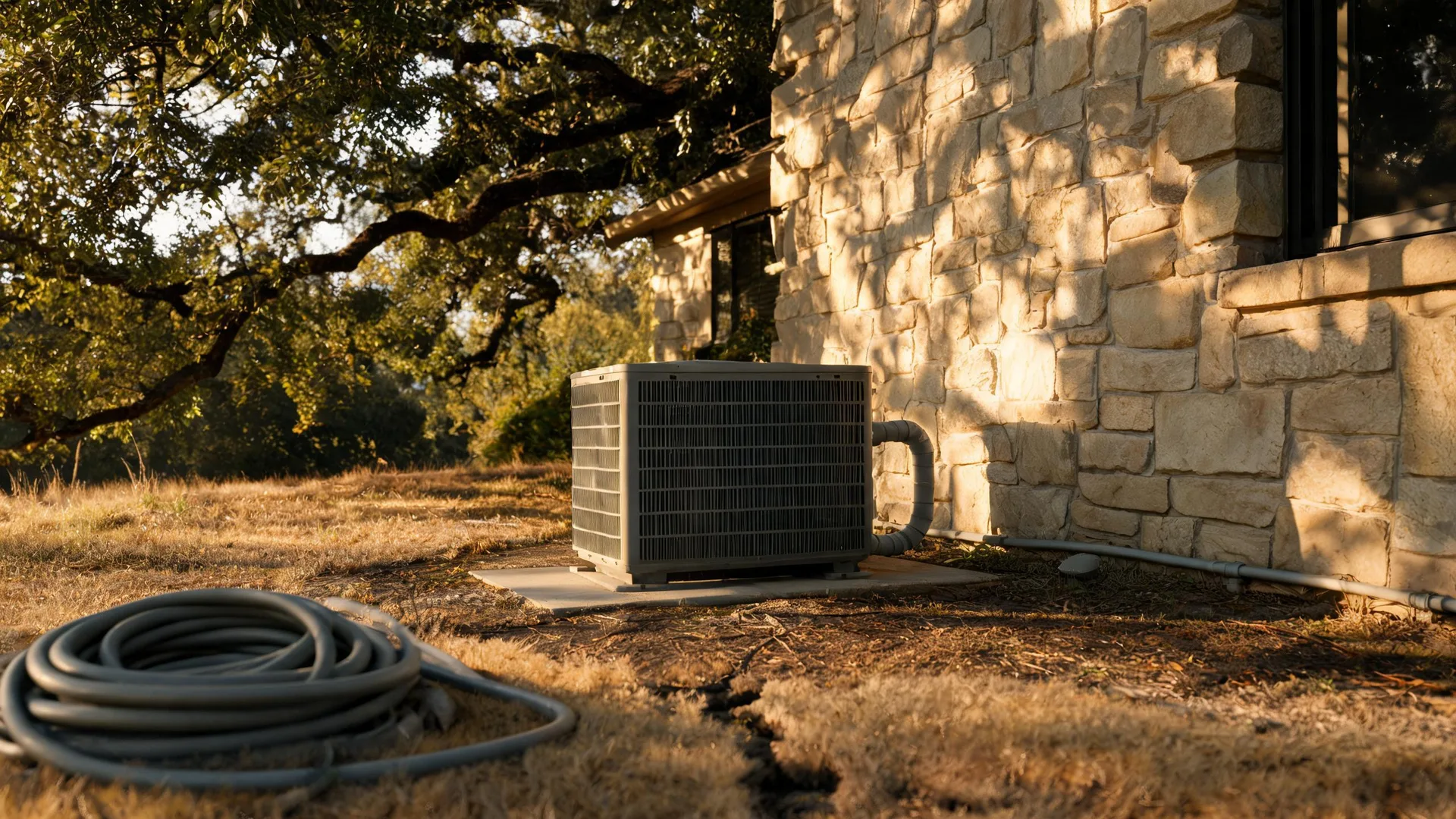
An overhead view of a residential air conditioning condenser unit mounted on a concrete pad next to a house with vinyl siding.

AC Repair in St. Cloud, MN

Tell us about the job

Takes about a minute. No obligation.

RepairCentral ACStearns County, MN
Step 1 of 2

What ZIP code is the job in?

June is when weak parts fail

Cooling in Stearns County runs June through August. A capacitor or contactor that barely made it through last summer often gives out in the first stretch of hot days, once the system is finally asked to run for hours at a time again.


May is worth a call

Before the heat sets in is the easier time to get a technician out to the house. A part that is close to failing can be found and replaced in May, instead of quitting partway through June.

3 months
June through August, your air conditioner is on duty
79°F
the average summer afternoon it cools against
74 hail events
in ten years, and hail bends the fins on outdoor coils
86 wind events
in ten years, and wind drives debris into outdoor units
Isometric line illustration of a cutaway single-story building showing interior rooms, ceiling ductwork, an indoor air handler, and an outdoor condenser unit connected by a line set.
Your air conditioner works hardest from June through August.

NOAA nClimDiv, 1991–2020 normals

Summer here only runs three months, June through August, with afternoon highs around 79.

Three mild months don't wear out an AC on their own, so a breakdown now usually points to one worn part doing the job it was always going to fail at.

Weather here breaks parts the same way it does everywhere else

203 severe weather events from 2015 to 2024
13% of homes statewide lost power a day or more in 2024
86 damaging wind events from 2015 to 2024
A lot of these homes are still youngHalf the homes in Stearns County were built in 1985 or later.

Nothing about a St. Cloud summer pushes an AC past what it is built for. A capacitor fails because it is worn out, not because of the heat. A contactor burns because its contacts have arced too many times, not because this county is harder on it than the next one. The fix is the same one a tech would make anywhere. Find the part that gave out and replace it. Minnesota homes paid 15.45 cents per kilowatt-hour for electricity in 2024, so a system running on a weak part, pulling extra amps to make up for it, costs more to run every day it sits unfixed.

A newer system is a repair, not a replacement

If your AC came with the house, there's a good chance it's not old enough to be the problem. Get the worn part found and swapped instead of planning around a new system.

Find a contractor
A gray residential air conditioning condenser unit mounted on a concrete pad outdoors, surrounded by green grass under a partly cloudy blue sky.

What to check before the truck shows up

Before anyone comes out, there are a few things worth checking yourself. Go to the thermostat first. Make sure it's set to cool and set below the room temperature, and check the batteries if it has a screen that looks dim or blank. Next, go to the breaker panel and see if the breaker for the outdoor unit has tripped. If it has, reset it once. If it trips again, stop and leave it off. That's a sign of a real problem, not something to keep resetting. Check the air filter. A filter clogged with dust and pet hair chokes the airflow and can cause the whole system to run weak or freeze up. Outside, look at the condenser unit and clear away any leaves, grass clippings or debris sitting against it. It needs open air around it to work right. If you see ice on the refrigerant lines or the indoor coil, turn the system off and let it thaw completely before anyone touches it further. Running it iced up can damage the compressor. If the outdoor unit isn't making any sound at all and the indoor fan isn't moving air, that points to something electrical, and that's where a homeowner's checklist ends and a technician's starts.

A weak part draws more to do the same job

A failing capacitor or a compressor low on charge makes the system work harder to produce the same cooling, and that extra strain lands on whatever is already weakest. The compressor runs hotter than it should, the windings take more heat than they're built for, and a problem that started small pushes the whole unit toward a harder failure.

A frozen coil can't be run through

Low airflow or a low refrigerant charge lets ice build on the indoor coil, and once that happens the system needs to be shut off and thawed, not pushed to keep working. Running a frozen system keeps liquid refrigerant moving toward the compressor, and a compressor isn't built to compress liquid.

Overhead view of an air conditioning condenser unit on a concrete pad next to a house with asphalt shingle roofing and vinyl siding.

A new air conditioner would save little on running costs in Stearns County, so the repair decision comes down to the unit's condition.

  • A new one at the federal minimum, 13.4 SEER2$130 a year
  • An older air conditioner$140 a year

Estimates for a typical Stearns County home, compared with an older unit built to the previous federal minimum, from EIA household energy data, Minnesota fuel prices and NOAA climate normals. Your home will differ.

Repair makes sense when a part like a capacitor or contactor has failed.

Replacement makes sense when the compressor has failed or the system uses R-22 refrigerant, which is no longer made.

Most AC visits come down to one part, not the whole system. A capacitor, a contactor, a fan motor, a low charge from a slow leak. Any one of those is a repair, and the compressor and coils around it are usually fine. What changes the conversation is the compressor itself. It's the most expensive part in the system and the hardest to get to, and when it fails outright, the labor to replace it can cost more than the part is worth on an older unit. A tech who's honest with you will tell you which kind of problem you have before touching anything, because that answer decides whether this is a quick fix or a harder conversation about the whole system.