





A quiet suburban street at twilight featuring two-story brick homes with illuminated windows and large trees lining the sidewalk.

AC Repair in Pine City, MN

Tell us about the job

Takes about a minute. No obligation.

RepairCentral ACPine County, MN
Step 1 of 2

What ZIP code is the job in?

AC here only runs from July through August, so most of the year that system just sits there. June is when it gets switched back on after sitting idle since last summer. A part that was already weak, a capacitor losing its charge, a contactor with worn points, tends to fail right when the system has to carry a full load again. That's why repair calls cluster in the first weeks of summer. If your AC is acting up right now, it's not because Pine City summers are hard on it. It's more likely something that was already wearing out and just got asked to work.

2 months
July through August, your air conditioner is on duty
78°F
the average summer afternoon it cools against
78 hail events
in ten years, and hail bends the fins on outdoor coils
53 wind events
in ten years, and wind drives debris into outdoor units
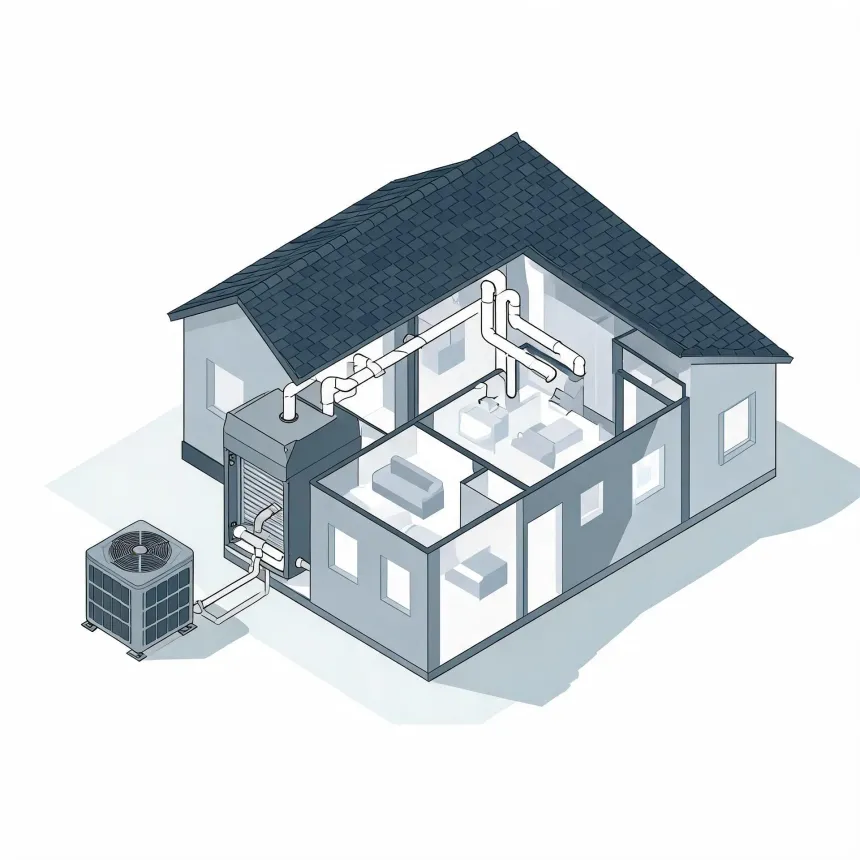
Isometric illustration of a cutaway single-story house showing interior rooms, ductwork running from an indoor air handler, and an outdoor condenser unit on a pad beside the building.
Your air conditioner works hardest from July through August.

NOAA nClimDiv, 1991–2020 normals

Afternoon highs around Pine City average 78°F in summer, with dew points near 58°F.

That's mild air to cool, so a system struggling with it likely has a real fault, not just a hard summer.

Half the homes here were built in 1984 or later

Half the homes here were built by 1984
Cooling runs July through August
Summer afternoons average 78°F

Pine County sees its share of rough weather. Damaging wind hit the county 53 times between 2015 and 2024, hail fell 78 times, and winter storms moved through 32 times in that same stretch. None of that has anything to do with summer heat, and none of it explains a compressor that won't start. What storms do affect is power, and an outage can leave a system that was running fine looking like it failed on its own. If your AC stopped working during or right after a storm, check the breaker and the outdoor disconnect before assuming the unit is bad. If it quit on a calm, clear day, the weather had nothing to do with it.

A newer system is usually worth fixing

If your house went up in 1984 or later, there's a good chance the system in it still has plenty of life left. That's worth knowing before you decide whether a repair makes sense. A technician can look at what actually failed and tell you if it's a quick fix or something bigger.

Find a contractor
A man in a dark T-shirt, tan work pants and a backward cap walks up stone steps toward a dark green door, carrying a worn canvas tool bag, with a potted shrub in a green ceramic planter beside him.
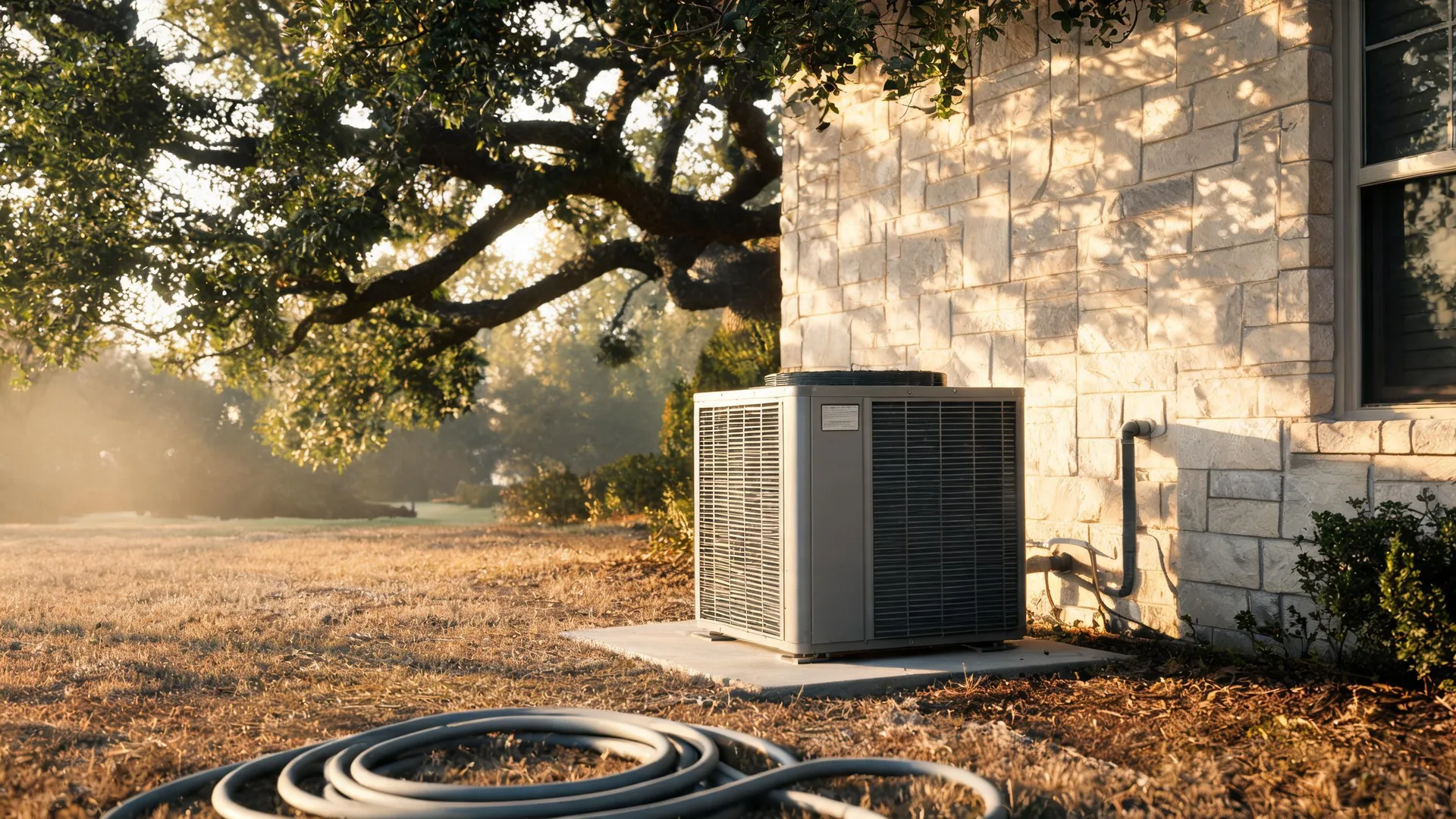
A gray metal air conditioning condenser unit mounted on a concrete pad in a flat grassy field under a partly cloudy sky.

What to check before you call

Before you call anyone, check the thermostat batteries and the setting itself. A thermostat stuck on a schedule, or set to the wrong mode, looks exactly like a dead system. Next, go to the breaker panel. Both the furnace breaker and the AC breaker can trip, since the two share part of the system, so check both, not just one. Outside, make sure the outdoor unit actually has power. If it's dead quiet and the fan isn't spinning at all, that's different from a unit that hums but doesn't cool. Check the air filter next. A filter clogged with dust and pet hair chokes off airflow, and a system starved for air will ice up the coil and stop cooling even though it's running fine otherwise. If you can get to the filter easily, pull it and look at it against a light. If you can't see light through it, it needs changing. While you're there, look at the outdoor unit itself. Leaves, grass clippings, a fallen branch, anything pressed against the coil blocks airflow the same way a dirty filter does. Clear debris away from it by hand. Don't hose it down or take anything apart. Inside, check that the vents are open and not blocked by furniture or rugs. Closed vents in a few rooms put extra strain on the whole system. None of this fixes a bad capacitor or a refrigerant leak, but it rules out the simple stuff first, and it gives a technician a clearer picture of what's actually wrong when they do come out.

What actually fails first

The capacitor and the contactor take the hardest hit over the life of the system. The capacitor gives the compressor and fan motor the jolt they need to start, and it weakens a little every time it does that job until one day it can't deliver enough. A contactor is just a switch, but its points arc every time they close, and worn points eventually stop making good contact. Both parts are small, both are cheap next to the rest of the system, and both cause a no-start that feels exactly like a dead unit.

Why this points to a fix, not a system

A compressor or a coil failing outright is rare next to a bad capacitor or a stuck contactor. Those parts are built to be swapped out, and doing that brings a working system back the same day. The outdoor unit not starting, or starting and tripping off, almost always traces back to something a technician can test with a meter in a few minutes. Worth knowing before deciding this is a bigger problem than it is.

An outdoor air conditioning condenser unit positioned beside a blue-sided house at sunset.

A new air conditioner would save little on running costs in Pine County, so the repair decision comes down to the unit's condition.

  • A new one at the federal minimum, 13.4 SEER2$90 a year
  • An older air conditioner$100 a year

Estimates for a typical Pine County home, compared with an older unit built to the previous federal minimum, from EIA household energy data, Minnesota fuel prices and NOAA climate normals. Your home will differ.

Repair makes sense when a part like a capacitor or contactor has failed.

Replacement makes sense when the compressor has failed or the system uses R-22 refrigerant, which is no longer made.

A diagnostic visit starts outside at the condenser, not inside at the thermostat. A technician checks for power at the disconnect, then checks whether the compressor and fan are getting a signal to run at all. If the unit hums but doesn't start, that points to the capacitor. If it's silent, that points further back, to the contactor or the breaker feeding it. From there they check refrigerant pressures with gauges, since low pressure usually means a leak and not just a system that's old. They'll check the coil for ice, because an iced coil can come from low refrigerant, a dirty filter, or a blower that's not moving enough air, and each of those leads to a different repair. A good diagnosis rules things out in order rather than guessing, so the part that actually failed gets replaced instead of the one that's easiest to reach.