



An outdoor air conditioning condenser unit mounted on a concrete pad next to a blue-sided residential house at sunset.

AC Repair in Owatonna, MN

Tell us about the job

Takes about a minute. No obligation.

RepairCentral ACSteele County, MN
Step 1 of 2

What ZIP code is the job in?

Summers in Steele County are short and mild. Cooling runs about three months, June through August, and the afternoon high averages 79°F. Your air conditioner isn't fighting triple digits all summer long. It's doing a modest job for a short stretch, which means less wear on the compressor and the rest of the system over time. So when something goes wrong, it's rarely because the unit has been run into the ground. More often it's a part reaching the end of its life or something that got missed on a service call. That's usually worth fixing rather than replacing.

3 months
June through August, your air conditioner is on duty
79°F
the average summer afternoon it cools against
17 hail events
in ten years, and hail bends the fins on outdoor coils
24 wind events
in ten years, and wind drives debris into outdoor units
Isometric illustration of a cutaway house showing interior ductwork, an indoor air handler and furniture, connected by lines to an outdoor condenser unit on a pad.
Your air conditioner works hardest from June through August.

NOAA nClimDiv, 1991–2020 normals

Cooling in Steele County starts in June.

A repair in May gets found before the first hot week puts load on it.

A failed AC in Owatonna is almost always a part problem, not a climate problem. The compressor here isn't straining against months of extreme heat, so when it trips out or stops cooling, the cause is usually something specific. A weak capacitor. A contactor with pitted contacts. A slow refrigerant leak that's dropped the charge low enough to matter. Electricity in Minnesota runs 15.45 cents per kilowatt-hour, enough that a system short-cycling or running nonstop because of a bad part shows up on the bill before you notice the house isn't cooling right. A contractor can usually point to the one part that failed rather than a system worn out from overuse, and that's the kind of repair worth making.

This is a repair, not a replacement

Your AC has had an easy few summers here, so a repair almost always makes sense over replacement. Get the actual part diagnosed before anyone talks about a new system.

Find a contractor
A man in a cap, dark shirt and olive pants climbs porch steps toward a dark green paneled door, carrying a worn canvas duffel bag, with a potted shrub beside the entry.
An outdoor air conditioning condenser unit mounted on a concrete pad surrounded by gravel, photographed against a partly cloudy blue sky.

Some of these get worse the longer the system runs

A low charge is the clearest case. Once there's a leak, the system keeps running short on refrigerant, and a compressor built to move a full charge starts working against pressures it wasn't designed for. Heat builds in the compressor that would normally get carried off with the refrigerant flow. Keep running it and the compressor windings take the damage, which turns a refrigerant repair into a compressor replacement. A failing capacitor behaves the same way in a different part. It can't hold the charge needed to keep the compressor or fan motor started cleanly, so the motor pulls harder on startup. Do that enough times and the motor windings wear from the strain instead of the capacitor just getting swapped out. A dirty coil causes trouble further out. Airflow drops, the coil can't shed heat properly, and the compressor ends up working against higher pressure than it was built for. None of these start as compressor problems. Left running, most of them end as one.

Check the thermostat and the breaker first

Set the thermostat below room temperature and listen for the system to kick on. If nothing happens, check the breaker panel for a tripped switch and the disconnect box next to the outdoor unit. A system that won't start at all often points to a power problem rather than a failed part, and it rules out the simplest cause before anyone comes out.

Look at the air filter and the outdoor unit

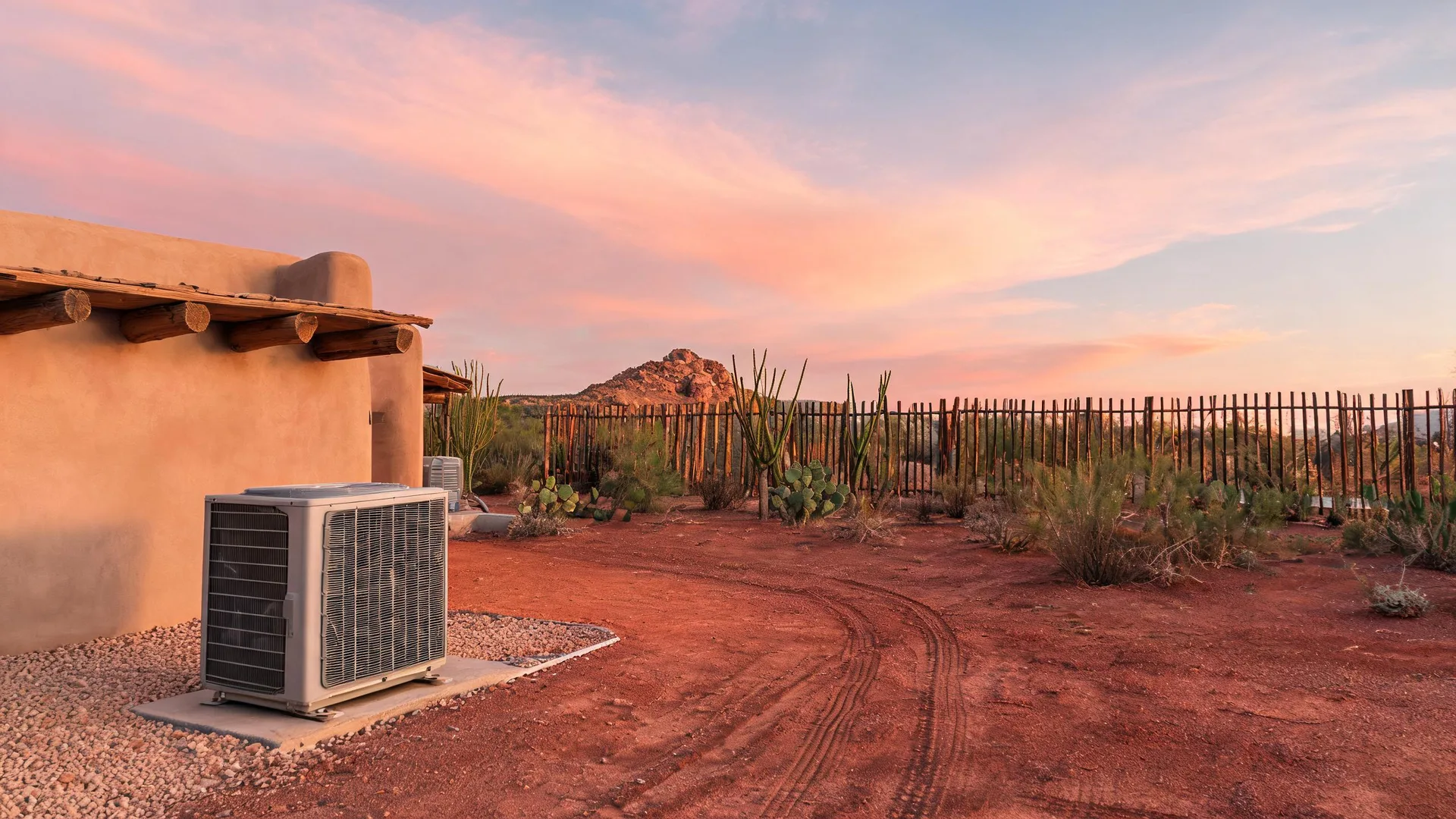
Pull the filter and hold it up to light. If you can't see through it, airflow is choked, and that alone can cause weak cooling or ice forming on the coil. Walk outside and check that the condenser isn't packed with leaves or grass clippings and that nothing is blocking airflow around it. What you find there tells a contractor something real before they even look at the system.

An outdoor central air conditioning unit mounted on a concrete pad beside a blue-sided house at sunset.

A new air conditioner would save little on running costs in Steele County, so the repair decision comes down to the unit's condition.

  • A new one at the federal minimum, 13.4 SEER2$150 a year
  • An older air conditioner$160 a year

Estimates for a typical Steele County home, compared with an older unit built to the previous federal minimum, from EIA household energy data, Minnesota fuel prices and NOAA climate normals. Your home will differ.

Repair makes sense when a part like a capacitor or contactor has failed.

Replacement makes sense when the compressor has failed or the system uses R-22 refrigerant, which is no longer made.

A repair makes sense when the failure is one part doing its job badly. A capacitor, a contactor, a fan motor, a low charge from a small leak. Swap or fix that one thing and the rest of the system, the compressor especially, goes back to running the way it was built to. Replacement starts to make sense when the compressor itself is the problem, since a compressor isn't something anyone repairs. It gets replaced on its own, or the whole system gets replaced along with it, and at that point a new system often makes more sense than a new compressor in an old one. How long the system's been running matters less than what actually failed. A bad capacitor is a repair almost no matter the age of the unit around it. A dying compressor is a harder call, and a costlier one either way you go. The honest answer comes from someone looking at the actual part, not a guess based on how long the unit's been in the ground.