







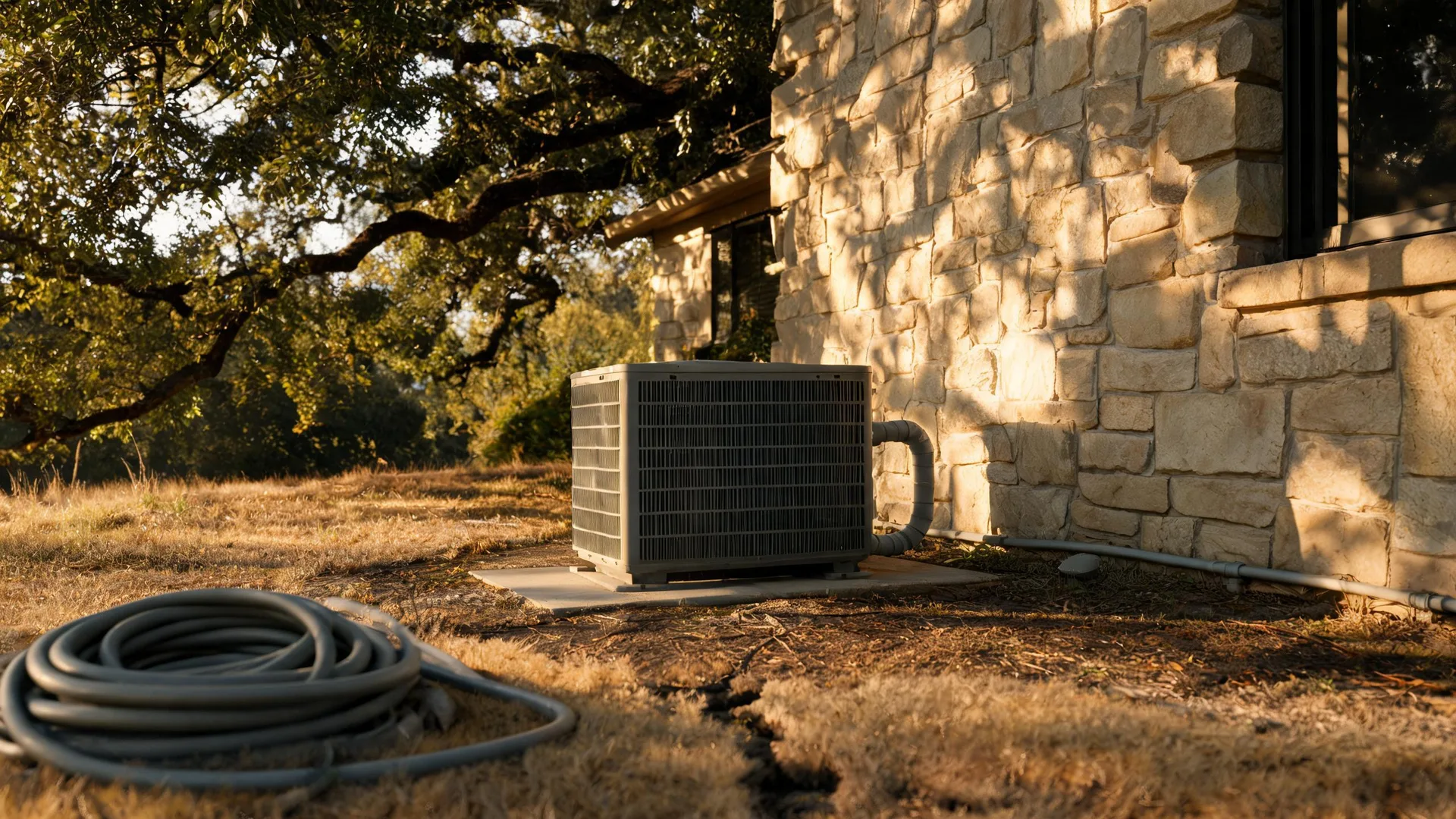
An overhead view of a residential air conditioning condenser unit mounted on a concrete pad next to a house with vinyl siding.

AC Repair in Otsego, MN

Tell us about the job

Takes about a minute. No obligation.

RepairCentral ACWright County, MN
Step 1 of 2

What ZIP code is the job in?

Three months of real cooling load here, June through August, with afternoon highs around 80. That's not a lot of strain on a system compared to what it sees further south, so when an AC in Otsego quits or starts acting up, it's rarely because the Minnesota summer pushed it too hard. More often it's a weak capacitor, a low refrigerant charge, a dirty coil, or a thermostat issue, the same things that go wrong with this equipment anywhere. A contractor can usually narrow it down fast once they're looking at the unit. The fix is almost always worth doing rather than replacing the whole system.

3 months
June through August, your air conditioner is on duty
80°F
the average summer afternoon it cools against
77 hail events
in ten years, and hail bends the fins on outdoor coils
65 wind events
in ten years, and wind drives debris into outdoor units
Isometric line illustration of a cutaway single-story building showing interior rooms, ceiling ductwork, an indoor air handler, and an outdoor condenser unit connected by a line set.
Your air conditioner works hardest from June through August.

NOAA nClimDiv, 1991–2020 normals

May is the last quiet month before cooling starts in Wright County.

Get the unit checked in May, before the first hot stretch finds the weak part.

Half the homes in Wright County were built in 1995 or later, so a lot of this equipment still has years left

Half the homes here were built by 1995
Climate zone 6A
Power costs 15.45 cents a kWh statewide
Otsego weather isn't why your AC quitWright County saw 77 hail events between 2015 and 2024, but that's not what breaks an air conditioner.

A capacitor or a low charge doesn't care what state it's in. It fails the same way in Otsego as it does anywhere else this equipment runs. The one local number worth knowing is the electric rate. Minnesota homes paid 15.45 cents per kilowatthour in 2024. A failing capacitor makes the compressor pull harder to start. A dirty coil makes the whole system run longer to do the same job. So a small fault costs more to ignore than to fix, and that cost shows up on the power bill before the unit quits for good. None of that is about the climate here being hard on the system. It's just what a strained system does to a bill, in Otsego or anywhere else.

If your AC came with the house, repair is the right call

A system installed with a newer Otsego home still has years of working life in it. That's the case for repairing what's wrong now instead of replacing the unit. Get the actual cause checked and fixed.

Find a contractor
A man in a dark long-sleeve shirt and tan work pants climbs porch steps toward a dark green front door, carrying a worn canvas and leather tool bag, with a potted conical shrub beside the entry.
A gray residential air conditioning condenser unit mounted on a concrete pad outdoors, surrounded by green grass under a partly cloudy blue sky.

The system usually tells you before it quits

Most of the time the system doesn't go quiet all at once. It tells you first. Warm air out of the vents while the outdoor unit still runs usually points to the refrigerant charge or a compressor that's struggling. A unit that short cycles, running a few minutes then stopping, then starting again, is often the capacitor giving out. Ice on the indoor coil usually means airflow is restricted, whether that's a dirty filter or a blower that isn't moving enough air. A warm room that used to cool fine, a system that runs longer than it used to, a hum from the outdoor unit with no fan movement. Any of those is worth a call before the part that's struggling takes something else down with it, like a compressor failing after months of running strained.

The compressor rarely fails on its own

A compressor is usually the last part to go, not the first. A bad capacitor, a low charge, or a dirty coil all make it work harder than it should, and run that way long enough and it burns out or seizes. Catching the earlier failure is what keeps the compressor out of the conversation.

Airflow problems cause more calls than refrigerant ones

A dirty filter, a blocked return, or a blower motor losing strength all starve the system of airflow. The coil ices up, the house doesn't cool, and it can look like a refrigerant leak when the charge is actually fine. A contractor checks airflow before touching the refrigerant, because fixing the wrong one doesn't fix anything.

Overhead view of an air conditioning condenser unit on a concrete pad next to a house with asphalt shingle roofing and vinyl siding.

A new air conditioner would save little on running costs in Wright County, so the repair decision comes down to the unit's condition.

  • A new one at the federal minimum, 13.4 SEER2$150 a year
  • An older air conditioner$160 a year

Estimates for a typical Wright County home, compared with an older unit built to the previous federal minimum, from EIA household energy data, Minnesota fuel prices and NOAA climate normals. Your home will differ.

Repair makes sense when a part like a capacitor or contactor has failed.

Replacement makes sense when the compressor has failed or the system uses R-22 refrigerant, which is no longer made.

A diagnostic call starts outside, at the condenser, before anything gets opened up. The contractor checks that the fan spins freely and the coil isn't caked with dirt or grass clippings. That alone can mimic a refrigerant problem. Next comes the electrical side, testing the capacitor, checking the contactor, looking for anything scorched or loose. Refrigerant pressures get checked with gauges, not guessed at, since too much or too little both point to different problems. Inside, the filter and the blower get a look too, because weak airflow on that end shows up as a coil problem on the other end. By the time the gauges come out, a contractor already has a good idea what they're going to find.