


A quiet residential street at dusk lined with illuminated two-story brick houses and mature trees.

AC Repair in North Branch, MN

Tell us about the job

Takes about a minute. No obligation.

RepairCentral ACChisago County, MN
Step 1 of 2

What ZIP code is the job in?

Your air conditioner only has to work three months a year here, June through August, with afternoon highs averaging around 80. That is a short season and a mild one. A unit that gets that kind of break tends to hold up well, so when something goes wrong it's rarely because the compressor ran itself ragged. More often it's a capacitor, a contactor, a low charge, something that fails on its own schedule, not from overwork. That's worth knowing when you're deciding whether a repair makes sense. A system that's had an easy life behind it is usually a system worth fixing.

3 months
June through August, your air conditioner is on duty
80°F
the average summer afternoon it cools against
26 hail events
in ten years, and hail bends the fins on outdoor coils
29 wind events
in ten years, and wind drives debris into outdoor units
Isometric line illustration of a cutaway house showing an indoor air handler with branching ducts in the attic space, connected by a line set to an outdoor condenser unit beside the building, with simple furniture in two rooms.
Your air conditioner works hardest from June through August.

NOAA nClimDiv, 1991–2020 normals

Half the houses in Chisago County were built in 1992 or later.

A newer system behind the wall usually still has years left to give, and that favors fixing it.

May is a good month to get your AC looked at, before June starts asking something of it. Systems that sat idle all winter tend to show their weak spot in the first hot stretch, not partway through summer. A capacitor or contactor that was already marginal doesn't get better from sitting unused, and the first real load will find it. Getting a tune-up or repair done before the heat arrives means you're not waiting on a contractor during the week everyone else's AC is also failing. It's a short season here, three months, so there's not much room to lose the first week of it to a part that could have been caught early.

An easy life behind it means it's usually worth fixing

A system that's had an easy three months a year doesn't need to be replaced over one bad part. If your AC is acting up, get it looked at and find out what's actually wrong before you decide it's done.

Find a contractor
An outdoor air conditioning condenser unit mounted on a concrete pad surrounded by gravel, photographed against a partly cloudy blue sky.

What you can check before anyone shows up

Before anyone comes out, check the thermostat first. Make sure it's set to cool and set below room temperature, and swap the batteries if it's got any. Go look at the outdoor unit. If the fan isn't spinning and you don't hear a hum, check the breaker panel, a tripped breaker is the cheapest problem you can have. If the breaker's fine, leave it alone. A unit that hums but doesn't spin usually means a bad capacitor, and poking at it won't fix that. Check the air filter next. One so clogged you can't see light through it chokes the airflow and can ice up the indoor coil. If that's happened, shut the system off and let it thaw rather than running it harder. Clear any leaves or grass clippings off the outdoor coil so air can move through the fins, and make sure nothing inside is blocking the supply vents. If the system runs but the air coming out doesn't feel cold, that detail matters, it points away from airflow and toward the charge or the compressor. Note any sounds too, a click that repeats, a buzz, a squeal. That often tells a tech more than anything else you can check yourself.

What you'll notice first

The air coming out feels warm or barely cool, or the system runs without ever catching up to the thermostat. Sometimes it's a smell, a musty note when it kicks on, or a new sound, a rattle, a squeal, a click that repeats. Any of these means something specific failed. It's rarely subtle once it starts.

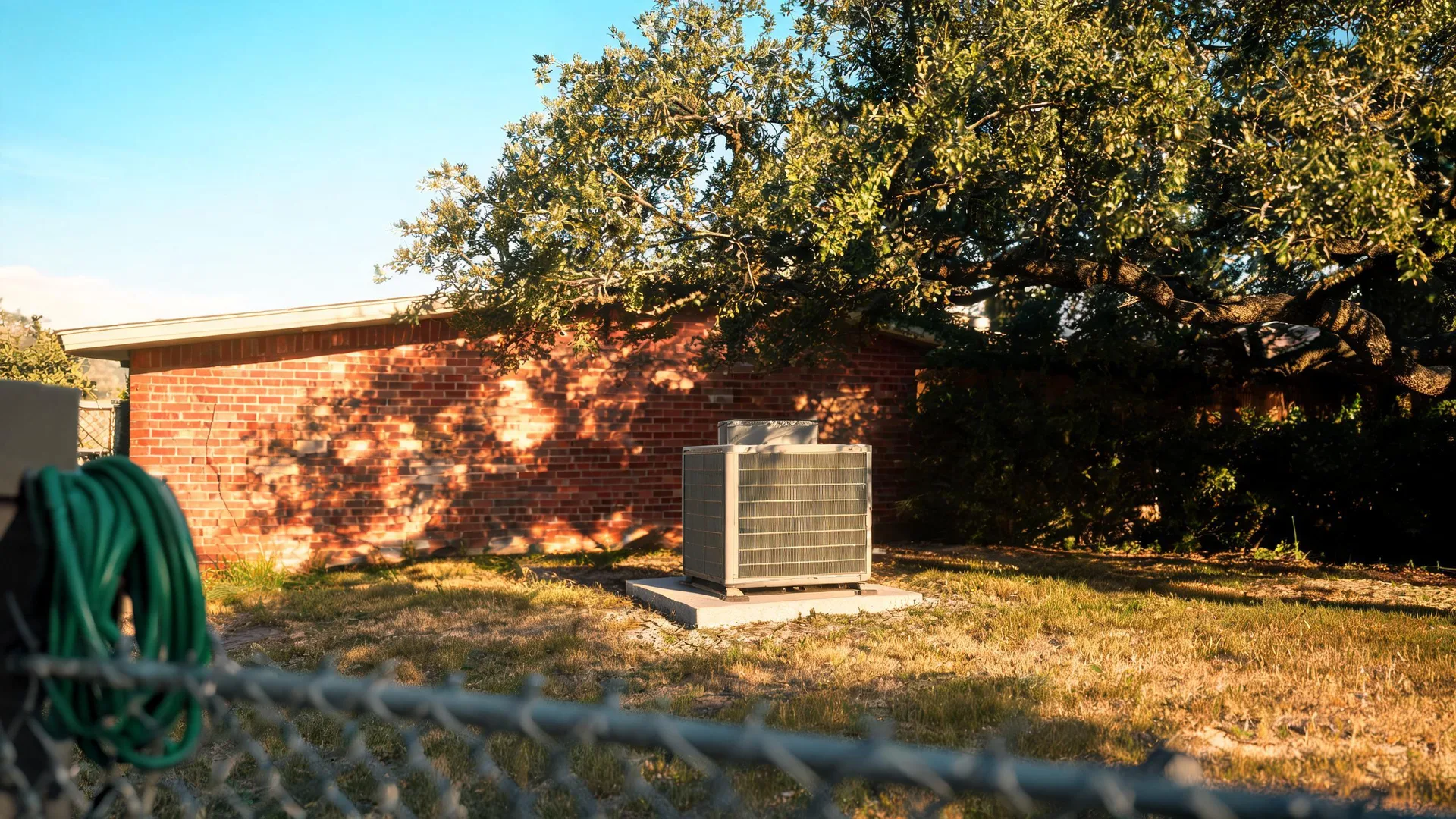
When it stops working altogether

If the outdoor unit won't start at all, no hum, no fan, that points to power not reaching the unit or a failed capacitor. If it hums but the fan doesn't turn, that's almost always the capacitor, and running it again won't fix it. A system that short cycles, shutting off soon after it starts, is protecting itself from something and needs a tech to find out what.

An outdoor air conditioning condenser unit mounted on a concrete pad next to a blue-sided residential house at sunset.

A new air conditioner would save little on running costs in Chisago County, so the repair decision comes down to the unit's condition.

  • A new one at the federal minimum, 13.4 SEER2$140 a year
  • An older air conditioner$150 a year

Estimates for a typical Chisago County home, compared with an older unit built to the previous federal minimum, from EIA household energy data, Minnesota fuel prices and NOAA climate normals. Your home will differ.

Repair makes sense when a part like a capacitor or contactor has failed.

Replacement makes sense when the compressor has failed or the system uses R-22 refrigerant, which is no longer made.

A diagnostic starts outside at the unit. The tech checks for power at the disconnect, then watches what happens when the system calls for cooling. Does the fan spin, does the compressor kick on, is there a hum with no movement at all. From there it's gauges on the refrigerant lines to see whether the charge is right, and a check of the capacitor and contactor, since those are what usually wear out first. Inside, the tech looks at the coil and the airflow across it. Restricted airflow can look like a refrigerant problem and send someone chasing the wrong fix. The goal is to find the one part that actually failed, not to start swapping parts on a guess.