






A row of illuminated two-story brick houses with front porches and mature trees photographed at twilight.

AC Repair in New Ulm, MN

Tell us about the job

Takes about a minute. No obligation.

RepairCentral ACBrown County, MN
Step 1 of 2

What ZIP code is the job in?

Summer here only runs about three months, June through August, with afternoon highs averaging around 81°F. That's not much of a workload for a condenser compared to what systems in hotter parts of the country handle every year. Your AC in New Ulm gets to rest most of the year and only has to work hard for a short stretch. So if something's gone wrong with it now, the cause is usually age, a part wearing out, or something that got missed last time it was serviced, not the system being run into the ground. That's good news for a repair call. A unit that hasn't been under constant strain is usually still worth fixing rather than replacing.

3 months
June through August, your air conditioner is on duty
81°F
the average summer afternoon it cools against
14 hail events
in ten years, and hail bends the fins on outdoor coils
50 wind events
in ten years, and wind drives debris into outdoor units
Isometric cutaway illustration of a single-story house showing interior rooms with furniture, overhead ductwork, an indoor air handler unit, and an outdoor condenser unit connected by lines at the side of the building.
Your air conditioner works hardest from June through August.

NOAA nClimDiv, 1991–2020 normals

AC runs here from June through August.

May is the month to get a weak part looked at, before the first hot week finds it.

A New Ulm summer doesn't ask much of a condenser

Power costs 15.45 cents a kWh statewide
Cooling runs June through August
Summer afternoons average 81°F
Half these homes date to 1963 or earlierHalf the homes in Brown County were built in 1963 or earlier. An AC that old is worth asking about.

Before you call anyone, check the thermostat is set to cool and the temperature is actually below room temperature. Go to the outside unit and look at the fan through the top grille. If it's not spinning and you hear a hum, that's different from it not spinning with no sound at all, and worth mentioning when you call. Check the breaker panel too, since a tripped breaker will shut the whole system down and is something you can safely reset yourself. Inside, pull the air filter and hold it up to a light. If you can't see light through it, that's restricting airflow and can make the whole system work harder than it should. Look at the vents around the house and make sure none are closed or blocked by furniture. None of this fixes a failing capacitor or a low refrigerant charge, but it rules out the simple stuff first.

Ask how much life is left in it

If your AC came with the house, it may date back to 1963 or earlier. Ask the contractor how much life is left in it before you commit to the repair.

Find a contractor
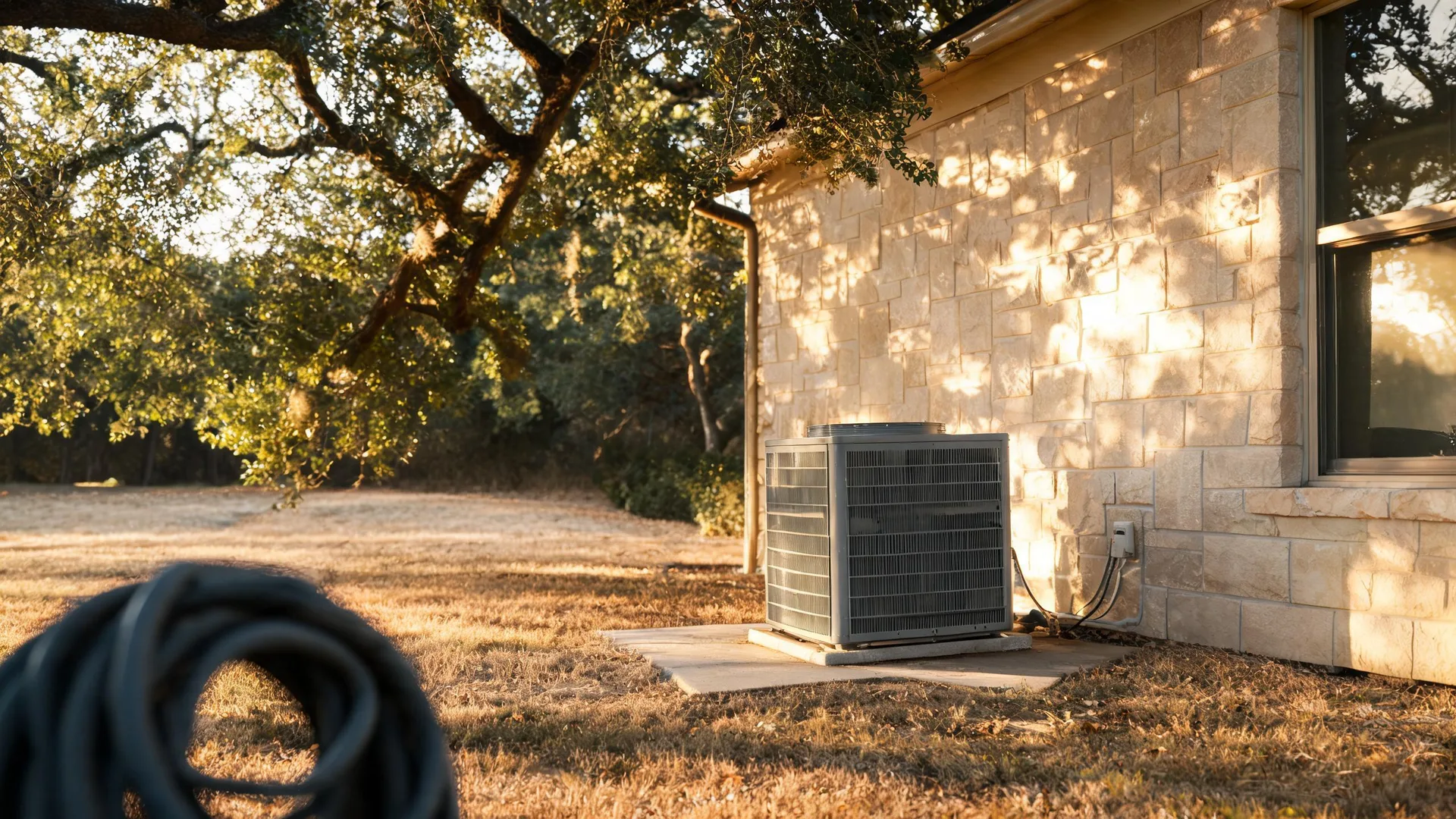
A gray residential air conditioner condenser unit mounted on a concrete pad in an open grass field.

Running it longer doesn't give a failing part time to recover

A capacitor that's starting to weaken will still kick the compressor on, so the system keeps running instead of shutting down and telling you something's wrong. Each start puts a harder jolt through it. A part that's marginal today fails outright a week later. Low refrigerant works the same way. A small leak means the compressor runs longer to make the same cooling, and running hot under that kind of strain is what kills a compressor early. Ice on the coil is the clearest case. Once airflow is restricted enough for the coil to frost, running it longer just builds more ice and cuts airflow further. It can also push liquid refrigerant back into the compressor, which it isn't built to handle. None of these fix themselves by giving the system time to work through it. The part either gets replaced while it's still a small job, or it keeps running until it takes something bigger down with it.

The capacitor is usually first

The run capacitor holds a charge that gets the compressor and fan motor started, and it weakens with age and heat cycling. When it goes, the fan may hum and not spin, or the compressor tries to start and can't. It's a small part, and catching it early keeps it from taking the compressor down with it.

A refrigerant leak never seals itself

Refrigerant doesn't get used up, so a low charge always means a leak somewhere in the coil or line set. The system keeps running on what's left, cooling less and working harder to do it. A contractor has to find the leak and seal it, not just add refrigerant back in, or the same drop happens again.

Aerial view of a square outdoor air conditioning condenser unit on a concrete pad beside a house wall with a sliding glass door.

A new air conditioner would save little on running costs in Brown County, so the repair decision comes down to the unit's condition.

  • A new one at the federal minimum, 13.4 SEER2$170 a year
  • An older air conditioner$190 a year

Estimates for a typical Brown County home, compared with an older unit built to the previous federal minimum, from EIA household energy data, Minnesota fuel prices and NOAA climate normals. Your home will differ.

Repair makes sense when a part like a capacitor or contactor has failed.

Replacement makes sense when the compressor has failed or the system uses R-22 refrigerant, which is no longer made.

Repair versus replacement comes down to what's actually wrong and what it would take to fix it. A failed capacitor or a bad contactor is a small, contained job, and there's no reason a sound system should be scrapped over a part like that. It gets different when the compressor itself is failing, or when a coil has leaked more than once. At that point you're paying to fix one thing while the rest of the system is still aging right alongside it. A contractor who's actually inside the unit can tell you which kind of problem you've got. That's worth more than any rule of thumb about when to stop repairing and start replacing.