A chain-link fence runs along the left edge of a wide mown lawn, with a row of two-story light-sided houses with porches and dark roofs beyond, under a large overhanging tree canopy.

AC Repair in Moorhead, MN

Tell us about the job

Takes about a minute. No obligation.

RepairCentral ACClay County, MN
Step 1 of 2

What ZIP code is the job in?

Warm air or warm rooms upstairs

Air coming out of the vents that isn't cold anymore usually points to the refrigerant charge or the compressor. If some rooms cool fine and others stay warm, the problem might just be airflow, a blocked vent or a return that isn't pulling right. Either way the unit is working harder to do less.


Short cycling or a unit that won't stop

An air conditioner that shuts off a couple minutes after starting is usually tripping on a safety switch, often from a dirty coil or low airflow. One that runs constantly and never satisfies the thermostat is losing the fight against the heat, which points to a bigger issue like a failing compressor or a significant refrigerant leak. Either pattern is worth having looked at before it leaves you without cooling altogether.

3 months
June through August, your air conditioner is on duty
80°F
the average summer afternoon it cools against
45 hail events
in ten years, and hail bends the fins on outdoor coils
78 wind events
in ten years, and wind drives debris into outdoor units
Isometric illustration of a cutaway house showing interior ductwork, an indoor air handler and furniture, connected by lines to an outdoor condenser unit on a pad.
Your air conditioner works hardest from June through August.

NOAA nClimDiv, 1991–2020 normals

A tech starts by checking the charge, the airflow across the coil, and the electrical draw on the compressor before touching anything.

That order tells them whether your unit needs a part replaced or just a cleaning, so you're not paying to guess.

Three months of mild heat, not a machine under siege

Cooling runs June through August
Summer afternoons average 80°F
78 damaging wind events from 2015 to 2024
Get it fixed before JuneAC in Clay County only has to run June through August

A repair is usually worth it if the compressor still runs well and the problem is a part around it, a capacitor, a contactor, a fan motor. Those parts fail on their own and swapping one doesn't tell you anything bad about the rest of the system. Replacement starts to make sense when the compressor itself is failing or the coil is leaking refrigerant, since both are expensive to fix and both sit at the center of everything else working. Age matters less than how the unit has been treated. A unit that's had its filter changed and coils cleaned regularly can outlast one that's newer but been ignored. Ask what's actually failing before you ask how old it is.

Your AC likely has years left in it

Half the homes in Clay County were built in 1981 or later, and systems in newer homes usually still have plenty of working life in them. If yours came with a newer house, a repair is probably all it needs.

Find a contractor
A man in a worn dark jacket and tan pants, seen from behind, climbs porch steps toward a dark green paneled front door while carrying a canvas tool bag holding a hammer and other tools, with a potted conifer shrub to the right.
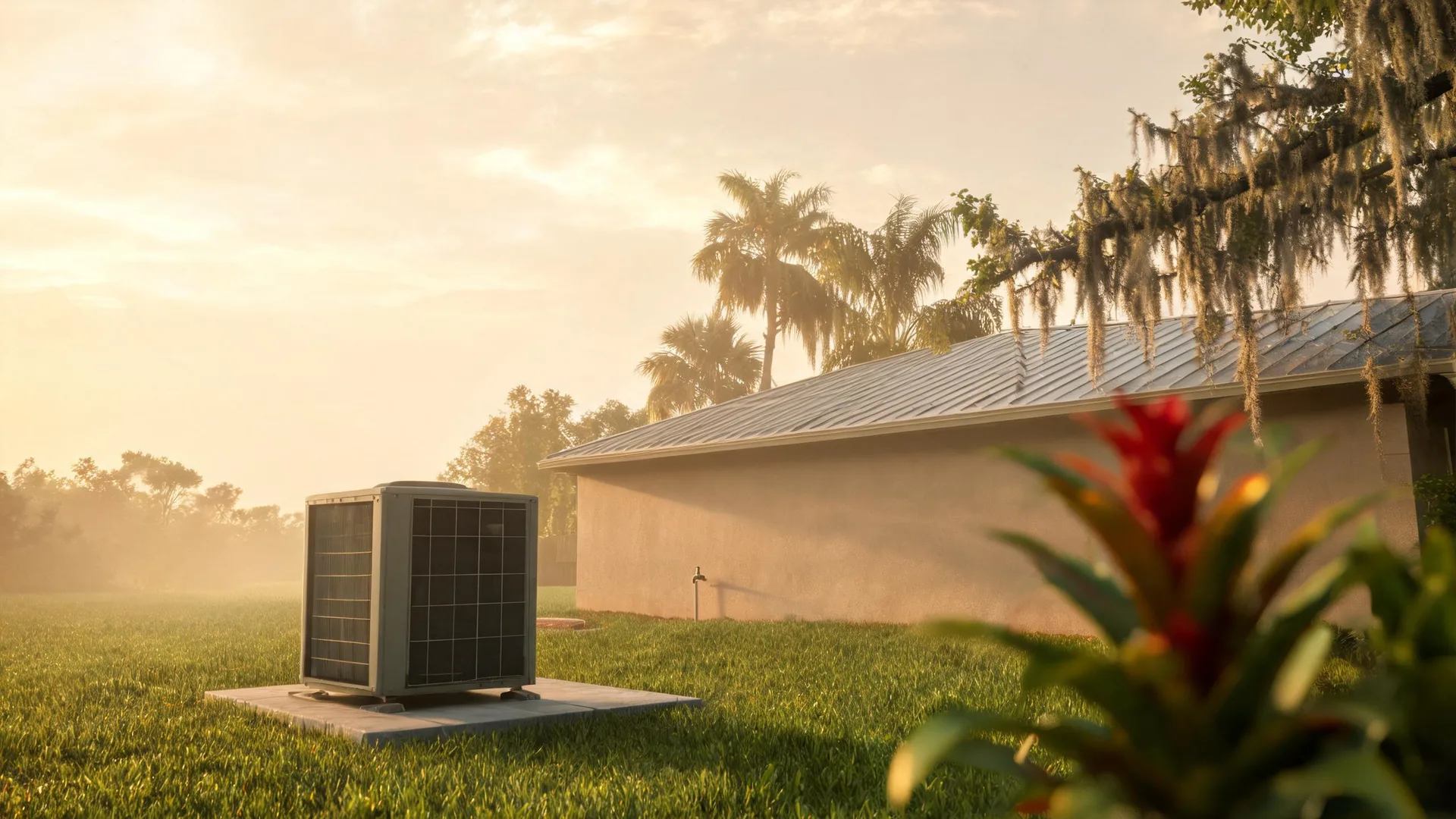
A gray residential air conditioner condenser unit mounted on a concrete pad in an open grass field.

Check the age of the unit, not just the house

A furnace or AC unit can be swapped out partway through a house's life, so the house's age is a starting point, not the answer. Worth checking when your particular system went in if you know, or asking the tech to look at the data plate on the unit itself. Either way, a tech can tell you roughly how many hours of work that compressor has likely seen, and that number matters more for deciding on a repair than the year the house went up.

Check the thermostat and the breaker first

Make sure it's set to cool and set below room temperature, not just on. A dead thermostat display usually means batteries. Then check the breaker and any shutoff switch near the indoor unit. Outdoor units also have a disconnect box, sometimes with a pull block inside. These take a minute to check and fix more than you'd think.

Look at the filter and the outdoor unit

Pull the filter and hold it up to light. If you can't see light through it, it's choking the airflow and the system is working against itself. Outside, look at the unit itself. Leaves, grass clippings or a fence line grown in close can block the airflow it needs to dump heat. Clear debris away from it and give it room to breathe before you call anyone out.

An outdoor air conditioning condenser unit on a concrete pad next to the gray vinyl siding of a residential home.

A new air conditioner would save little on running costs in Clay County, so the repair decision comes down to the unit's condition.

  • A new one at the federal minimum, 13.4 SEER2$130 a year
  • An older air conditioner$140 a year

Estimates for a typical Clay County home, compared with an older unit built to the previous federal minimum, from EIA household energy data, Minnesota fuel prices and NOAA climate normals. Your home will differ.

Repair makes sense when a part like a capacitor or contactor has failed.

Replacement makes sense when the compressor has failed or the system uses R-22 refrigerant, which is no longer made.

Most AC failures start with something other than the compressor. Capacitors weaken over time and stop giving the compressor and fan motor the jolt they need to start, so the unit hums or clicks but doesn't turn over. Contactors wear from the constant arcing every time they close, until they stick or stop making contact at all. Fan motors fail on their own too, either the bearings go or the windings do, and once that motor stops the condenser can't shed heat even if the compressor is still working fine. Refrigerant leaks are different. They don't announce themselves, they just show up as weaker cooling over time, usually at a fitting or a coil that's corroded through. None of this has much to do with the compressor itself, which is built to outlast most of the parts around it.