






Aerial view of a gray central air conditioning condenser unit on a concrete pad next to a house with vinyl siding.

AC Repair in Little Falls, MN

Tell us about the job

Takes about a minute. No obligation.

RepairCentral ACMorrison County, MN
Step 1 of 2

What ZIP code is the job in?

Cooling only runs here from July through August, so the system sits idle most of the year before it's asked to work again. June is when it pays to get it looked at, before that first hot stretch hits. A capacitor or contactor that was already weak tends to fail right when the load hits it, not before. If yours is struggling in the first weeks of July, that's usually not a new problem, it's an old one finally showing itself.

2 months
July through August, your air conditioner is on duty
78°F
the average summer afternoon it cools against
36 hail events
in ten years, and hail bends the fins on outdoor coils
41 wind events
in ten years, and wind drives debris into outdoor units
Isometric cutaway illustration of a single-story house showing interior ductwork and an air handler connected by lines to an outdoor condenser unit on a pad beside the building.
Your air conditioner works hardest from July through August.

NOAA nClimDiv, 1991–2020 normals

Afternoon highs here average 78 in June, July and August.

Your condenser isn't working against brutal heat all summer, so a repair has a good shot at holding.

Half these homes are older, but that's not what breaks your AC

Half the homes here were built by 1977
Cooling runs July through August
Summer afternoons average 78°F
Little Falls AC repairElectricity here runs 15.45 cents a kilowatt-hour, so a unit that's losing efficiency costs you more every month it runs.

When a repair holds up, there's usually a reason for it, and here it's the short season. A capacitor or contactor that's been fixed right has only July and August to prove itself before the unit shuts down again. That's a fair test, not a hard one. Wind and hail move through this county often enough that it's worth asking whether a storm knocked something loose rather than assuming the part just wore out. Either way, once the real cause is found, there's usually no reason to replace the whole unit over it.

Get it looked at early

Problems tend to show up in the first weeks of the season, when the load hits a part that was already weak.

Find a contractor
An outdoor residential air conditioning condenser unit mounted on a concrete pad, surrounded by gravel with a blue sky in the background.

Keep running it and the job gets bigger

A struggling AC rarely fails clean. A compressor that's drawing too hard because of a weak capacitor keeps drawing too hard every minute it runs, and heat is what wears a compressor down. A refrigerant leak doesn't hold steady either. The charge keeps dropping, so the compressor works harder to move what's left of it. Run it long enough in that state and a capacitor job turns into a compressor job. A clogged coil or a failing fan motor pushes head pressure up, and high head pressure strains that same compressor from a different direction. One weak part makes the part next to it work harder, and that part wears faster too. Shutting the system off when something sounds wrong or smells off is the safer move until someone can look at it.

What you'll actually notice first

Warm air out of the vents when the thermostat says it should be cold. Short cycling, where the unit kicks on and off every few minutes instead of running a full cycle. Ice on the refrigerant line or the coil itself. A hissing or bubbling sound near the lines, which points to a leak. Water pooling near the indoor unit from a clogged condensate drain. Any of these means something inside is already failing, not about to.

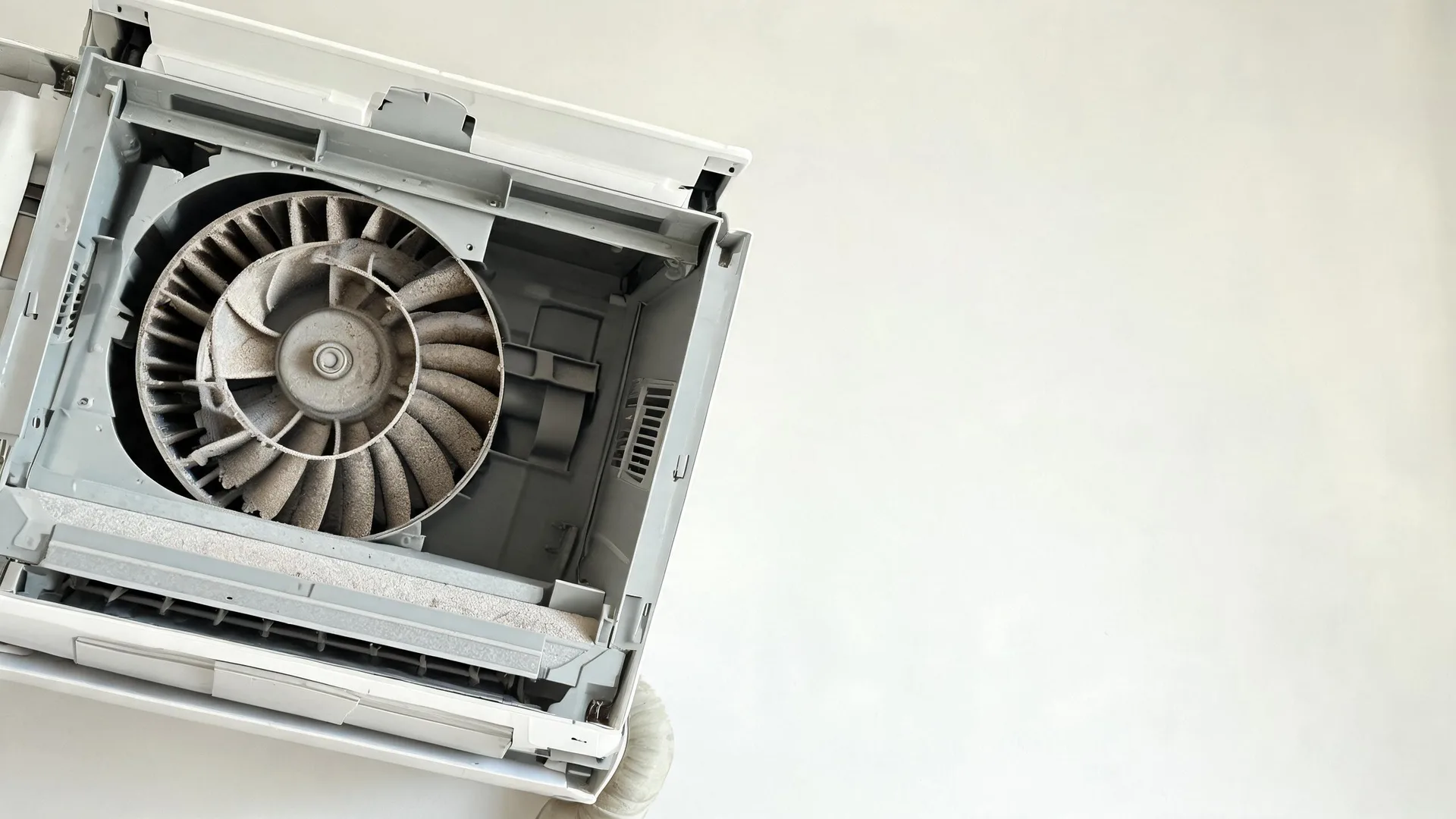
Noise and smell tell you where to look

A grinding or screeching sound usually means a motor bearing is going. A loud bang on startup often means a part has come loose inside the compressor. A burning smell means stop the system and leave it off, since that can mean wiring or a motor winding is overheating. A musty smell points to mold in the ductwork or on the coil, not a mechanical failure, but still worth a look.

An overhead view of a residential air conditioning condenser unit mounted on a concrete pad next to a house with vinyl siding.

A new air conditioner would save little on running costs in Morrison County, so the repair decision comes down to the unit's condition.

  • A new one at the federal minimum, 13.4 SEER2$120 a year
  • An older air conditioner$130 a year

Estimates for a typical Morrison County home, compared with an older unit built to the previous federal minimum, from EIA household energy data, Minnesota fuel prices and NOAA climate normals. Your home will differ.

Repair makes sense when a part like a capacitor or contactor has failed.

Replacement makes sense when the compressor has failed or the system uses R-22 refrigerant, which is no longer made.

A repair decision usually comes down to what actually failed and what it's connected to. A bad capacitor, a stuck contactor, a dirty coil, these are parts that fail on their own and don't say anything bad about the rest of the system. Replace the part and the unit is back to normal. The compressor is the one that changes the math. It's the most expensive part in the system, and if it's failing, or if it's been run hard for a long time on a low charge or a bad capacitor, a tech may tell you straight that putting money into the rest of the unit isn't worth it. Age matters less than people think. A unit that's been maintained and never run while something else was wrong can hold up fine for a long time. One that's been limping for a while, even if it's newer, is in worse shape than the calendar suggests.