






Overhead view of a gray outdoor AC condenser unit on a concrete pad beside a mulched garden bed and a house with vinyl siding.

AC Repair in Lakeville, MN

Tell us about the job

Takes about a minute. No obligation.

RepairCentral ACDakota County, MN
Step 1 of 2

What ZIP code is the job in?

Lakeville runs its AC June through August, with afternoon highs around 80. That's enough heat to expose a weak unit, but it's not extreme weather putting unusual strain on the system. If yours is short cycling, blowing warm air, or tripping its breaker, the cause is most likely the same thing a tech would find anywhere else. A weak capacitor. A dirty coil. A low refrigerant charge. A clogged filter choking airflow. Hail and wind do pass through this county, so a unit that started acting up after a storm is worth having someone check for bent fins or a damaged fan blade. Otherwise, this is routine troubleshooting, not a mystery particular to this area.

3 months
June through August, your air conditioner is on duty
80°F
the average summer afternoon it cools against
102 hail events
in ten years, and hail bends the fins on outdoor coils
56 wind events
in ten years, and wind drives debris into outdoor units
Isometric line illustration of a cutaway house showing interior rooms with furniture, ceiling ductwork, an indoor air handler, and an outdoor condenser unit connected by lines.
Your air conditioner works hardest from June through August.

NOAA nClimDiv, 1991–2020 normals

AC in Lakeville runs June through August.

May is the month to get a weak unit looked at, before the first hot week finds the part that was already failing.

Dakota County sees its share of storms, but that's not why your AC is down

210 severe weather events from 2015 to 2024
13% of homes statewide lost power a day or more in 2024
56 damaging wind events from 2015 to 2024

Minnesota homes paid 15.45 cents per kilowatthour in 2024. That's the rate a struggling AC is working against. A dirty coil or a low charge makes the compressor run longer to cool the same house, and that cost shows up on the electric bill before the unit ever quits outright. None of this is particular to Lakeville. It's the same math wherever a compressor is pushing against a problem instead of just running. Fixing the actual cause is cheaper than paying all summer to cool a house through a system that's struggling.

A newer system is a system worth repairing

Half the homes in Dakota County were built in 1988 or later, so if yours came with the house, it's likely not old enough to be the real problem. A unit that age has plenty of working life left in it. Worth fixing what's actually wrong with it.

Find a contractor
A man in a cap, dark jacket and work pants carries a worn canvas tool bag up stone steps toward a dark green front door, with a shrub in a green planter beside the entry.
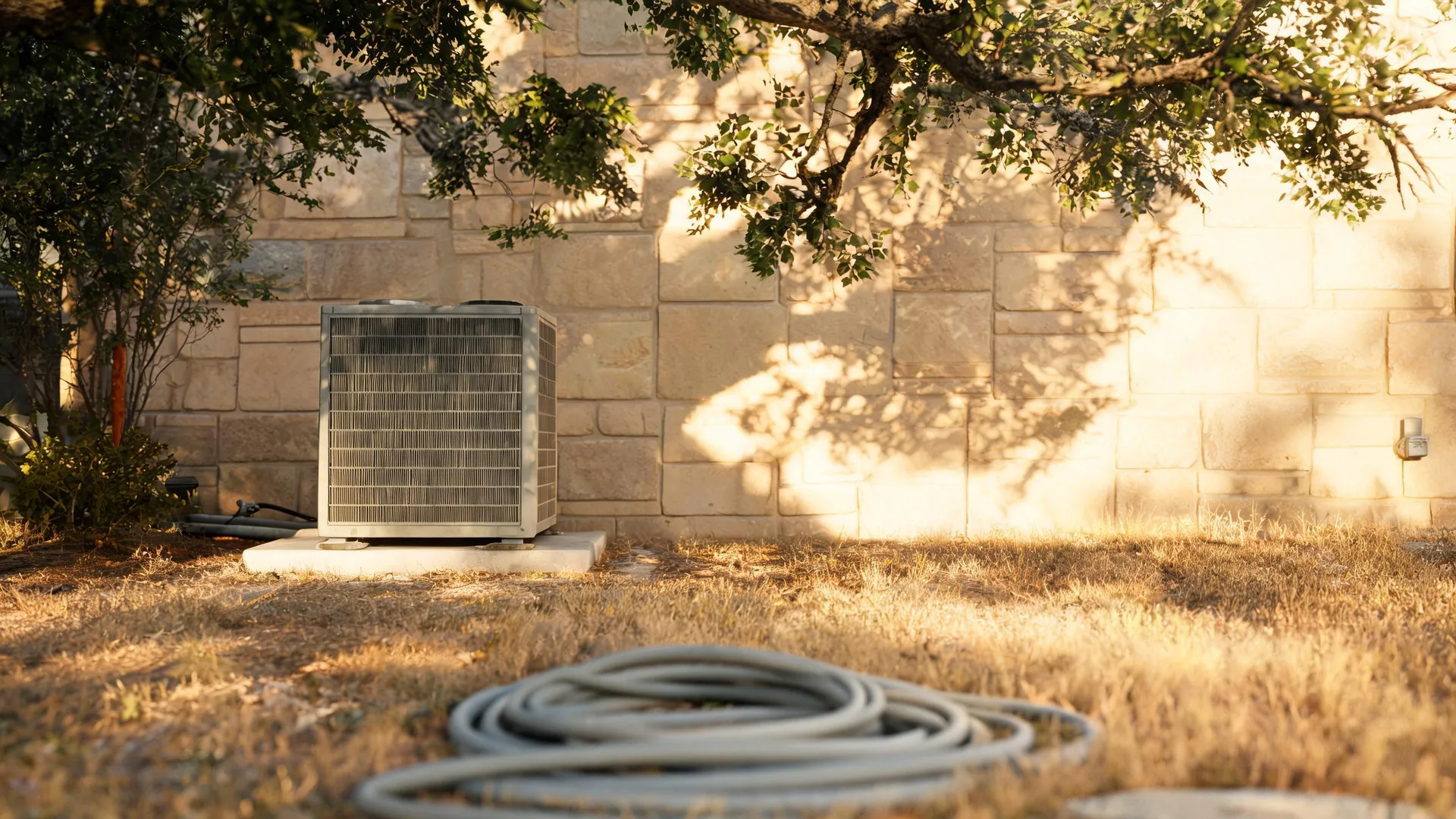
An outdoor air conditioning condenser unit mounted on a concrete pad surrounded by gravel, photographed against a partly cloudy blue sky.

Age isn't the diagnosis

If your AC came with the house and the house is newer, age isn't what's wrong with it. A capacitor or a contactor can fail in a unit a few years old the same as one much older. Have the tech find the actual part before anyone talks about replacing the system.

The sounds that mean something is wrong

A grinding or squealing noise usually means a motor bearing is going out. A loud bang when the compressor kicks on can mean a loose or broken part inside it. Clicking that repeats without the unit starting points to a failed capacitor or relay. None of these get quieter on their own.

What to do with what you hear

Shut the system off at the thermostat if you hear grinding, banging, or the breaker tripping. Running it longer can turn a bad capacitor or a worn bearing into a ruined compressor. Warm air or weak airflow is not an emergency in the same way, but it still means something has failed and will not fix itself.

An outdoor air conditioning condenser unit mounted on a concrete pad next to a blue-sided residential house at sunset.

A new air conditioner would save little on running costs in Dakota County, so the repair decision comes down to the unit's condition.

  • A new one at the federal minimum, 13.4 SEER2$170 a year
  • An older air conditioner$180 a year

Estimates for a typical Dakota County home, compared with an older unit built to the previous federal minimum, from EIA household energy data, Minnesota fuel prices and NOAA climate normals. Your home will differ.

Repair makes sense when a part like a capacitor or contactor has failed.

Replacement makes sense when the compressor has failed or the system uses R-22 refrigerant, which is no longer made.

Most of the time, repair is the right call. A capacitor, a contactor, a fan motor, a blower motor. Each one fails on its own and gets replaced on its own without touching the rest of the system. Replacing the whole unit makes more sense when the compressor itself is failing. That part is not sold separately, and it costs too much to replace on its own to make sense. It also makes sense when a tech keeps coming out for a different failure every few months. That pattern means the system is wearing out all over, not that one part let go. Short of that, a unit that has cooled a house for years does not stop being worth fixing just because something finally broke.