






A row of dark gray gabled houses behind a trimmed hedge and mowed lawn, framed by large leafy trees under an overcast sky.

AC Repair in Hutchinson, MN

Tell us about the job

Takes about a minute. No obligation.

RepairCentral ACMcLeod County, MN
Step 1 of 2

What ZIP code is the job in?

Half the homes in McLeod County were built in 1979 or later. If yours is one of them, the air conditioner probably isn't original to the house, but it's likely a newer system compared to what's running in a lot of homes around here. A newer system still has real working life in it. That changes the math on a repair. Replacing a unit that has years left in it rarely makes sense when a fix will do the job.

3 months
June through August, your air conditioner is on duty
80°F
the average summer afternoon it cools against
44 hail events
in ten years, and hail bends the fins on outdoor coils
50 wind events
in ten years, and wind drives debris into outdoor units
Isometric cutaway illustration of a small house showing interior rooms, ductwork, an indoor air handler, and an outdoor condenser unit connected by lines, on a plain white background.
Your air conditioner works hardest from June through August.

NOAA nClimDiv, 1991–2020 normals

A compressor straining against a bad capacitor draws more current every minute it runs.

Shutting it off until the part gets replaced costs a lot less than running it until the compressor itself fails.

Three months of work a year, not six

Cooling runs June through August
Summer afternoons average 80°F
50 damaging wind events from 2015 to 2024
May is the month to check itCooling starts in June here, and a weak part usually shows itself in the first week of real heat.

A capacitor failure is one of the most common reasons a condenser stops cooling. It stores a charge that gives the compressor and fan motor the push they need to start, and over time the capacitor loses its ability to hold that charge. A failing one often shows up as a unit that hums but doesn't start, or a fan that spins slow. Contactors wear out too, from the constant making and breaking of the electrical connection every time the thermostat calls for cooling. Refrigerant leaks are another common cause, usually at a fitting or coil, and unlike a worn part, low refrigerant means something is leaking and needs to be found, not just topped off. Dirty coils make the whole system work harder than it should, and that extra strain shortens the life of the compressor itself, which is the part nobody wants to replace.

A light workload like this is usually worth fixing

Three months of real work a year is not much to wear out a compressor. If yours is acting up, that points to a bad part or a few years of buildup, not a machine that's worn out. Worth getting it looked at and fixed.

Find a contractor
A man in a cap, dark shirt and tan work pants, seen from behind, carries a worn duffel bag as he climbs steps toward a dark green front door beside a potted shrub.
A gray cylindrical air conditioning condenser unit mounted on a concrete pad next to a light-colored vinyl-sided house exterior.

One day, logged against a short working year

This clip runs one day for this machine, start to finish. Multiply that by the months it actually works and the picture changes. A system here spends most of the year sitting idle, not running. Half the homes in this county were built in 1979 or later, so a lot of the units behind that glass have had fewer years, and fewer of these daily cycles, to put wear on the compressor. A short working season and a young system together mean a part giving trouble now is more likely the reason, not old age catching up with the machine.

Check the thermostat and the breaker first

Set the thermostat below room temperature and listen for the system to kick on. If nothing happens, check the breaker panel for a tripped switch and the furnace or air handler for a power switch that may have been bumped off. Some outdoor units also have a disconnect box mounted on the wall right next to them, and it needs to be pushed in all the way.

Look at the filter and the outdoor unit

Pull the air filter and hold it up to a light. If you can't see light through it, air isn't moving through it either, and that alone can make a system struggle or freeze up. Walk outside and look at the condenser unit for leaves, grass clippings, or anything blocking the sides where it pulls air in. If the coil fins are packed with debris, clearing them by hand can bring a weak system back before anyone has to open it up.

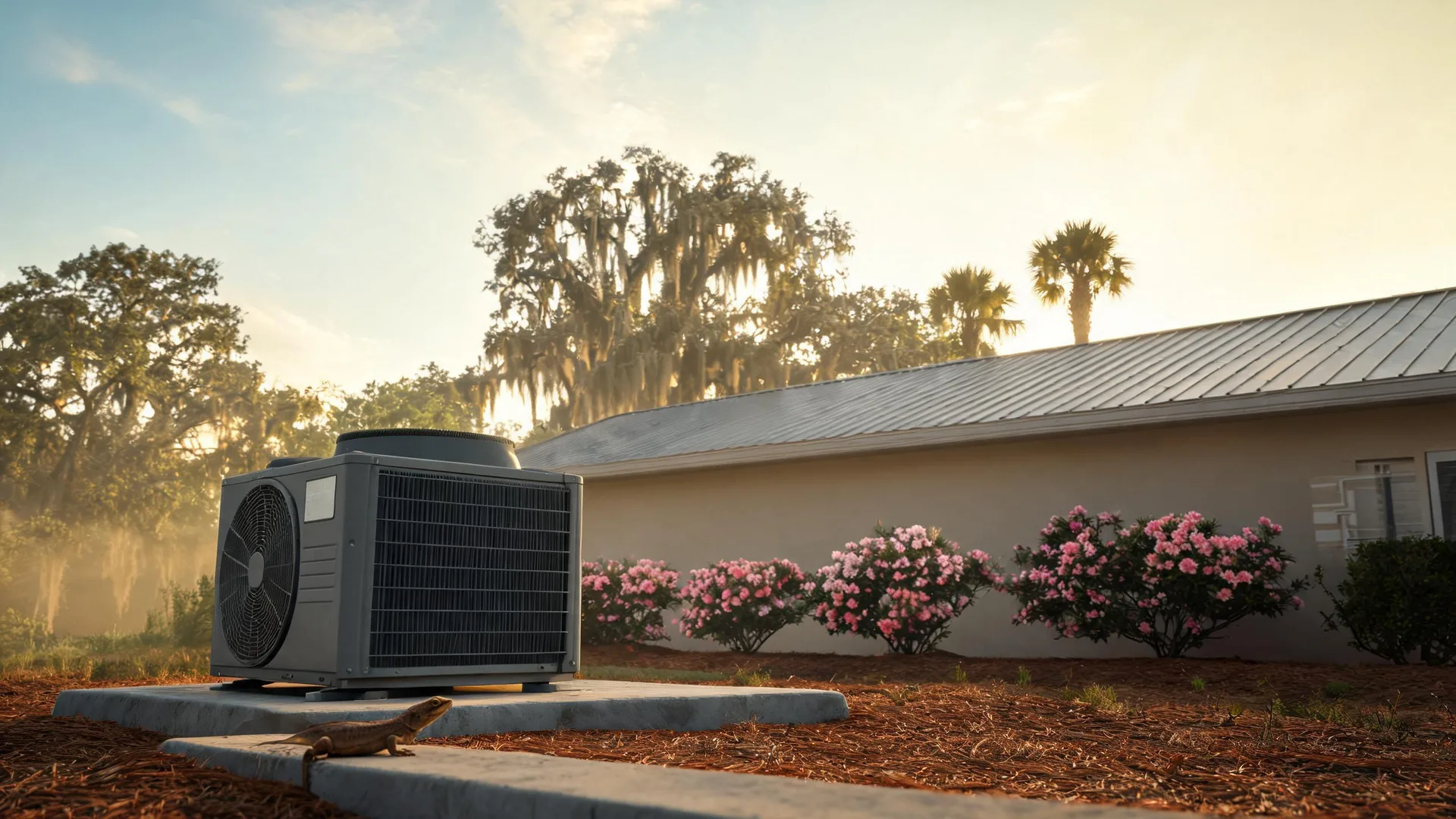
An outdoor air conditioning condenser unit installed beside the exterior wall of a blue vinyl-sided house at sunset.

A new air conditioner would save little on running costs in McLeod County, so the repair decision comes down to the unit's condition.

  • A new one at the federal minimum, 13.4 SEER2$160 a year
  • An older air conditioner$170 a year

Estimates for a typical McLeod County home, compared with an older unit built to the previous federal minimum, from EIA household energy data, Minnesota fuel prices and NOAA climate normals. Your home will differ.

Repair makes sense when a part like a capacitor or contactor has failed.

Replacement makes sense when the compressor has failed or the system uses R-22 refrigerant, which is no longer made.

A diagnostic visit starts with questions, not tools. What's it doing, when did it start, has it happened before. Then the tech checks the thermostat call and watches what the system actually does when it's asked to run. If the outdoor unit isn't starting, they'll test the capacitor and contactor before anything else, since those fail more than any other part out there. If it's running but not cooling, next comes refrigerant pressure and the coils, since a dirty coil can look like a refrigerant problem until it's cleaned. Electrical readings come with a meter, not a guess, because a part can look fine and still be bad. Once the cause is found, the tech should be able to show it, not just name it.