A row of dark-sided buildings with brown shingled gable roofs behind trimmed hedges, with a mown lawn in the foreground and leafy trees under an overcast sky.

AC Repair in East Gull Lake, MN

Tell us about the job

Takes about a minute. No obligation.

RepairCentral ACCass County, MN
Step 1 of 2

What ZIP code is the job in?

A weak compressor works harder to keep up

If the compressor is struggling, a low charge or a failing capacitor forces it to run longer to reach the thermostat setting. That extra strain heats up the windings and wears the start components faster than they'd wear otherwise.


Ice on the coil spreads the damage

Warm air blowing where cold air should be often means the evaporator coil is icing over. Running the system in that state pushes liquid refrigerant back toward the compressor instead of letting it evaporate, and refrigerant isn't supposed to reach the compressor as a liquid.

2 months
July through August, your air conditioner is on duty
77°F
the average summer afternoon it cools against
106 hail events
in ten years, and hail bends the fins on outdoor coils
107 wind events
in ten years, and wind drives debris into outdoor units
Isometric line illustration of a cutaway single-story house showing interior rooms, ducted air handler, ceiling ductwork, and an outdoor condenser unit connected by refrigerant lines.
Your air conditioner works hardest from July through August.

NOAA nClimDiv, 1991–2020 normals

Your AC only earns its keep in July and August, and even then the afternoon high is just 77 degrees.

A compressor that light on work doesn't wear out fast, so most repairs here bring back a system worth keeping.

Two months of work a year, so trouble in July usually means one weak part, not a dying system

Cooling runs July through August
Summer afternoons average 77°F
107 damaging wind events from 2015 to 2024

Worth fixing before the season's two busy months

Get the repair done and the system has another easy season ahead of it, June through August and done for the year. Have a contractor take a look.

Find a contractor
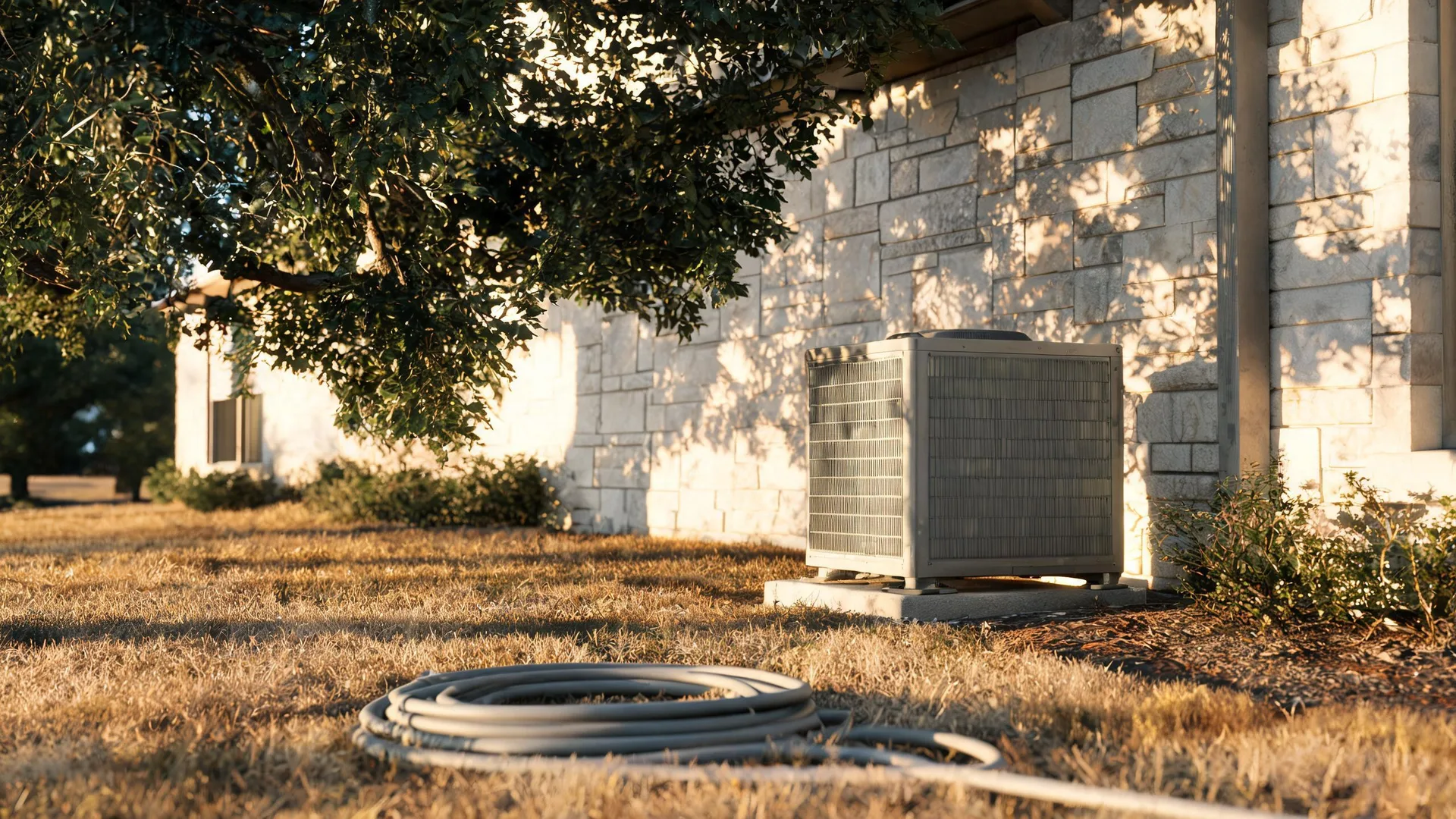
A gray residential air conditioner condenser unit mounted on a concrete pad in an open grass field.

What to listen for before the busy stretch hits

A system that barely runs still needs to be caught early when something's off. Short cycling is the one to listen for. The unit kicks on, runs a few minutes, shuts off, then starts again before the room's caught up. That's hard starting, and it's rough on the compressor every time it happens. Watch the airflow too. If the vents go from strong to weak over a few days, something's restricting it, whether that's at the coil or further back in the system. A hissing or bubbling sound near the indoor unit points to refrigerant escaping, not just running low on its own. None of these fix themselves by running the system less. Left alone, a failing capacitor turns into a dead compressor by the next time the system gets real use.

Check the thermostat first

Make sure it's set to cool and the setting is actually below room temperature. A dead thermostat battery or a setting bumped by accident looks exactly like a bigger problem.

Look at the outdoor unit

Walk outside and see if the fan is spinning and air is moving through the fins. Leaves, grass clippings or a fallen branch against the cabinet can block airflow enough to shut the whole system down.

An outdoor air conditioning condenser unit positioned on a concrete pad next to a blue-sided house, surrounded by green shrubs and flowering hydrangeas at sunset.

A new air conditioner would save little on running costs in Cass County, so the repair decision comes down to the unit's condition.

  • A new one at the federal minimum, 13.4 SEER2$90 a year
  • An older air conditioner$100 a year

Estimates for a typical Cass County home, compared with an older unit built to the previous federal minimum, from EIA household energy data, Minnesota fuel prices and NOAA climate normals. Your home will differ.

Repair makes sense when a part like a capacitor or contactor has failed.

Replacement makes sense when the compressor has failed or the system uses R-22 refrigerant, which is no longer made.

A compressor doesn't fail out of nowhere. Something smaller goes first. A capacitor weakens, a contactor pits, a fan motor starts dragging, and the compressor ends up carrying that extra load until it gives out too. That's why repair usually makes sense. A tech is replacing the part that actually broke, not the one that happened to be running when it broke. A unit that's been reliable and just hit a bad part is worth fixing. One that's needed a few visits already, where each repair seems to expose the next weak spot, is telling you the compressor's margin is gone. A tech can check how hard the compressor is working relative to what it should take, and that tells you more than how old the unit is or how it sounds.