





A nighttime view of a tree-lined residential street with illuminated two-story brick houses and street lamps.

AC Repair in Duluth, MN

Tell us about the job

Takes about a minute. No obligation.

RepairCentral ACSt. Louis County, MN
Step 1 of 2

What ZIP code is the job in?

Duluth doesn't ask much of an air conditioner. Afternoon highs average 76 degrees across June, July and August, and even then no month really calls for cooling. A system here isn't cycling on hard, day after day, trying to keep up with heat. That means less wear on the compressor and the coils over the years. So when one starts acting up, it's rarely because the machine was worked too hard. More often it's a part that failed on its own or something that got missed in service, and those are usually worth fixing rather than replacing.

76°F
the average summer afternoon it cools against
215 hail events
in ten years, and hail bends the fins on outdoor coils
284 wind events
in ten years, and wind drives debris into outdoor units
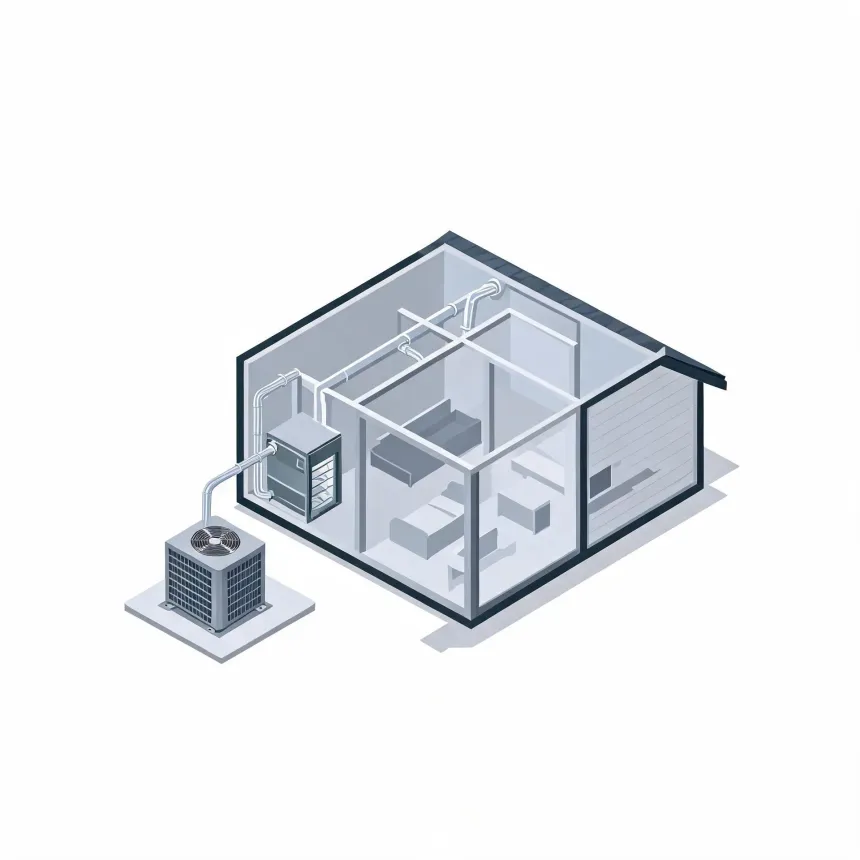
Isometric grayscale illustration of a cutaway house showing interior rooms, ductwork, an indoor air handler, and an outdoor condenser unit on a pad connected by lines.
Your air conditioner works hardest from July through August.

NOAA nClimDiv, 1991–2020 normals

A weak capacitor still lets the compressor start, just slower and rougher each time.

Left alone, that slow start is what burns the compressor out, and that's a bigger job than swapping a capacitor.

St. Louis County gets rough weather, but none of it targets your AC

695 severe weather events from 2015 to 2024
13% of homes statewide lost power a day or more in 2024
284 damaging wind events from 2015 to 2024

A capacitor or a contactor doesn't wear out from heat here, it just gets old. That's worth knowing when you're deciding what to do next. Get the part replaced and the unit runs fine again, often for years after. There's no reason to treat a quit part as a sign the whole system is done. If the compressor and coils were never run hard, chances are they've still got life left in them.

Worth knowing how old your system is before you fix it

Half the homes in St. Louis County were built in 1962 or earlier. If your AC came with a house that old, it's probably not the original unit, but it's worth finding out how old it actually is. A repair makes sense when the system has years left in it. Ask whoever comes out to look for a straight answer on that before you pay for anything.

Find a contractor
A man in a cap, dark long-sleeved shirt and brown work pants climbs porch steps toward a dark green front door, carrying a canvas tool bag filled with hand tools.
A gray residential air conditioner condenser unit mounted on a concrete pad in an open grass field.

It's not the hours that run up, it's the cycles

Most AC failures start small and electrical, not big and mechanical. A capacitor weakens, a contactor's contacts pit and burn, a run winding gets weak from age, and the symptom shows up as a unit that hums but won't start, or short cycles, or won't kick on at all. None of that comes from the compressor wearing out. The compressor and coils tend to outlast the smaller parts around them, since those parts carry the electrical load every single cycle, hot day or not. Time in service is what wears a capacitor down, not how hard the system worked that year.

What you'll notice first

Warm air out of the vents when the thermostat says it should be cold. A unit that clicks and hums but doesn't start. Short cycles, where it kicks on and off every few minutes instead of running a full cooling cycle. Ice on the indoor coil or the line running to the outdoor unit. Any of these is worth a call before the next hot stretch, not after.


What the noise is telling you

A grinding or rattling from the outdoor unit usually means a motor bearing or a fan blade hitting something it shouldn't. A loud click with no start points to a contactor or capacitor. A hissing or bubbling sound can mean refrigerant escaping from a line, which also means the coil it feeds won't get cold the way it should. The sound almost always points to a specific part, not the whole system.

Overhead view of a gray residential air conditioning condenser unit mounted on a concrete pad beside a house with asphalt shingle roofing.

A new air conditioner would save little on running costs in St. Louis County, so the repair decision comes down to the unit's condition.

  • A new one at the federal minimum, 13.4 SEER2$50 a year
  • An older air conditioner$60 a year

Estimates for a typical St. Louis County home, compared with an older unit built to the previous federal minimum, from EIA household energy data, Minnesota fuel prices and NOAA climate normals. Your home will differ.

Repair makes sense when a part like a capacitor or contactor has failed.

Replacement makes sense when the compressor has failed or the system uses R-22 refrigerant, which is no longer made.

A diagnostic starts outside at the unit, not with a clipboard of guesses. The tech checks for power at the disconnect, then checks the capacitor and contactor before touching anything else, since those fail more than any other part. Refrigerant pressure gets checked on the lines. Amp draw gets checked on the compressor and fan motor. The tech also checks the temperature of the air going into the system against the air coming out, since that tells you whether the system is actually cooling or just moving air around. Inside, the coil and the drain line get a look too, since a clogged line backs up and shuts the system down on its own as a safety measure. By the time all that's checked, the failing part is usually obvious, and so is whether it's safe to run until it's replaced.