




Aerial view of a gray outdoor air conditioning condenser unit mounted on a concrete pad next to a house with vinyl siding.

AC Repair in Chaska, MN

Tell us about the job

Takes about a minute. No obligation.

RepairCentral ACCarver County, MN
Step 1 of 2

What ZIP code is the job in?

Your air conditioner only has to work three months a year here, June through August. Afternoons average around 80°F, which is mild as summers go. The air itself is lighter than what most of the country deals with too. The dew point averages 59°F across those months, well below what makes a summer feel heavy, and that's the number that counts. A compressor working against thick, humid air runs harder and wears faster. Yours isn't fighting that fight. So when something goes wrong, it's rarely because the machine has been pushed hard for years. More often it's a part that failed or something that got skipped along the way, and that kind of problem is usually worth fixing.

3 months
June through August, your air conditioner is on duty
80°F
the average summer afternoon it cools against
26 hail events
in ten years, and hail bends the fins on outdoor coils
51 wind events
in ten years, and wind drives debris into outdoor units
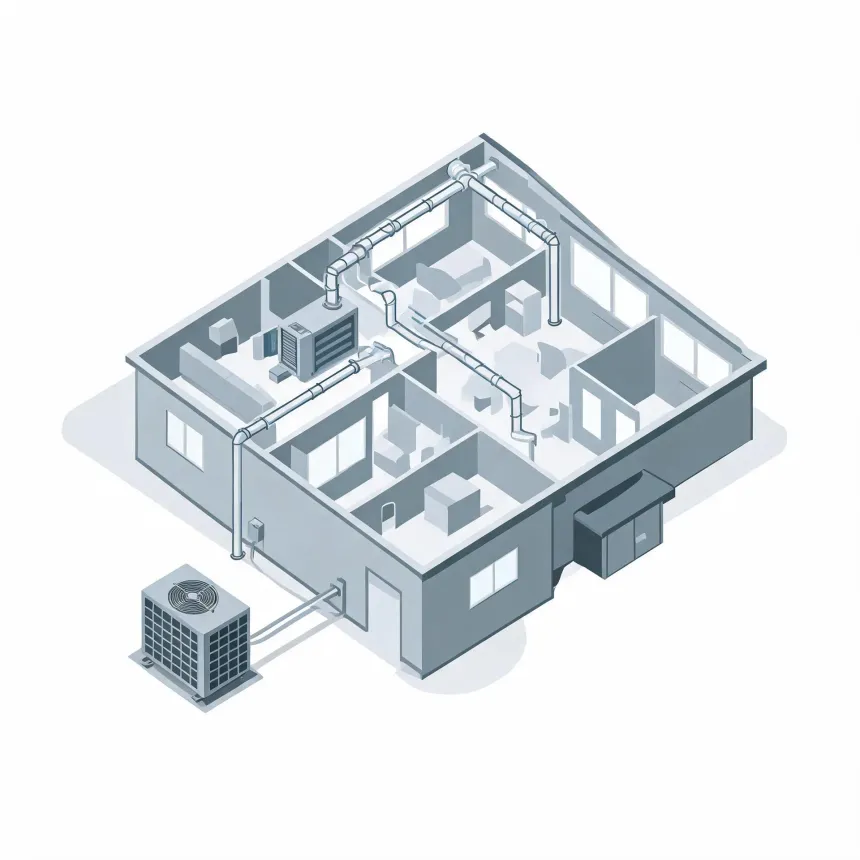
Isometric grayscale illustration of a cutaway house showing interior rooms, ceiling ductwork connected to an indoor air handler, and an outdoor condenser unit linked by lines along the exterior wall.
Your air conditioner works hardest from June through August.

NOAA nClimDiv, 1991–2020 normals

Most AC failures start with one worn part, not a system giving out.

Find the failed part and the rest of the unit usually still has years left in it.

Half the homes here were built in 1996 or later, and the AC inside them is just as young

Half the homes here were built by 1996
Cooling runs June through August
Summer afternoons average 80°F

Before anyone comes out, check the thermostat is set to cool and the setting is below room temperature. Go to the breaker box and make sure the breaker for the outdoor unit hasn't tripped. Look at the air filter. If it's gray and clogged, airflow gets choked off and the whole system struggles, so swap it if it looks bad. Walk outside and look at the condenser. If the fan isn't spinning, or you hear a hum but nothing moves, that's worth telling the tech before they arrive. Check for ice on the refrigerant lines or the indoor coil. If you find any, switch the system off and let it thaw rather than running it more, since ice usually means airflow or charge trouble that gets worse the longer it runs.

If your AC came with the house, it's probably worth fixing

Most houses here are standing in 1996 or later, so the system inside is young too. A repair on a unit that age almost always makes sense. Get the part fixed and the rest of the system keeps running.

Find a contractor
A gray metal air conditioning condenser unit mounted on a concrete pad in a flat grassy field under a partly cloudy sky.

June is when a weak part shows itself

June is when it has to prove itself. The unit sits idle most of the year, then gets switched on for a June afternoon and has to run right the first time. A capacitor that weakened over the winter, a contactor that corroded a little, a low refrigerant charge that was never quite right, none of that shows up until the system is asked to work. That's usually when a repair call comes in, not in the middle of August. If yours is struggling right at the start of summer, it's not a sign of a system wearing out. It's more likely one part that didn't make it through the off season.

A weak part gets worse under load

A capacitor that's starting to fail won't just stay weak, it degrades faster every time the compressor leans on it. A refrigerant leak lets a little more refrigerant out each day the system runs. A failing contactor arcs a bit more with every cycle until it fails to close at all. Running the unit doesn't give these parts a chance to hold steady. It pushes them along.


Running low on charge strains the compressor

When refrigerant charge is low, the compressor has to work harder to move heat, and it runs hotter than it was built to. Ice can form on the indoor coil, which blocks airflow and makes the compressor work harder still. Left alone, that heat and strain is what turns a repair into a compressor replacement. Shutting the system off when you see ice or hear it struggling protects the one part that's expensive to replace.

Aerial view of a gray central air conditioning condenser unit on a concrete pad next to a house with vinyl siding.

A new air conditioner would save little on running costs in Carver County, so the repair decision comes down to the unit's condition.

  • A new one at the federal minimum, 13.4 SEER2$170 a year
  • An older air conditioner$180 a year

Estimates for a typical Carver County home, compared with an older unit built to the previous federal minimum, from EIA household energy data, Minnesota fuel prices and NOAA climate normals. Your home will differ.

Repair makes sense when a part like a capacitor or contactor has failed.

Replacement makes sense when the compressor has failed or the system uses R-22 refrigerant, which is no longer made.

A diagnostic visit starts before the panels come off. A tech will ask what the system is doing, when it started, and whether it happens all the time or just in the afternoon heat. Then they check pressures and temperatures with gauges, because guessing at refrigerant charge gets people in trouble. They'll test the capacitor under load rather than just looking at it, since a capacitor can read fine sitting still and still fail to start the compressor. They'll check the contactor for pitting and the wiring for scorch marks, since a loose connection generates heat long before it fails outright. Airflow gets checked too, at the filter, the coil, and the vents, because a compressor can test fine and still struggle if it isn't moving enough air. By the end you should hear exactly which part failed and why, not just that something did.