






Overhead view of a gray outdoor AC condenser unit on a concrete pad beside a mulched garden bed and a house with vinyl siding.

AC Repair in Brainerd, MN

Tell us about the job

Takes about a minute. No obligation.

RepairCentral ACCrow Wing County, MN
Step 1 of 2

What ZIP code is the job in?

Crow Wing County saw 297 severe weather events between 2015 and 2024. Most of that was wind and hail. Damaging wind hit the county 139 times, and hail came through 120 times, with four tornadoes in the mix too. An outdoor AC unit sits outside through all of it, with nothing but a thin metal case around the coil and fan. Hail dents that case and bends the fins on the coil. Wind throws branches and debris into it. A unit can take a hit like that and still start up and blow cold air, with the damage working against it quietly underneath. Statewide, 13% of households lost power for a day or more in 2024, and a long outage is its own problem for a home that depends on the same system for cooling.

2 months
July through August, your air conditioner is on duty
78°F
the average summer afternoon it cools against
120 hail events
in ten years, and hail bends the fins on outdoor coils
139 wind events
in ten years, and wind drives debris into outdoor units
Isometric line illustration of a cutaway single-story house showing interior rooms, attic ductwork and an air handler, connected by a line to an outdoor condenser unit on a pad.
Your air conditioner works hardest from July through August.

NOAA nClimDiv, 1991–2020 normals

Warm air from the vents, a unit that short cycles, or ice on the line all mean the same thing: something inside isn't working right anymore.

None of those problems fix themselves, and running a struggling system hard enough can take out the compressor next.

Half the homes here were built in 1988 or later, and the systems in them are worth fixing

Half the homes here were built by 1988
Cooling runs July through August
Summer afternoons average 78°F
June is quiet. July finds whatever was already weak.Cooling runs July through August here, and whatever was already weak tends to show itself right at the start.

If your AC is giving you trouble, that doesn't mean it's worn out. A system installed when the house was built, or anytime after, still has working life in it unless something major has failed. Most problems that show up as warm air, short cycling, or a frozen line are single-part failures: a capacitor, a contactor, a low charge from a slow leak. A contractor can check the part against the rest of the system before anyone talks about replacing anything. Fixing what's actually wrong is usually the faster and more sensible path.

A unit that still runs isn't the same as a unit that's fine

If your outdoor unit took a hit from hail or wind and still runs, that's not the same as running fine. Have it checked before the dent in the case or a bent fin turns into a bigger repair.

Find a contractor
A gray residential air conditioning condenser unit mounted on a concrete pad outdoors, surrounded by green grass under a partly cloudy blue sky.

Some of these failures feed on themselves

A refrigerant leak is the clearest case. Keep running the system low on charge and the compressor keeps pumping with less gas than it needs to cool itself. Compressors rely on refrigerant moving through them to carry heat away from the motor and bearings. Starve that flow long enough and the compressor overheats and wears out early, turning a leak repair into a full compressor job. Ice on the line is a warning sign, not a cosmetic issue. Once ice forms, airflow across the coil gets worse, so more ice builds, and the compressor can end up pulling in liquid refrigerant instead of gas. That can bend or break the valves inside it. A failing capacitor behaves the same way. It makes the compressor and fan motor struggle to start, and a motor that struggles to start pulls more current and runs hotter every time it tries. None of this announces itself. The air coming out might still feel cool enough to ignore for another week, while the part underneath is already further gone than it was yesterday.

Check the filter and the thermostat first

A clogged filter starves the coil of airflow and can bring on the same warm-air or icing problems a failing part would cause. Pull it and hold it up to a light. If you can't see through it, that alone could be the issue. Check that the thermostat is set to cool and set below room temperature, and that its batteries aren't dead. These take a minute and rule out the simplest cause before anything else.

Look at the outdoor unit and the breaker, then stop

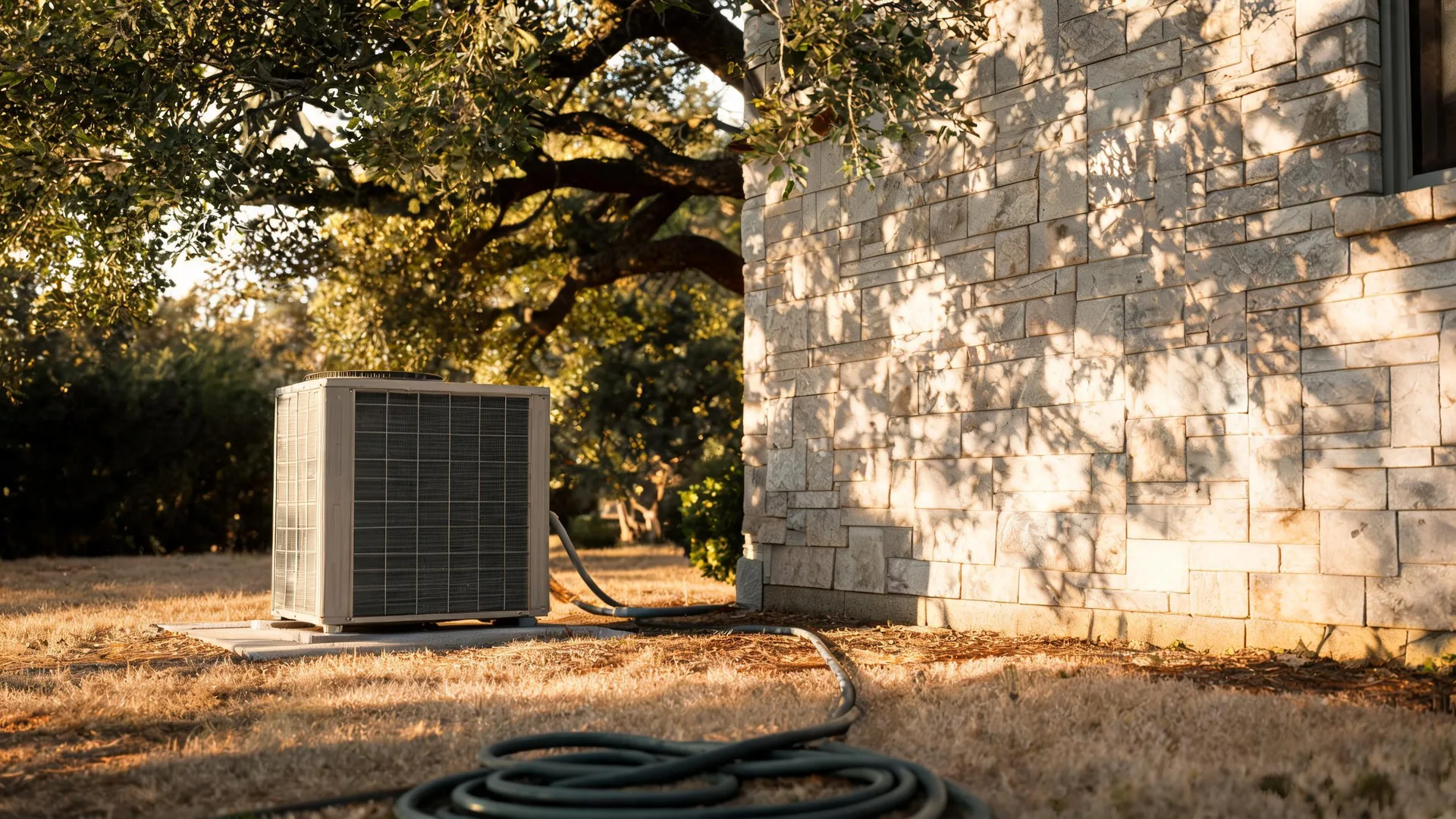
Walk outside and check that the fan is spinning and nothing is pressed against the cabinet. Clear leaves or grass clippings away from the sides if the airflow looks blocked. Check the breaker panel for a tripped switch and reset it once. If it trips again, leave it off and call someone. Don't open the cabinet or touch anything inside it. The refrigerant lines and the electrical parts in there aren't something to handle without training.

An outdoor air conditioning condenser unit mounted on a concrete pad next to a blue-sided residential house at sunset.

A new air conditioner would save little on running costs in Crow Wing County, so the repair decision comes down to the unit's condition.

  • A new one at the federal minimum, 13.4 SEER2$100 a year
  • An older air conditioner$110 a year

Estimates for a typical Crow Wing County home, compared with an older unit built to the previous federal minimum, from EIA household energy data, Minnesota fuel prices and NOAA climate normals. Your home will differ.

Repair makes sense when a part like a capacitor or contactor has failed.

Replacement makes sense when the compressor has failed or the system uses R-22 refrigerant, which is no longer made.

A diagnostic visit starts outside at the unit itself, checking the fan, the coil, and the case for anything bent or blocked before a single tool comes out. A gauge set goes on the lines to check refrigerant pressure, since that number alone points toward a leak, a bad valve, or a compressor working harder than it should. The capacitor and contactor get tested under load, not just looked at, because a capacitor can look fine and still be too weak to start the motor reliably. Electrical connections get checked for corrosion or a loose spot, since those cause intermittent problems that are easy to miss otherwise. Airflow gets checked across the coil too, because a weak reading there can mean a duct problem or a blower issue rather than anything wrong with the refrigerant side. By the end, the findings point to one part or one system, not a guess.