







Aerial view of a residential air conditioning condenser unit mounted on a concrete pad next to a house with vinyl siding and a sliding glass door.

AC Installation in Shakopee, MN

Tell us about the job

Takes about a minute. No obligation.

New system or replacementCentral ACScott County, MN
Step 1 of 2

What ZIP code is the job in?

Gas heats 81.2 percent of homes in Scott County, and most of those same homes cool with central air. That pairing matters at installation time. A central AC system ties into the existing ductwork, so if your furnace and ducts are already in place, adding or replacing the AC is mostly about matching the right size unit to your home and connecting it to what's already there. Electric heat and propane each account for a smaller share here, and homes on those systems still cool the same way, through central air or a ductless setup if there's no duct system to use.

3 months
June through August, your air conditioner is on duty
80°F
the average summer afternoon it cools against
44 hail events
in ten years, and hail bends the fins on outdoor coils
13.4 SEER2
the federal minimum any new unit must meet
Isometric line illustration of a cutaway house showing interior rooms with furniture, ceiling ductwork, an indoor air handler, and an outdoor condenser unit connected by lines.
Your air conditioner works hardest from June through August.

NOAA nClimDiv, 1991–2020 normals

Summer here lasts about three months, June through August, with afternoon highs averaging near 80.

A system that only has to work hard three months a year doesn't need to be the highest-efficiency unit on the lot.

May is the month to put in a new AC, not June

Cooling runs June through August
Summer afternoons average 80°F
53 damaging wind events from 2015 to 2024
A standard system is the right call hereMinnesota power runs 15.45 cents a kilowatt-hour, nothing that pushes you toward a pricier unit

Ask for the load calculation, not just a quote. A contractor should size your AC to your house, the windows, the insulation, the square footage, not swap in whatever matched the old unit. Ask what happens to your existing ductwork too. If a duct run is too small for the new system's airflow, you'll hear it as a whistle at the vents or feel it as a room that never quite cools. Ask how they're handling the line set, whether it's being reused or replaced, since an old line set can carry contamination into a new compressor. And ask what the warranty actually covers. Parts, labor, or both, and for how long. Bids that look the same on price can carry very different coverage underneath.

Pick a system built for three months of work

Three months of summer work is not hard use. A standard system installed now will keep up fine, and with ductwork already in place for most homes here, putting it in is straightforward.

Find a contractor
A man in a cap, dusty work shirt and tan trousers walks up front steps toward a dark green panelled door, carrying a canvas tool bag with hand tools, beside a potted shrub.
An outdoor air conditioning condenser unit mounted on a concrete pad surrounded by gravel, photographed against a partly cloudy blue sky.

The old unit doesn't get reused, just removed

The old condenser doesn't get hauled off still running. By the time someone pulls it out, the compressor has usually lost some of its original capacity or the refrigerant charge has drifted off from a slow leak somewhere in the coil. That's why a side by side with a new unit never looks fair. Age alone wears down seals and bearings even in a system that got serviced every year. If yours is on its last stretch, a tech disconnects the line set, recovers the refrigerant so it doesn't vent to open air, and disconnects the electrical whip at the disconnect box before the old cabinet comes off the pad. None of that touches your ductwork or the pad itself, both usually get reused. What goes away is just the compressor, the coil, and the old refrigerant charge inside them.

The unit itself is only part of the bid

A condenser sitting outside is one line item. Labor to set it, charge the line set, wire the disconnect, and commission the system is another. Bids with the same equipment can still land far apart once you look at how much of the price is the box and how much is the work to make it run right.

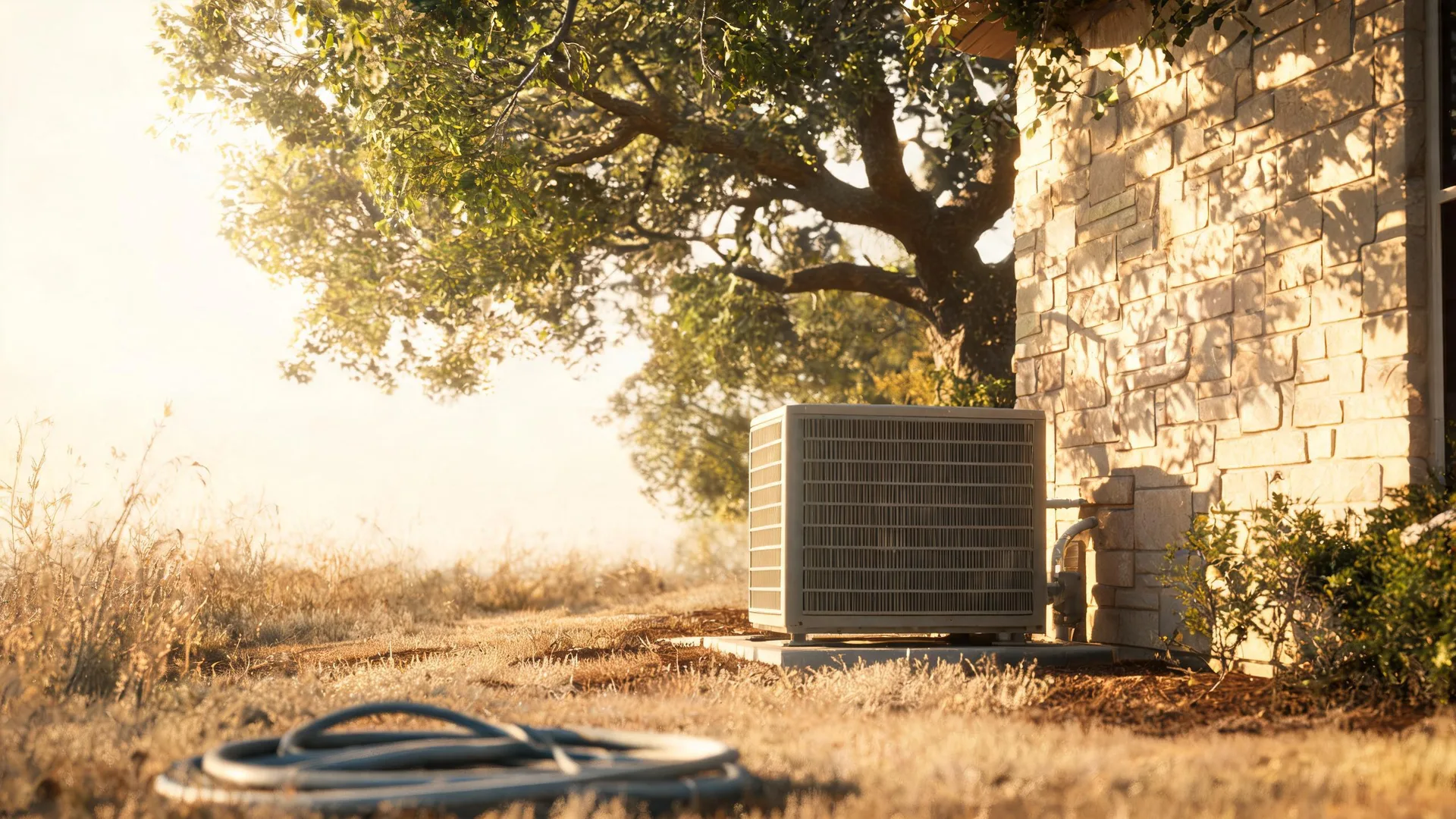
Ductwork changes the number fast

If the existing ducts can handle the new system's airflow, installation is a straight swap. If a return is undersized or a trunk line was never right for the house, a contractor has to modify it before the new system can perform, and that work costs more than the swap itself. It's worth knowing which job you're getting before you compare prices.

Overhead view of an air conditioning condenser unit on a concrete pad next to a house with asphalt shingle roofing and vinyl siding.

Going above the federal minimum saves little here, about $20 a year.

  • A higher-efficiency unit$150 a year
  • A new unit at the federal minimum, 13.4 SEER2$170 a year

Estimates for a typical Scott County home, from EIA household energy data, Minnesota fuel prices and NOAA climate normals. Your home will differ.

The efficiency number on the label, the SEER2 rating, tells you how much cooling you get for the electricity you put in. A higher number means the compressor is doing more with less, through a variable-speed motor or a bigger coil, not anything more mysterious than that. That number is measured assuming the system runs correctly for its full rated capacity, which means an oversized unit on the right label still cycles on and off too fast to pull moisture out of the air. A unit charged by guess instead of the manufacturer's exact weight won't hit its rated number either, no matter what the sticker says. The label tells you what the equipment is capable of. Sizing and installation decide whether you actually get it.