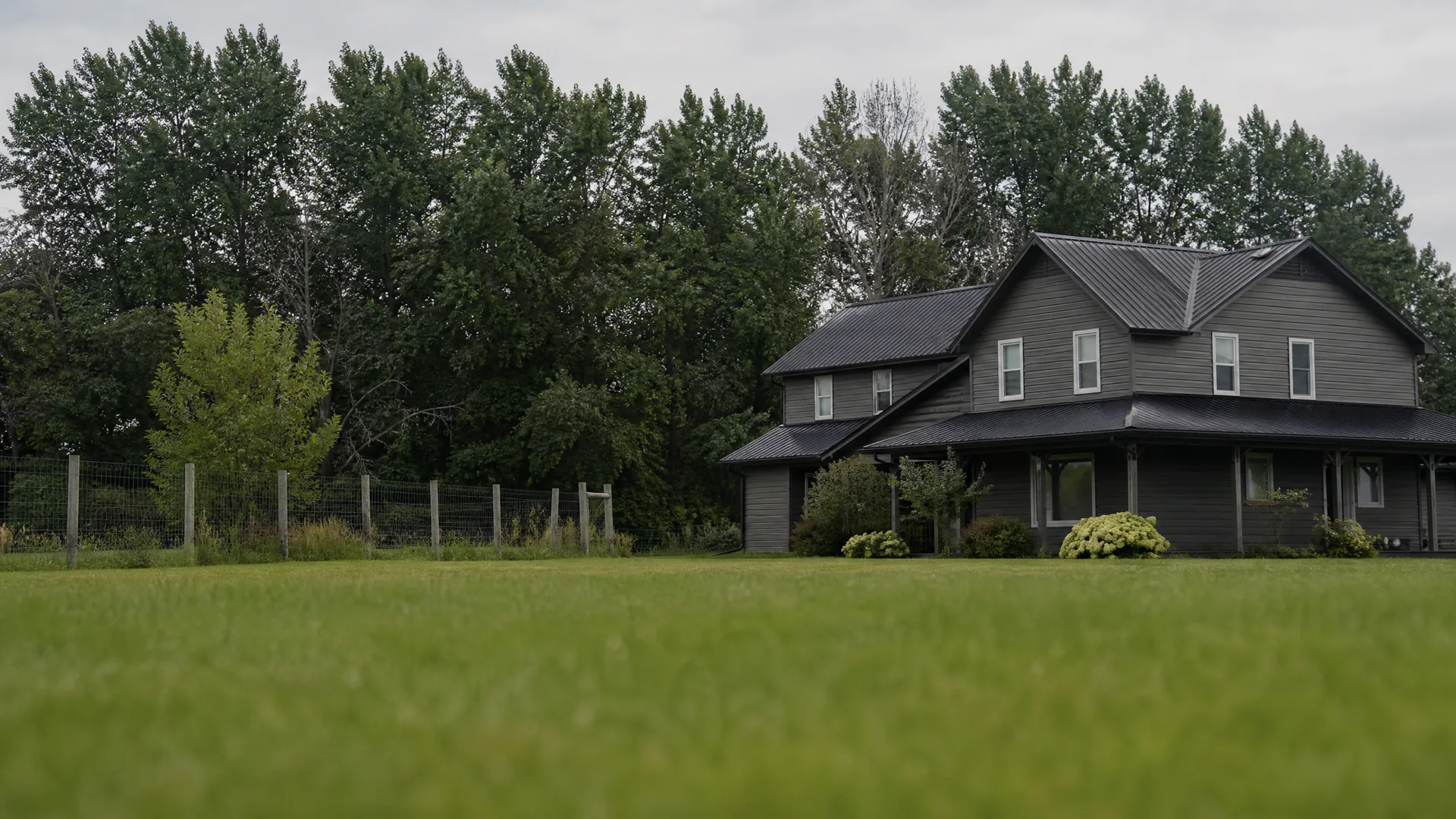
A dark-clad two-story house with a metal roof and covered porch stands behind a mown lawn, with deciduous trees and a wire fence to the left under an overcast sky.

AC Installation in East Grand Forks, MN

Tell us about the job

Takes about a minute. No obligation.

New system or replacementCentral ACPolk County, MN
Step 1 of 2

What ZIP code is the job in?

Gas is the common setup here

Utility gas heats 41.7% of homes in Polk County, more than any other fuel. An AC installation in a home like that usually means adding cooling to a gas furnace, matching the new coil and condenser to work with the existing ductwork and blower.


Check what your home runs on first

Electricity, propane and fuel oil heat the rest of the homes in the county, and each pairs with AC differently. If your system came with the house, confirm the furnace or air handler type before an installer specs the new equipment.

2 months
July through August, your air conditioner is on duty
78°F
the average summer afternoon it cools against
98 hail events
in ten years, and hail bends the fins on outdoor coils
13.4 SEER2
the federal minimum any new unit must meet
Isometric line illustration of a cutaway house showing interior rooms with furniture, ductwork leading to an indoor air handler, and an outdoor condenser unit connected by a line set.
Your air conditioner works hardest from July through August.

NOAA nClimDiv, 1991–2020 normals

Minnesota homes paid 15.45 cents per kilowatt-hour in 2024.

A correctly sized system costs less to run here than one that's oversized or underpowered for the home.

Polk County's weather is rough on power lines, not on AC sizing

353 severe weather events from 2015 to 2024
13% of homes statewide lost power a day or more in 2024
136 damaging wind events from 2015 to 2024
Your AC has to fit the house that's already thereHalf the homes in Polk County were built in 1971 or earlier.

Cooling in Polk County runs from July through August, about two months a year. June is the quiet month right before it, and that makes it the right time to put in a new system. An installer can size the unit, run the lines and test it with no pressure to rush the job before a hot stretch hits. Wait until July and a failed system means working around whatever the installer's schedule allows, not yours. Getting it done in June also means the system is already proven out before the two months it actually has to work.

Short, mild summers mean this system won't be pushed hard

Two months of real cooling a year, with afternoon highs averaging 78 degrees, is not a hard season on an AC system. That's a short, mild stretch for the equipment to earn its keep. A well matched system built for reliability will handle it fine without the top-tier efficiency rating.

Find a contractor
A gray residential air conditioning condenser unit mounted on a concrete pad outdoors, surrounded by green grass under a partly cloudy blue sky.

Two months a year, that's the job

Skip the top-tier efficiency tier when you're comparing quotes. A unit built to run reliably for two months of real cooling a year will do the job here. Put the money into correct sizing and a clean installation instead, since that's what decides how the system runs in July and August.

Sizing is a calculation, not a guess

An installer works out the cooling load by looking at the square footage, the window area and orientation, the insulation, and the ceiling height. That math points to a specific capacity. Pick a unit off a chart by square footage alone and you skip the parts of the calculation that actually change the answer.

Bigger isn't safer, it's worse

An oversized condenser cools the air fast and shuts off before it pulls the moisture out, so the house feels clammy even at the right temperature. It also cycles on and off more, which wears the compressor harder than a system that runs a longer, steady cycle. The unit that matches the load is the one that runs the way it's built to run.

Aerial view of a residential air conditioning condenser unit mounted on a concrete pad next to a house with vinyl siding and a sliding glass door.

Going above the federal minimum saves little here, about $20 a year.

  • A higher-efficiency unit$90 a year
  • A new unit at the federal minimum, 13.4 SEER2$110 a year

Estimates for a typical Polk County home, from EIA household energy data, Minnesota fuel prices and NOAA climate normals. Your home will differ.

Installation day starts with the old equipment coming out, not the new one going in. The condenser gets disconnected and hauled off, the old coil comes out of the plenum, and the line set gets cut loose. Then the installer checks what they're actually connecting to. The ductwork, the electrical disconnect, the condensate drain all have to work with the new unit, and sometimes a fitting or a breaker needs to be swapped to make that true. The new coil goes in above or beside the furnace, the condenser gets set on a pad outside, and the line set between them gets run, connected, and sealed. Once it's charged with refrigerant and the power's on, the installer runs the system and checks the pressures and the temperature split at the vents before calling it done.