Gas heat is the default here
Just over half of homes in Isanti County heat with utility gas, and most of the rest run on propane. Straight electric heat is far less common.
Takes about a minute. No obligation.
Just over half of homes in Isanti County heat with utility gas, and most of the rest run on propane. Straight electric heat is far less common.
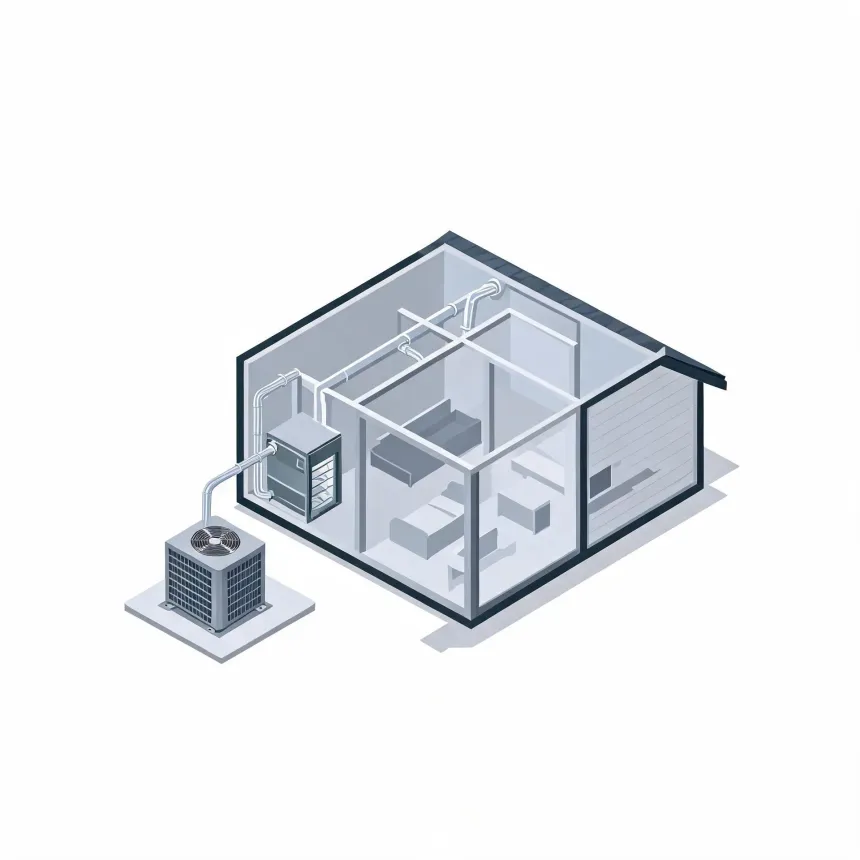
Whatever heats your home, a central air system pairs with the furnace's blower to move cool air through the same ducts. The installer still needs to size the unit to your house and check that the ductwork can handle it.
NOAA nClimDiv, 1991–2020 normals
Cambridge gets three months of real cooling weather, June through August.
An AC here does not need to be built for heavy daily use, just sized right for your house.




A contractor sizes an air conditioner with a load calculation, not a tape measure on the old unit. It weighs square footage, ceiling height, window area and direction, insulation, and how many people typically use the space. Too big and the unit cools the air fast but shuts off before it pulls the moisture out, so the house feels cool and clammy at once. It also cycles on and off more than it should, and that short cycling wears on the compressor over time. Too small and it runs constantly on the hottest days, straining to keep up and never quite getting there. The right size runs long, steady cycles that bring down both temperature and humidity, which is the whole point of the thing.
Pick a system that's built to last, not one built to work hard. With three months of real cooling and afternoons averaging 79°F, a standard unit sized right for your house will do the job for years.
Find a contractorThe unit itself is only part of the bill. Ductwork drives a lot of it. If the existing ducts are the right size and in good shape, the installer connects to them and moves on. If they're undersized, leaky, or routed poorly, bringing them up to what the new system needs adds real labor. Where the lineset runs between the indoor coil and the outdoor unit matters too. A straight shot through an easy wall costs less than a long run through finished space that has to be opened up and patched. The disconnect, the breaker, and the wiring to the outdoor unit need to match what the new system draws, and older electrical sometimes needs work to get there. Where the unit sits counts as well. Pouring a new pad or building a stand costs more than setting it on one that is already there and level. None of this shows up on the sticker price of the equipment itself. It shows up when the installer walks the house and sees what has to happen to make the new system work with what's already there.
A straight swap means the installer disconnects the old condenser, cuts it loose from the lineset, and takes it when the job's done. The refrigerant gets recovered first. It's against the law to vent it into the air, so a tech draws it out into a tank before the old lines ever get cut.
The outdoor unit isn't the only piece being replaced. The evaporator coil sits in the plenum above or beside the furnace, and it comes out with the old system. A new condenser matched to an old, worn coil won't hit the capacity or efficiency it's rated for, so most installers replace both at once.
Estimates for a typical Isanti County home, from EIA household energy data, Minnesota fuel prices and NOAA climate normals. Your home will differ.
Install day starts with the old system coming out and the new one going through its paces, not just a swap and a handshake. Once the condenser is set and the coil is in, the installer pulls a vacuum on the lineset to drive out air and moisture before any refrigerant goes in. Skip that step and moisture sits in the system, and it'll cause problems down the line. After the charge is in, the installer checks it against the manufacturer's spec, usually by measuring temperatures at the vents and pressures at the unit, not by guessing. Then comes a full cycle test, running the system long enough to see it hit the thermostat setting and shut off on its own. Before anyone leaves, the installer should walk through the thermostat settings and point out the filter location, since that's the one part of the system that needs attention from the homeowner going forward.