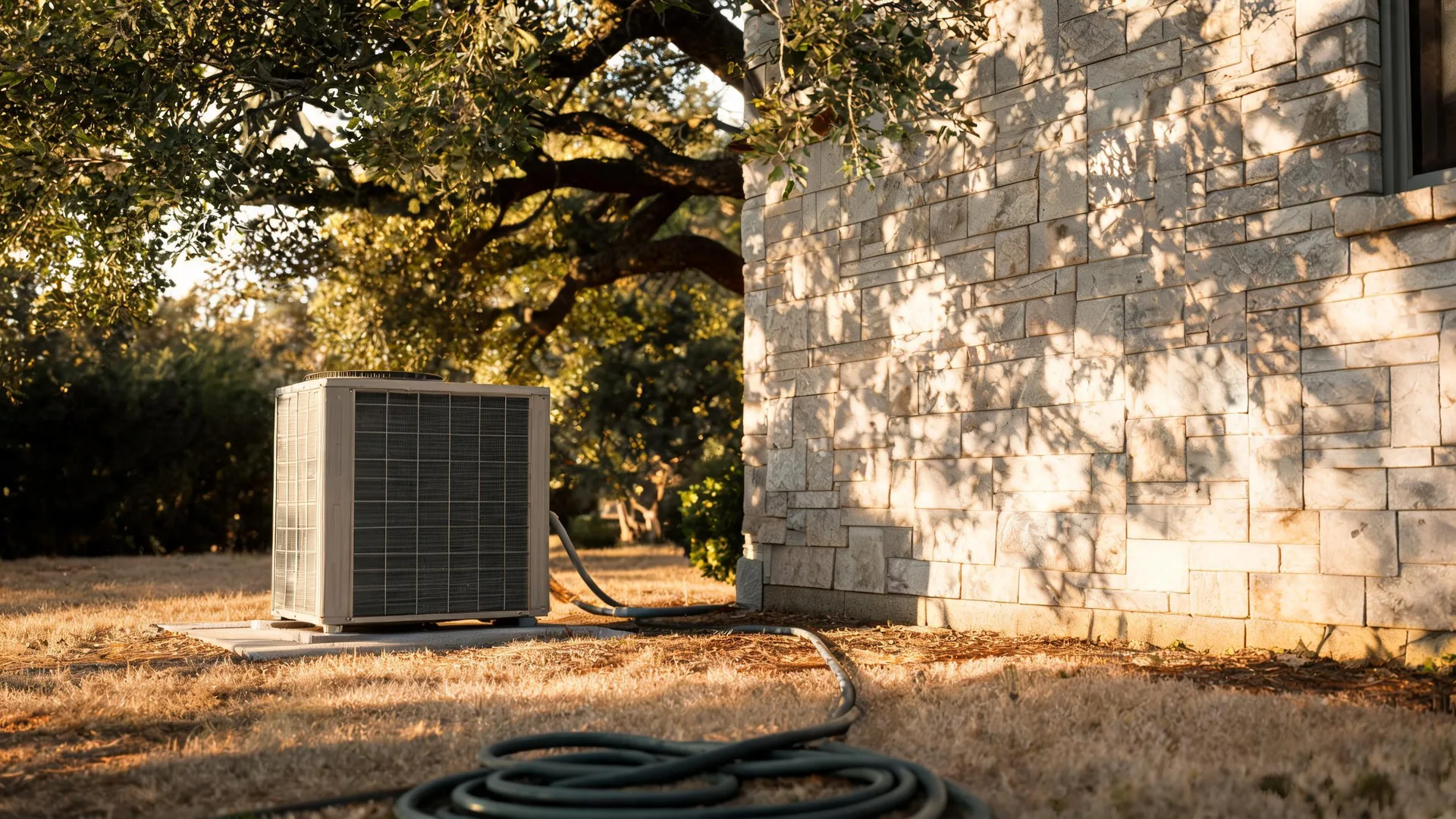
A grey heat pump outdoor unit mounted on a concrete pad against the exterior wall of a house with grey siding and stone veneer.

Heat Pump Repair in Pine City, MN

Tell us about the job

Takes about a minute. No obligation.

RepairHeat PumpPine County, MN
Step 1 of 2

What ZIP code is the job in?

Weather that beats on the outdoor unit

Pine County recorded 78 hail events and 53 damaging wind events between 2015 and 2024. The outdoor unit sits through all of it, coils and fan blade exposed to whatever comes through. A dented coil or a bent blade does not show up as a failure right away. It shows up months later as weak heating or cooling, or a noise that was not there before.


Why that matters for the repair

A heat pump that has taken years of hail and wind does not usually fail for one clean reason. Whatever is wrong now likely has company: a coil that is not transferring heat the way it should, a motor working against a bent blade, a refrigerant charge that has been low for a while. Fixing the symptom in front of you without checking the rest means the next call comes sooner than it should.

9 months
September through May, your system heats
2 months
July through August, it cools
6°F
the average winter night it heats against
78°F
the average summer afternoon it cools against
Isometric cutaway illustration of a single-story house showing interior rooms with ductwork, an indoor air handler unit, and an outdoor condenser unit connected by lines along the exterior wall.
Your system heats September through May and cools July through August.

NOAA nClimDiv, 1991–2020 normals

Electricity in Pine County runs 17.10 cents a kilowatt-hour, higher than most of the country.

A heat pump that's struggling pulls more power every time it runs, and that rate makes the difference harder to ignore.

Nine months of heat, two of cooling, and almost no break in between

Cooling runs July through August
Heat runs September through May
53 damaging wind events from 2015 to 2024

Half the homes in Pine County were built in 1984 or later, which means a lot of the heat pumps out there are still well inside their working life. If yours came with a newer build, age is probably not what's behind the problem. Worn parts or storm damage are more likely explanations than a system that's simply worn out. That's worth knowing before anyone talks about replacing it instead of fixing what's wrong.

A heat pump that works this hard deserves a real diagnosis

Whatever is going wrong, it's rarely just one thing after years of Pine County weather. A proper diagnosis checks the coil, the fan blade, and the charge, not just whatever symptom brought you to this page. That's what makes the fix hold.

Find a contractor
A man in a cap, dark long-sleeved shirt and brown work pants climbs porch steps toward a dark green front door, carrying a canvas tool bag filled with hand tools.
A gray heat pump outdoor unit mounted on a concrete pad next to the stone-accented exterior wall of a house.

Built recently, still has years left

If your heat pump came with the house and the house is newer, ask whoever comes out to repair it rather than replace it. A system with years left on it is worth fixing properly: the coil, the fan blade, the charge, whatever got damaged. Replacement makes sense when a system is actually at the end of its life, not just because something on it broke.

The reversing valve is often the first thing to go

A heat pump switches between heating and cooling by reversing the flow of refrigerant, and the valve that does that switching works every single cycle, all year. It can stick partway, get stuck in one mode, or start leaking internally. When it fails, the system might blow cold air when it should be heating, or it won't switch over at all.

The outdoor unit carries most of the wear

The compressor, the fan motor, and the coil all sit outside, running through heat and cold alike. A failing capacitor can keep the fan or compressor from starting. A weak contactor can cause the outdoor unit to not kick on at all. Keeping the coil clear of debris and the fan blade free to spin is what keeps those parts from working harder than they have to.

A heat pump in trouble usually tells you before it quits outright. The air coming from the vents feels lukewarm instead of properly warm or cool, like the system is running but not doing its job. It might run in long stretches without shutting off, trying to hit a temperature it can't quite reach. You may hear it cycling on and off faster than it used to, short bursts instead of full runs. A hissing or bubbling sound near the outdoor unit can mean refrigerant escaping where it shouldn't. Ice building up on the outdoor coil when it shouldn't be there points to airflow or charge problems underneath. None of these mean the same repair, but any of them means something is already working harder than it should.

A heat pump that is struggling does not use less power, it uses more. The compressor and fan motor keep running, trying to reach a temperature they cannot quite hit, and every extra minute they run costs something at Pine County's rate. That cost shows up on the bill whether or not the system ever gets there. Waiting it out does not save money, it just spreads the cost over more months. Getting it looked at now, while it is likely still a part or two worth fixing, is the way to stop paying for a system that is working against itself.