A lit brick residential street at dusk showing a row of two-story homes with covered porches and mature trees.

Heat Pump Repair in Little Falls, MN

Tell us about the job

Takes about a minute. No obligation.

RepairHeat PumpMorrison County, MN
Step 1 of 2

What ZIP code is the job in?

The tech checks the whole system, not just the symptom

A heat pump that won't heat could be a thermostat setting, a stuck reversing valve, a low refrigerant charge, or a frozen outdoor coil. The tech will check refrigerant pressures, test the reversing valve, look at the defrost control board, and inspect the electrical connections before deciding what's actually wrong. Guessing from one symptom alone usually leads to the wrong fix.

You get a straight answer on repair versus replacement

Once the tech finds the actual problem, they can tell you what it takes to fix it and whether the system is worth fixing. A failed capacitor or a bad contactor is a quick repair. A compressor on its way out, or a coil that's failing again after prior repairs, changes that math. Either way you walk away knowing what's wrong and what the options are, instead of guessing.

9 months
September through May, your system heats
2 months
July through August, it cools
6°F
the average winter night it heats against
78°F
the average summer afternoon it cools against
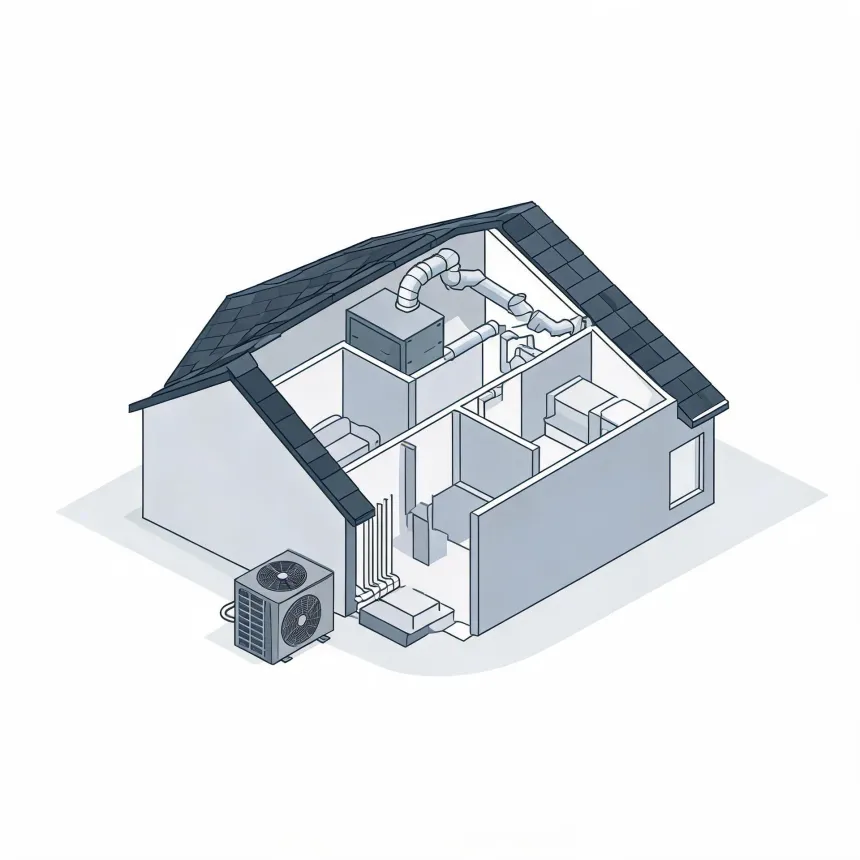
Isometric line illustration of a cutaway house showing interior rooms, an air handler with ductwork in the attic space, and an outdoor condenser unit beside the exterior wall.
Your system heats September through May and cools July through August.

NOAA nClimDiv, 1991–2020 normals

Heat pumps in Morrison County switch over to heat in September, after running cooling through July and August.

August is when a weak part gets found out, right before the system has to carry the next nine months.

At 15.45 cents a kilowatt-hour, a heat pump working harder than it should costs you all winter

Power costs 15.45 cents a kWh statewide
36 hail events from 2015 to 2024
24 winter storms from 2015 to 2024

A reversing valve is the part most specific to a heat pump, and it's a common point of failure. It slides back and forth to switch between heating and cooling, and over years of cycling the seal can wear or the valve can stick in one position. When that happens the system runs but delivers the wrong temperature air, or gets stuck in one mode no matter what the thermostat calls for. The defrost control board is another weak point, since it tells the unit when to switch into defrost and back, and if the sensor or board fails the outdoor coil can ice over and stay iced. Low refrigerant charge from a slow leak shows up as weak heating or weak cooling, never both fixed by the same repair. Contactors and capacitors wear out from simple age and heat cycling, and when they go the outdoor unit may hum but not start, or not start at all. A heat pump that's losing a part to wear usually shows a pattern, not a single clean failure.

Get it looked at early

Problems tend to show up in the first weeks of the season, when the load hits a part that was already weak.

Find a contractor
A residential heat pump outdoor unit mounted on a concrete pad next to a house with gray vinyl siding.

The part that fails first is rarely the part that breaks

A reversing valve that's starting to stick will often still work if you catch it early, moving slow but getting there. Keep running the system on that sticking valve and it stops seating fully, and now the system runs long trying to reach a setpoint it can't hit cleanly. That extra runtime is heat the compressor is pushing with no payoff, and compressors are not built to run that hard for that long. A coil icing over from a bad defrost sensor behaves the same way. The first cycle it misses, you lose a little efficiency. Ignore it and the ice builds layer on layer until airflow across the coil is choked off almost entirely, and the compressor can end up pulling liquid refrigerant it was never designed to handle. A slow refrigerant leak follows the same path from minor to serious. Low charge makes the compressor work harder to move the same heat, and a compressor that runs hot for weeks wears in ways that don't reverse. None of these start as compressor problems. They end as compressor problems if the system keeps running on them.

Check the thermostat and the breaker first

Make sure the thermostat is set to heat and the setpoint is actually above room temperature, since a setting bumped by accident looks exactly like a dead system. Check the breaker for the outdoor unit and the indoor air handler too. A tripped breaker or a thermostat with dead batteries gets ruled out in a minute, before anyone needs to look at the equipment itself.

Look at the outdoor unit, but don't touch it

Walk outside and look at the coil and the base of the unit. Heavy ice or snow built up around the coil, or anything stacked against the cabinet blocking airflow, can be enough to stop a heat pump from working right. Don't chip at ice or reach into the cabinet. If the coil is iced over or buried, that's something to point out when the tech arrives, not something to clear yourself.

Most of the time the system tells you something is wrong before it quits outright. Air coming from the vents that's cooler than it should be in heating mode is one of the first signs, even if the system is still running and the thermostat still clicks on. Short cycling is another, where the unit starts, runs a few minutes, and shuts off again instead of completing a normal heating cycle. Listen for sounds that weren't there before too, a hard clunk when the system switches modes, or a buzz from the outdoor unit that wasn't part of normal startup. Ice on the outdoor coil that doesn't clear on its own during a defrost cycle is worth noting, since a working system should shed that ice automatically. Any of these on their own might be nothing, but they're worth a call before the system stops heating altogether.

A heat pump's compressor is the most expensive part in the system, and the decision usually comes down to what's happening to it. If the compressor itself is failing, the honest conversation is about replacement, since a compressor swap costs close to a new system and doesn't reset the age of everything else. If the problem is a reversing valve, a capacitor, a contactor, or a defrost board, that's a contained repair and the rest of the system keeps running like it should. A unit that's needed repair after repair in close succession is telling you something different than one that's run clean for years and just lost a capacitor. A tech who checks refrigerant pressures and electrical components before naming a fix can usually tell you which kind of problem you have, not just that something's wrong.