







An outdoor HVAC condensing unit on a concrete pad next to a beige single-story house with a dark shingle roof.

Heat Pump Repair in East Gull Lake, MN

Tell us about the job

Takes about a minute. No obligation.

RepairHeat PumpCass County, MN
Step 1 of 2

What ZIP code is the job in?

Your heat pump earns its keep out here. Overnight lows in Cass County average 3°F across December, January and February, well below where a heat pump can pull much heat from the outside air on its own. It leans on backup heat to make up the difference, and that strain adds up over a winter. The outdoor unit also sits through the wind and ice that come with living here, year after year. A unit worked this hard shows problems sooner than the brochure suggests. When yours starts acting up, the cause is usually tied to that strain, and a proper diagnosis is what makes the fix hold.

9 months
September through May, your system heats
2 months
July through August, it cools
3°F
the average winter night it heats against
77°F
the average summer afternoon it cools against
Isometric line illustration of a cutaway single-story house showing interior rooms, ceiling ductwork, an indoor air handler unit, and an outdoor condenser connected by a line set.
Your system heats September through May and cools July through August.

NOAA nClimDiv, 1991–2020 normals

Heat pumps here switch over to heat in September.

August is when a weak part gets found the hard way.

At 15.45 cents a kilowatt-hour, a heat pump struggling to keep up costs you every month it runs

Power costs 15.45 cents a kWh statewide
107 damaging wind events from 2015 to 2024
106 hail events from 2015 to 2024
Fix it before it costs you all winterA heat pump losing efficiency shows up on the bill before it fails outright.

Half the homes in Cass County were built in 1990 or later, so there's a good chance yours is one of them. That doesn't mean the strain of winters here hasn't caught up with it. It means age isn't the reason, and a repair is still the way to go. A capacitor, a reversing valve, a sensor out of calibration, these fail from the work the unit's been doing, not from years on the nameplate. If your system came with the house, that's worth knowing when someone starts talking replacement instead of repair.

Get the cause checked, not just the symptom

A proper diagnosis finds what the strain actually did, whether that's a reversing valve stuck from overuse or backup heat that's been carrying more than its share. Get it looked at before the next cold snap asks more of it than it can give.

Find a contractor
A man in a cap, dark long-sleeve shirt and brown work pants, seen from behind, steps up onto a porch toward a dark green door while carrying a canvas tool bag.
A gray air-source heat pump mounted on a concrete pad next to a house with gray vinyl siding, surrounded by gravel and flanked by green shrubs and white hydrangea flowers.

Time is still on its side

A heat pump that's only a few years into its life hasn't put in enough hours to justify swapping it out over one bad part. If yours came with the house, get the repair quote before any replacement talk. The time on this unit is still working in your favor.

Check the obvious first

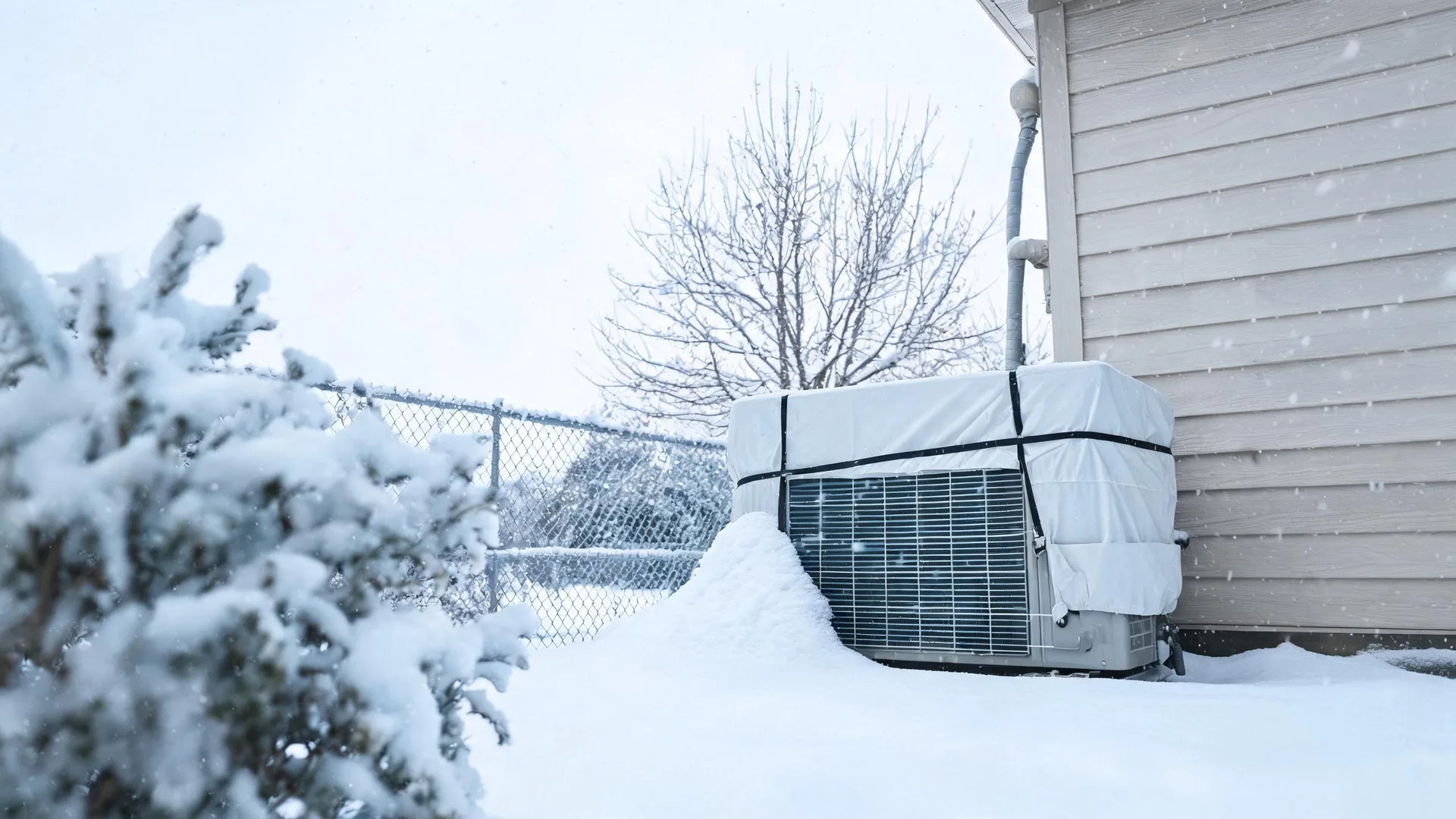
Walk outside and look at the outdoor unit. Ice or snow packed around the coil stops it from pulling heat from the air, and sometimes that's the whole problem. Check that nothing is blocking airflow around it, no leaves, no stacked firewood, no drifted snow against the side. Inside, check your thermostat batteries and settings before you assume the worst. Then check the air filter. A filter clogged with dust chokes airflow and can make the system struggle in ways that look like a bigger failure.
Know what you can't fix yourself

If the outdoor unit is running but blowing cold air when it should be heating, that's usually the reversing valve, not something to open up yourself. A clicking sound when the system switches modes, a breaker that keeps tripping, or ice that keeps coming back after you clear it all point to a part that needs a contractor's tools to diagnose. Flip the breaker to the unit off if you hear grinding or smell anything burning, and leave it off until someone's looked at it.

A heat pump that's struggling doesn't fix itself by staying on. If ice is building on the outdoor coil, letting the unit keep running just means it's pulling in air it can barely get heat from, so the compressor works harder for less output. A reversing valve that's starting to stick gets worse with every cycle, not better, since each switch between heat and defrost is another chance for it to hang partway. Backup heat makes this easy to miss, because the house stays warm even as the heat pump itself falls further behind. By the time the outdoor unit is running constantly and never catching up, the part that started the problem has usually been failing for a while. Shutting it down and having it looked at stops a worn part from turning into a failed one.

A diagnostic visit starts outside, at the unit itself. A tech checks refrigerant pressure, looks at the reversing valve while it cycles between heat and defrost, and watches how the compressor responds when it's asked to switch. They'll pull the access panel and test the capacitor and contactor, since those wear out quietly and cause symptoms that look like something bigger. Airflow gets checked on both ends, the indoor coil and the outdoor coil, because a system can have a perfectly good compressor and still underperform if air isn't moving through it right. They'll also check the defrost board and sensors, since a sensor reading wrong can send the whole system bad instructions even when every part is otherwise fine. The point of all this is to find which part started the problem, not just which part failed last.