





A snow-covered small-town street at dusk, with lit white clapboard houses, bare trees, and a grain elevator silhouetted against an orange and blue twilight sky.

Heat Pump Repair in Detroit Lakes, MN

Tell us about the job

Takes about a minute. No obligation.

RepairHeat PumpBecker County, MN
Step 1 of 2

What ZIP code is the job in?

A heat pump in Becker County works hard in both directions. Winter storms, heavy snow and ice have hit the county 80 times between 2015 and 2024, and each one means the outdoor unit is pulling heat out of cold air for hours at a stretch. Hail has struck 73 times in that same span, and damaging wind nearly as often, both landing directly on the outdoor unit sitting exposed to the weather. Summer here is milder on it, since the air doesn't carry the heavy dew point that southern systems fight all season. But between the storms and the cold stretches, the unit logs more hard running than most, and a part on its way out tends to show itself sooner here than it would somewhere easier on equipment. When a heat pump in this county starts acting up, that wear is usually the reason.

9 months
September through May, your system heats
2 months
July through August, it cools
2°F
the average winter night it heats against
77°F
the average summer afternoon it cools against
Isometric cutaway illustration of a small house showing interior ductwork and an air handler connected by lines to an outdoor condenser unit on a pad beside the building.
Your system heats September through May and cools July through August.

NOAA nClimDiv, 1991–2020 normals

Half the homes in Becker County were built in 1981 or later.

A heat pump that came with a newer house still has working life in it, and that makes repair worth doing.

Nine months of heat a year, and trouble shows up the week the load changes

Cooling runs July through August
Heat runs September through May
72 damaging wind events from 2015 to 2024

Power here is cheap, 12.61 cents a kilowatt-hour, lower than most of the country. That's the one break a heat pump in Becker County gets. A unit running on a bad capacitor or a stuck reversing valve still draws power the whole time it's struggling, and it struggles longer here than it would somewhere mild. Low rates soften that bill. They don't erase it, and a heat pump that's working harder than it should will still cost you something every month it goes unfixed.

Worn by the weather here. Fixed to handle it again.

A heat pump that's been through 80 winter storms and 73 hail events in the same stretch of years has earned the right to act up. The part giving you trouble now has been working against weather most systems never see. Get it looked at and fixed properly, so the repair holds up to what's coming this winter.

Find a contractor
A gray heat pump condenser unit mounted on a concrete pad against the gray lap-siding exterior wall of a house.

Built in 1981 or later, this unit still has years in it

If your heat pump came with the house and the house is newer, that's worth finding out before you decide anything. Half the homes in this county went up in 1981 or later, which puts a lot of equipment well inside its working life even after the kind of winter this one just had. A system that age is usually worth repairing rather than replacing. Check the age against when your house was built, or ask the technician to confirm it off the unit's nameplate when they're out. Either way, a repair on a newer system is money spent on something with years left to run.

What you can check outside

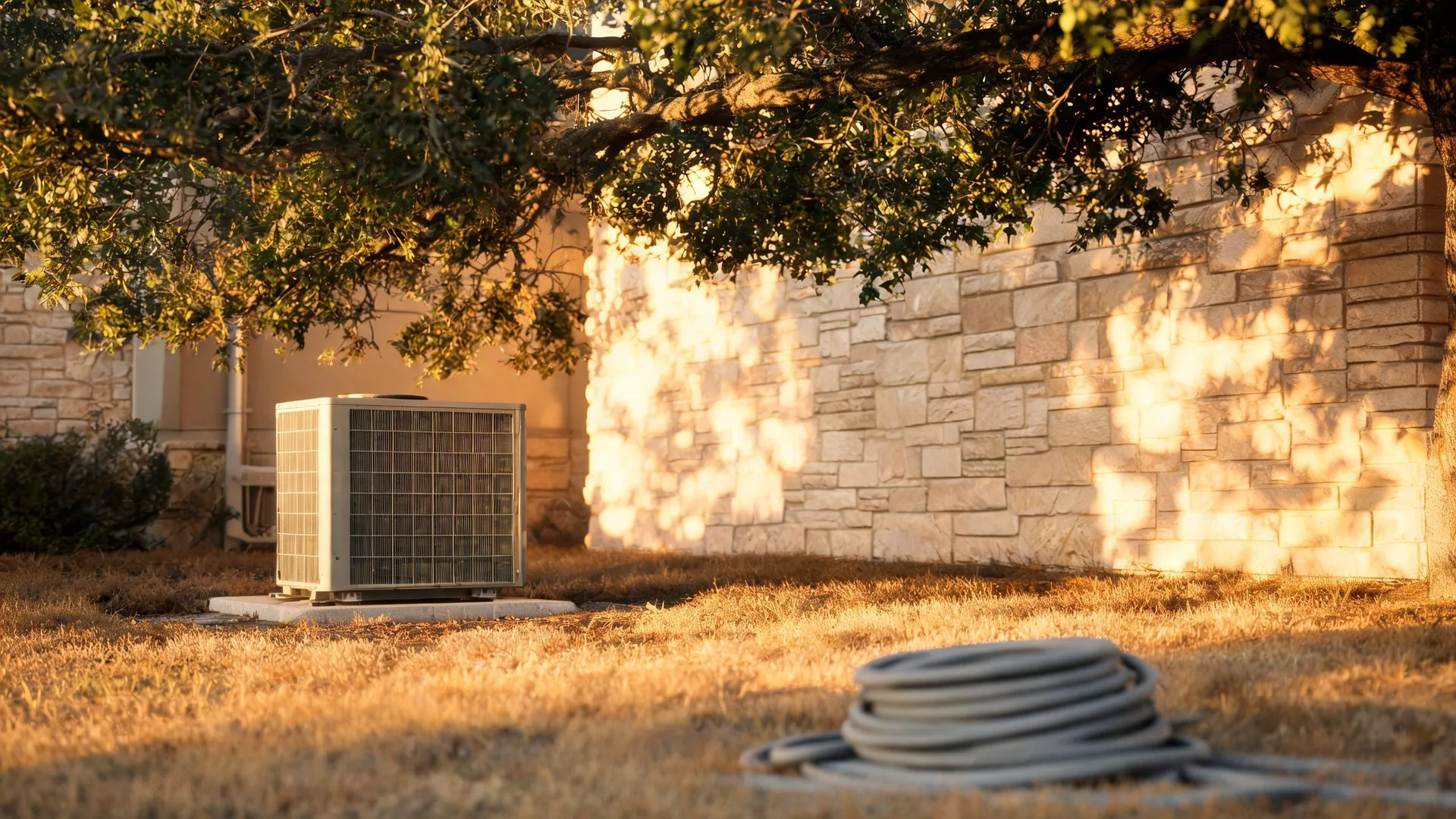
Look at the outdoor unit before you call anyone. Clear away leaves, ice or snow piled against the cabinet, since airflow in and out of that unit matters as much in winter as summer. Check that the fan on top isn't iced over solid or jammed with debris. If you see a thick layer of frost that doesn't go away during a defrost cycle, or the unit is caked in ice after a storm, that's worth noting for the technician. Don't chip at the coil or force anything frozen. A breaker that's tripped is also worth checking at the panel before assuming the worst.
What you can check inside

Change the filter if it's been a while. A clogged filter starves the system of airflow and can make a working heat pump act like a broken one, short cycling or blowing air that never feels warm enough. Check the thermostat is set to heat and the temperature is actually above room temperature, especially if it's a smart thermostat that may have switched modes on its own. Look at supply vents around the house and make sure none are closed or blocked by furniture. If the system is running constantly but the house won't come up to temperature, that's useful information to give the technician, not something to keep troubleshooting on your own.

Most heat pump failures start with the reversing valve or the defrost control board, since those two parts carry the extra work that heating and cooling in one machine demands. The reversing valve switches the refrigerant flow so the system can heat instead of cool, and over years of switching back and forth it can stick or leak. A stuck valve shows up as a unit that runs but blows cold air when it should be heating, or heats when it should be cooling. The defrost board manages the cycle that clears frost off the outdoor coil, and when its sensor or timer fails, ice builds up on the coil and never clears, which chokes off airflow and makes the whole system work harder for less heat. Capacitors and contactors wear out too, the same as in any compressor-driven machine, and a failing one often shows up as a unit that hums but won't start, or shuts off on its own partway through a cycle. Any of these is worth having a technician check before the compressor itself takes the strain and turns a simple repair into a much bigger one.

A heat pump that's struggling still pulls power the whole time it struggles. Cheap power in this county only goes so far against that. If yours is running longer cycles than it used to, or running constantly without getting the house warm, that's not a cheap habit to let ride. A stuck reversing valve or a failing defrost board doesn't fix itself by running more. It just keeps drawing power while it loses the fight against the cold outside. Getting it looked at now stops that meter from turning for a problem a repair would have solved weeks ago.