






A dark-clad two-story house with a gabled roof and white-trimmed windows stands behind a wire fence at the edge of a mown grass field, with a dense row of tall conifers behind it under an overcast sky.

AC Maintenance in Willmar, MN

Tell us about the job

Takes about a minute. No obligation.

Tune-up, service, or cleaningCentral ACKandiyohi County, MN
Step 1 of 2

What ZIP code is the job in?

Cooling in Willmar runs June through August, three months of steady work. May is the month to get a technician out, before the first hot stretch asks the system to prove itself. A unit that has sat idle all winter needs someone to check the refrigerant charge and the capacitor before it has to run all day. Wait until June and you're booking the check at the same time the system is already working hard, which is a worse time to find a weak part. Get it looked at in May and summer just starts, without a call partway through.

3 months
June through August, your air conditioner is on duty
80°F
the average summer afternoon it cools against
43 hail events
in ten years, and hail bends the fins on outdoor coils
40 wind events
in ten years, and wind drives debris into outdoor units
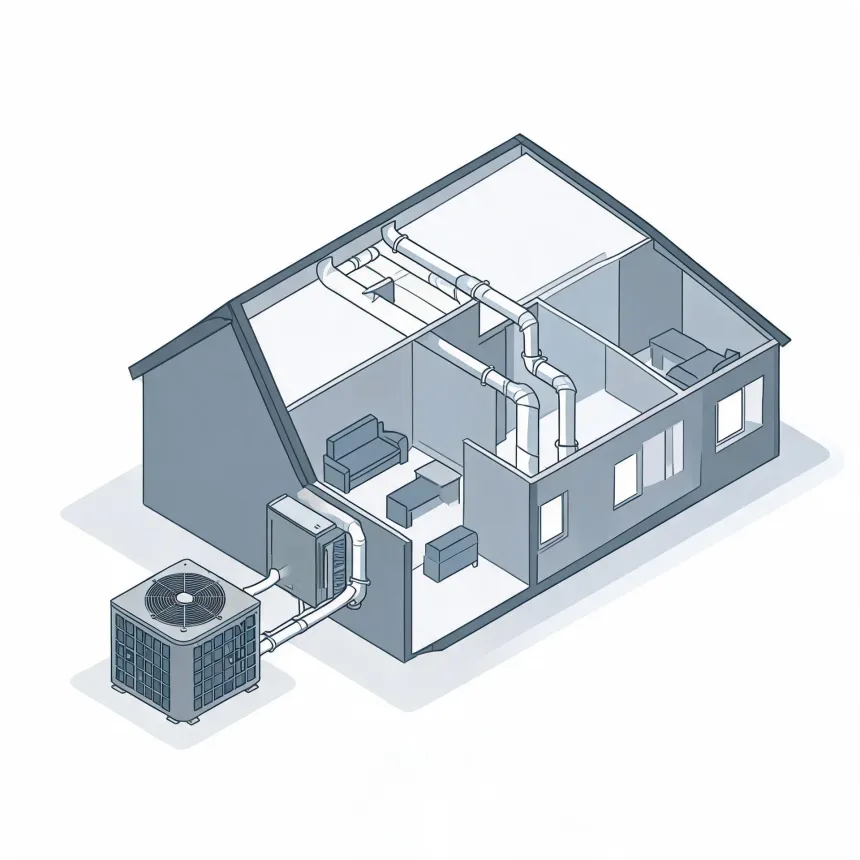
Isometric line illustration of a cutaway house showing interior rooms with ductwork, an indoor air handler, and an outdoor condenser unit connected by lines, on a white background.
Your air conditioner works hardest from June through August.

NOAA nClimDiv, 1991–2020 normals

Three months of cooling a year is light duty for an air conditioner.

A unit that isn't strained still needs its yearly check, because age and neglect cause most of the problems a short season doesn't.

One check a year is enough for a June through August season

Half the homes here were built by 1978
Cooling runs June through August
Summer afternoons average 80°F
Once a year covers itMinnesota power runs 15.45 cents a kilowatt-hour, so a clean, well-tuned unit matters more than how often it's serviced.

A yearly check is what keeps a light-duty system running for years instead of failing early. The technician will test the capacitor, check the refrigerant charge, and clean the coil if it needs it, the same things worth checking whether the unit ran hard or easy the summer before. Mention anything odd from last season while they're there, a rattle, a room that never cooled right, a longer runtime than you remember. Three months of work a year is not nothing, and a part can wear out or fail even in a system that was never pushed. Skip the check and the first sign of trouble shows up in June, July or August, with the system already running and the house already uncomfortable.

Book it before the season

It starts running hard in the first month of the season here. Book the check the month before.

Find a contractor
A man in a dark long-sleeve shirt and tan work pants, seen from behind, carries a canvas tool bag up porch steps toward a dark green front door beside a potted shrub.
A gray cylindrical air conditioning condenser unit mounted on a concrete pad next to a light-colored vinyl-sided house exterior.

What tells you it's due

A few things point to a check even when the system still runs. A breaker that trips once and resets. A startup that takes a beat longer than it used to. A hiss or a click that wasn't there before. None of these stop the unit from cooling, so they're easy to let slide. Usually it's the capacitor weakening or the contacts wearing, and both get worse by waiting, not better. There's another sign that has nothing to do with sound. A system that ran fine last year but sat all winter with nobody checking the refrigerant charge or the coil. Sitting idle doesn't damage a unit on its own, but it hides whatever was already starting to go wrong when the season ended.

The coil gets dirty whether or not anyone notices

Dust and fine debris settle on the outdoor coil and the indoor coil both, and neither one announces it. The unit still turns on, still blows cold air for a while. But a coated coil can't shed heat the way a clean one does, so the compressor runs longer to do the same job. Nobody skips a tune-up on purpose. They just don't see the coil, so they don't think about it.


A refrigerant leak doesn't fix itself

Refrigerant doesn't get used up the way fuel does. If the charge is low, something let it out, a loose fitting or a slow leak at a joint, and it stays low until someone finds the source and adds refrigerant back. Left alone, the compressor keeps working against a charge that's wrong for it, and that's the part most owners aren't eager to replace.

Overhead view of an outdoor AC condenser unit on a concrete pad next to a house with a dark shingle roof.

Book your AC tune-up in May, before homes here start needing cooling in June.

  1. Jan
  2. Feb
  3. Mar
  4. Apr
  5. May
  6. Jun
  7. Jul
  8. Aug
  9. Sep
  10. Oct
  11. Nov
  12. Dec

A tune-up checks the refrigerant charge, cleans the coils, tests the capacitor and tightens the electrical connections.

A tune-up starts outside at the condenser. The technician checks the refrigerant charge against what the system calls for, tests the capacitor and contactor, and cleans the coil if it's coated enough to hold heat in. Inside, the evaporator coil gets checked too, along with the blower and the filter. They'll check line voltage and amp draw on the compressor, since a motor pulling more current than it should is a motor wearing out early. The condensate drain gets cleared while they're at it, because a clogged one backs up and spills water where it shouldn't. None of this is guesswork. Every part has a range it's supposed to fall in, and the point of the visit is finding out which parts don't.