






A row of dark-sided cottages with brown shingled roofs behind a trimmed hedge, beside a mown lawn and large leafy trees under an overcast sky.

AC Maintenance in Sauk Rapids, MN

Tell us about the job

Takes about a minute. No obligation.

Tune-up, service, or cleaningCentral ACBenton County, MN
Step 1 of 2

What ZIP code is the job in?

Three months of real cooling here, June through August, with afternoons averaging 79 degrees. That is not much to ask of a compressor. The air stays fairly dry too, with dew points around 58°F, so the system isn't fighting heavy, wet air just to keep the house comfortable. An AC built for this county rarely runs flat out. But a light workload doesn't mean no workload. Dust still collects in the coil, refrigerant levels still drift, capacitors still age, whether the unit runs hard or easy. A yearly check catches that wear while it's still cheap to fix.

3 months
June through August, your air conditioner is on duty
79°F
the average summer afternoon it cools against
18 hail events
in ten years, and hail bends the fins on outdoor coils
6 wind events
in ten years, and wind drives debris into outdoor units
Isometric cutaway illustration of a house showing attic ductwork, an indoor air handler, refrigerant lines running outside, and an outdoor condenser unit on a pad.
Your air conditioner works hardest from June through August.

NOAA nClimDiv, 1991–2020 normals

A warm start to a cool season, when the air barely moves from the vents, usually points to a dirty coil or a low charge.

Catch either one on a tune-up before the compressor has to strain to make up for it.

Half the homes here were built in 1986 or later, which is why the AC is usually worth keeping up

Half the homes here were built by 1986
Climate zone 6A
Power here costs 15.91 cents per kilowatt-hour
Get it looked at before June, when the season startsCooling starts in June here, so book the check in May.

A real tune-up starts outside at the condenser. The tech clears leaves and grass clippings away from the cabinet, then washes the coil fins so heat can actually leave the refrigerant instead of getting trapped against caked-on dirt. Refrigerant gets checked against the system's target pressures, not just topped off by guess, because too much or too little both make the compressor work harder than it should. Inside, the tech checks the capacitor and contactor that start and run the compressor and fan motor, since a weak capacitor is one of the more common reasons a unit starts struggling on the first hot stretch. The evaporator coil and blower get a look too, since a dirty coil or a clogged filter ahead of it both choke airflow the same way. Electrical connections get tightened, because a loose one generates heat and wears out parts faster than normal operation ever would.

Keep it maintained, and it's worth fixing when something goes wrong

A system installed when the house was built is likely still well within its working life. Keeping it on a yearly check is what makes it reasonable to repair rather than replace when something does wear out.

Find a contractor
An outdoor residential air conditioning condenser unit mounted on a concrete pad, surrounded by gravel with a blue sky in the background.

A thorough tune-up touches parts you can't see from across the yard

A quick visit and a real one can look the same from the driveway. The difference shows up in what gets touched. A tech doing a thorough job pulls the panel and checks the capacitor's actual output against its rating, not just whether the fan spins. They wash the condenser coil instead of hosing dirt off the top layer. They check refrigerant against the system's target pressures with gauges, not a glance at the line. A rushed visit skips the gauges, skips the coil wash, and tightens nothing, because none of that shows unless something fails later. Ask what the tech checked the capacitor against, and whether the coil got washed or just rinsed. Those answers tell you which visit you got.

Change the filter

A dirty filter is the one thing between visits that's fully on the homeowner. Airflow drops as it clogs, and the evaporator coil behind it can ice over when air can't move past it fast enough. Check it against the light, and if you can't see through it, swap it. A washable filter gets rinsed and dried fully before it goes back in, since a damp filter grows mold.

Watch and listen, don't open anything up

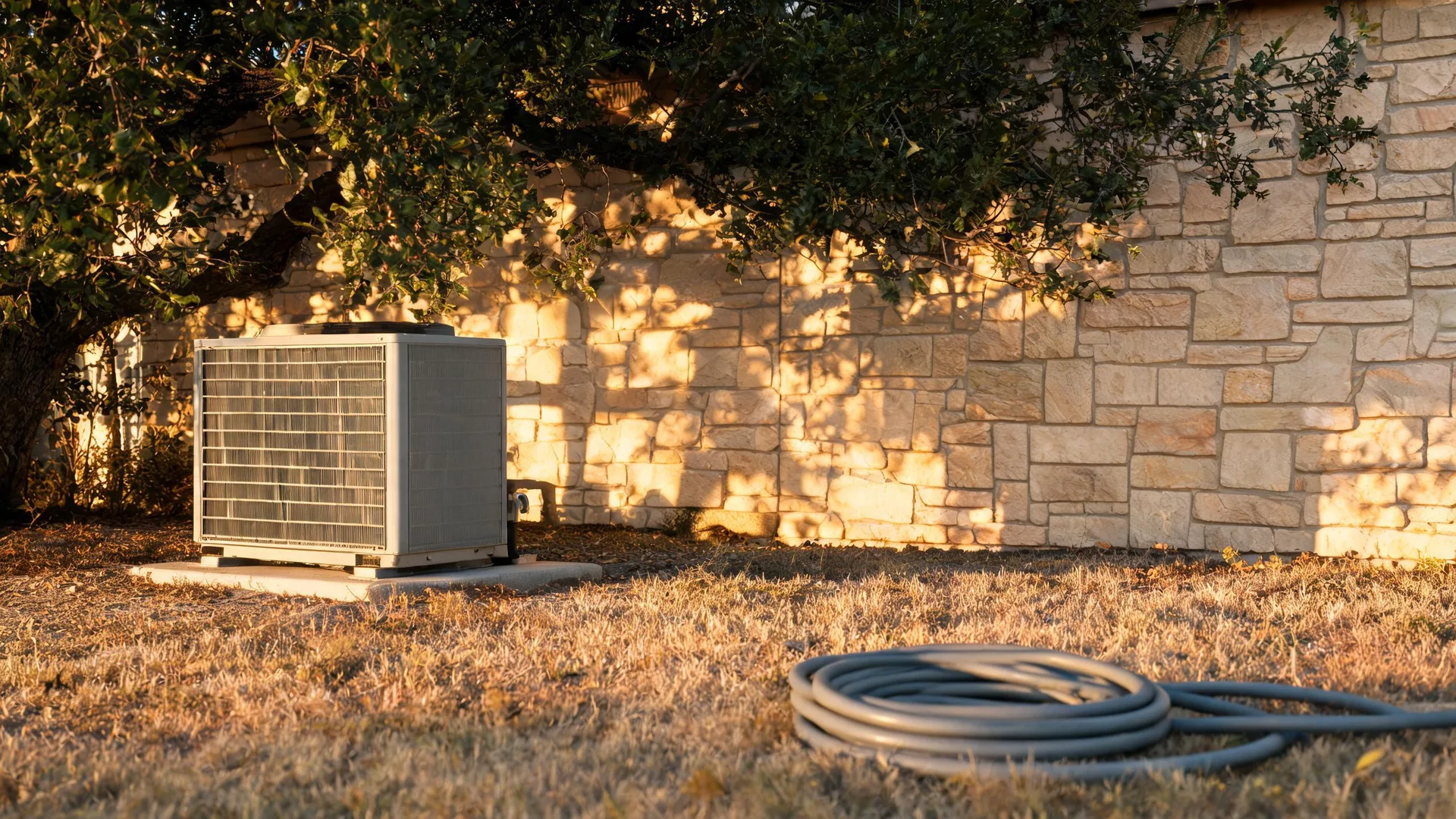
Keep the area around the outdoor unit clear of leaves, grass clippings, and anything stacked against the cabinet, since the condenser needs open air around it to shed heat. Past that, the job is noticing, not fixing. A new rattle, a burning smell, ice on the copper line, or water pooling by the indoor unit all mean it's time to call someone, not reach for a wrench. Opening the cabinet or touching refrigerant lines is a tech's job, not a homeowner's.

Overhead view of a gray residential air conditioning condenser unit mounted on a concrete pad beside a house with asphalt shingle roofing.

Book your AC tune-up in May, before homes here start needing cooling in June.

  1. Jan
  2. Feb
  3. Mar
  4. Apr
  5. May
  6. Jun
  7. Jul
  8. Aug
  9. Sep
  10. Oct
  11. Nov
  12. Dec

A tune-up checks the refrigerant charge, cleans the coils, tests the capacitor and tightens the electrical connections.

Skip the yearly check and nothing fails right away. That's what makes it easy to put off. The coil keeps collecting dust a little at a time, and as it cakes up, the system has to run longer to move the same heat out of the house. A capacitor losing strength doesn't fail all at once either. It just weakens until the compressor has to kick harder to start, and that extra strain is what eventually takes it out. Low refrigerant works the same way, usually from a slow leak rather than a sudden one, and a system running low stays colder on the coil than it should, which invites ice instead of cooling. None of this announces itself. It shows up later as a compressor that won't start, a coil frozen solid, or a utility bill that crept up without anyone noticing why.