Three illuminated two-story brick houses on a tree-lined residential street photographed at twilight, with warm window light and landscape uplighting visible against a deep blue evening sky.

AC Maintenance in Red Wing, MN

Tell us about the job

Takes about a minute. No obligation.

Tune-up, service, or cleaningCentral ACGoodhue County, MN
Step 1 of 2

What ZIP code is the job in?

Three months of real work

Your AC here only has to earn its keep from June through August, with afternoons averaging around 79 degrees. That's a short season compared to a lot of the country, and the compressor spends the rest of the year sitting idle.


Light duty still needs a yearly look

A system that isn't straining still has a capacitor that weakens, coils that collect dirt, and refrigerant that can slowly drop. Catching those early is usually worth it here, since age and neglect cause more trouble than the workload does.

3 months
June through August, your air conditioner is on duty
79°F
the average summer afternoon it cools against
39 hail events
in ten years, and hail bends the fins on outdoor coils
52 wind events
in ten years, and wind drives debris into outdoor units
Isometric cutaway illustration of a small house showing interior rooms with furniture, an indoor air handler with ducts in the attic space, and refrigerant lines running to an outdoor condenser unit on a pad.
Your air conditioner works hardest from June through August.

NOAA nClimDiv, 1991–2020 normals

June is when cooling starts in Goodhue County, and the compressor goes straight to work.

Have it checked in May, before that first hot stretch asks anything of it.

Skip a few years of maintenance and an air conditioner doesn't quit all at once. It loses ground slowly. Dirt builds up on the condenser coil outside, and the coil can't shed heat the way it's supposed to, so the compressor works harder and runs longer to hit the same temperature. The capacitor that gives the compressor its starting kick weakens with age anyway, but heat and strain speed that up. Refrigerant doesn't get used up, but a slow leak that would have been caught and sealed early just keeps draining the charge instead, and a system low on refrigerant can freeze its own coil. None of this shows up as a dead system right away. It shows up as a system that runs longer than it should and quits on the one afternoon you needed it most.

Have it looked at before June, not after

Get it checked before summer and a weak capacitor or a dirty coil gets caught before June through August asks anything of it.

Find a contractor
A man in a dark long-sleeved shirt and tan pants, seen from behind, carries a worn canvas tote bag as he climbs wooden steps toward a dark green front door flanked by a potted shrub.
A gray residential air conditioning condenser unit mounted on a concrete pad outdoors, surrounded by green grass under a partly cloudy blue sky.

What you can handle, and what you can't

The filter is the one thing worth checking on your own. A dirty filter chokes airflow across the indoor coil, and a coil that can't shed heat the way it should is more likely to ice up. Pull the filter and hold it to a light. If light doesn't come through, clean it or swap it, depending on what kind you have. Outside, keep the area around the condenser clear. Grass clippings, leaves and seed pods pile up against the fins and block airflow the same way a dirty filter does. A hose can rinse them out from the inside if you can reach them, but nothing that bends or flattens the fins. Keep shrubs and furniture back a couple feet so it can breathe. Inside, make sure supply vents and return grilles aren't blocked by furniture or rugs. A closed vent in one room makes the whole system work harder to cover for it. None of this replaces an actual inspection. A weak capacitor or a slow refrigerant leak doesn't show from the outside, and the cabinet and the wiring inside it aren't a homeowner's job. But a clean coil and a clean filter mean the technician spends the visit catching what's actually wearing out.

The drain is the part no one checks

Condensation builds up on the indoor coil and drips into a pan, and from there it runs out through a drain line. That line grows algae over time like anything else that's wet and dark. Once it clogs, the pan overflows, and depending on how the system is set up that water lands in a closet, an attic, or right through a ceiling. Nothing about the cooling suffers until the day it does.

A dirty coil hides as something else

The indoor coil sits in the airflow and picks up dust the filter missed, same as the outdoor coil picks up whatever blows against it. Either one caked with dirt can't transfer heat the way it's built to, so the system runs longer to get the same cooling. Most people blame the thermostat or the compressor first. It's often just a coil that hasn't been cleaned.

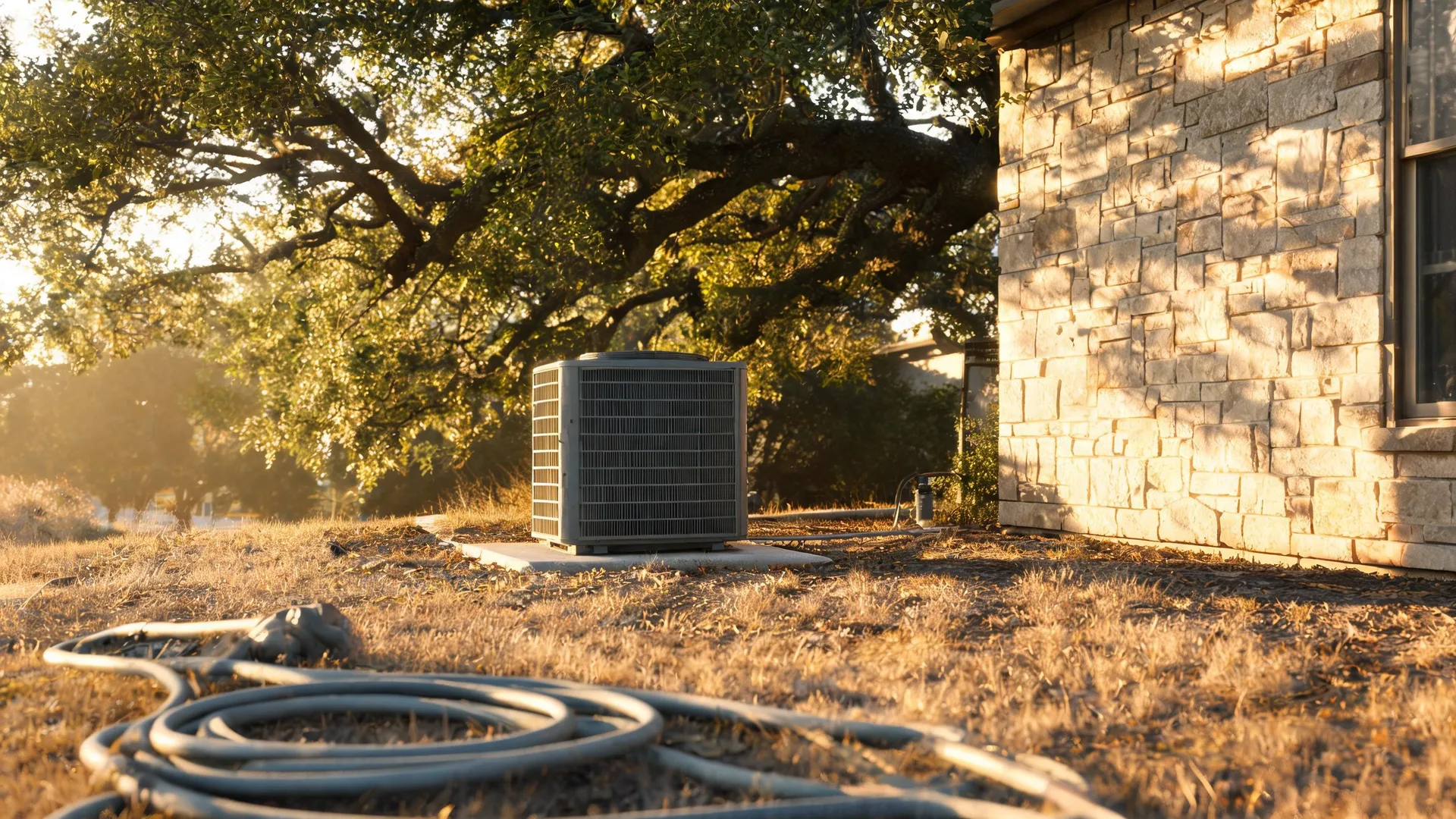
An outdoor air conditioning condenser unit on a concrete pad next to the gray vinyl siding of a residential home.

Book your AC tune-up in May, before homes here start needing cooling in June.

  1. Jan
  2. Feb
  3. Mar
  4. Apr
  5. May
  6. Jun
  7. Jul
  8. Aug
  9. Sep
  10. Oct
  11. Nov
  12. Dec

A tune-up checks the refrigerant charge, cleans the coils, tests the capacitor and tightens the electrical connections.

A tune-up is not just a filter check. The technician measures refrigerant pressure against what the system is supposed to run at, since too little points to a leak somewhere and too much points to a bad charge from the start. They test the capacitor and the contactor, the parts that get the compressor started and keep it running, because a capacitor usually weakens instead of failing outright, and a struggling start pulls more current every time it happens. They check the condenser fan motor and clean the coils if they're dirty, since a coil that can't shed heat makes the compressor run longer for the same result. They flush the condensate drain before algae clogs it, and check the electrical connections for corrosion, since a loose connection generates heat of its own. None of this is guesswork. It's the same parts every time, because those are the parts that wear out every time.