





A dark two-story house with a wide covered front porch, framed by large leafy trees, behind a trimmed hedge and a striped mowed lawn.

AC Maintenance in Minneapolis, MN

Tell us about the job

Takes about a minute. No obligation.

Tune-up, service, or cleaningCentral ACHennepin County, MN
Step 1 of 2

What ZIP code is the job in?

A tune-up starts with the refrigerant charge, checked against what the system calls for. Too little and the compressor runs long and hard without cooling the house. A tech also checks the contactor, the relay that switches the compressor on, for pitting and burn marks you'd never see unless you pulled the panel. The capacitor gets tested under load, not just looked at, because a capacitor can read fine sitting still and still fail to kick the compressor on. Coils get inspected front and back. A dirty evaporator coil loses its grip on the air passing over it, and a dirty condenser coil can't shed heat the way it should, so the system works harder to do less. None of this shows up as a problem you'd notice from the thermostat, not until the day it does.

3 months
June through August, your air conditioner is on duty
80°F
the average summer afternoon it cools against
132 hail events
in ten years, and hail bends the fins on outdoor coils
142 wind events
in ten years, and wind drives debris into outdoor units
Isometric cutaway illustration of a single-story house showing interior rooms, ceiling ductwork, an indoor air handler, and an outdoor condenser unit connected by lines, in gray and white tones on a white background.
Your air conditioner works hardest from June through August.

NOAA nClimDiv, 1991–2020 normals

Cooling in Minneapolis runs June through August.

Have the AC checked in May, before it has to work.

Summer here runs a few months hot. A once-a-year check is what it needs.

Power costs 15.45 cents a kWh statewide
Cooling runs June through August
Summer afternoons average 80°F
Three months of real heatAfternoon highs average 80°F across June, July and August here.

Half the homes in Hennepin County were built in 1973 or earlier. If your system came with the house, it has had a long string of summers to wear its parts down. That doesn't mean something's wrong with it. It means small problems have had more time to turn into bigger ones, usually without any sign at the thermostat. A yearly check is how those get caught while they're still small.

Book it before the season

It starts running hard in the first month of the season here. Book the check the month before.

Find a contractor
A gray metal air conditioning condenser unit mounted on a concrete pad in a flat grassy field under a partly cloudy sky.

What it tells you before it fails

A system can run fine right up until the day it doesn't, and most of the warning happens somewhere you can't hear it from the couch. Watch how long it runs. A unit that used to shut off and rest, now grinding through long stretches without stopping, is working harder than it used to for the same result. Short cycling, kicking on and off again within a few minutes, points somewhere else, usually the contactor or a thermostat that isn't reading the room right. Ice on the lines in warm weather is never a good sign, even though people assume ice means the system is working hard at cooling. A puddle under the indoor unit usually means the drain line is clogged, not that anything is leaking refrigerant. None of these mean the system is about to quit outright. They mean something is already wrong, small enough right now to fix on a bench instead of a service call at night.

Watch the hands, not just the checklist

A thorough tech pulls the blower wheel and looks at it. A coated wheel moves less air no matter how clean the coil is. They also check the suction line temperature against the pressure instead of reading pressure alone, since pressure by itself can look normal while the system still isn't cooling right. A quick visit checks what's easy to see and calls it done.

What a short visit skips

A fast tune-up tests the capacitor once and moves on. A thorough one checks it under load, because a capacitor can pass a cold test and still fail to start the compressor an hour later. The drain line gets the same treatment. A quick check glances at the pan. A real one flushes the line, since a clog that's just starting won't show up as standing water yet.

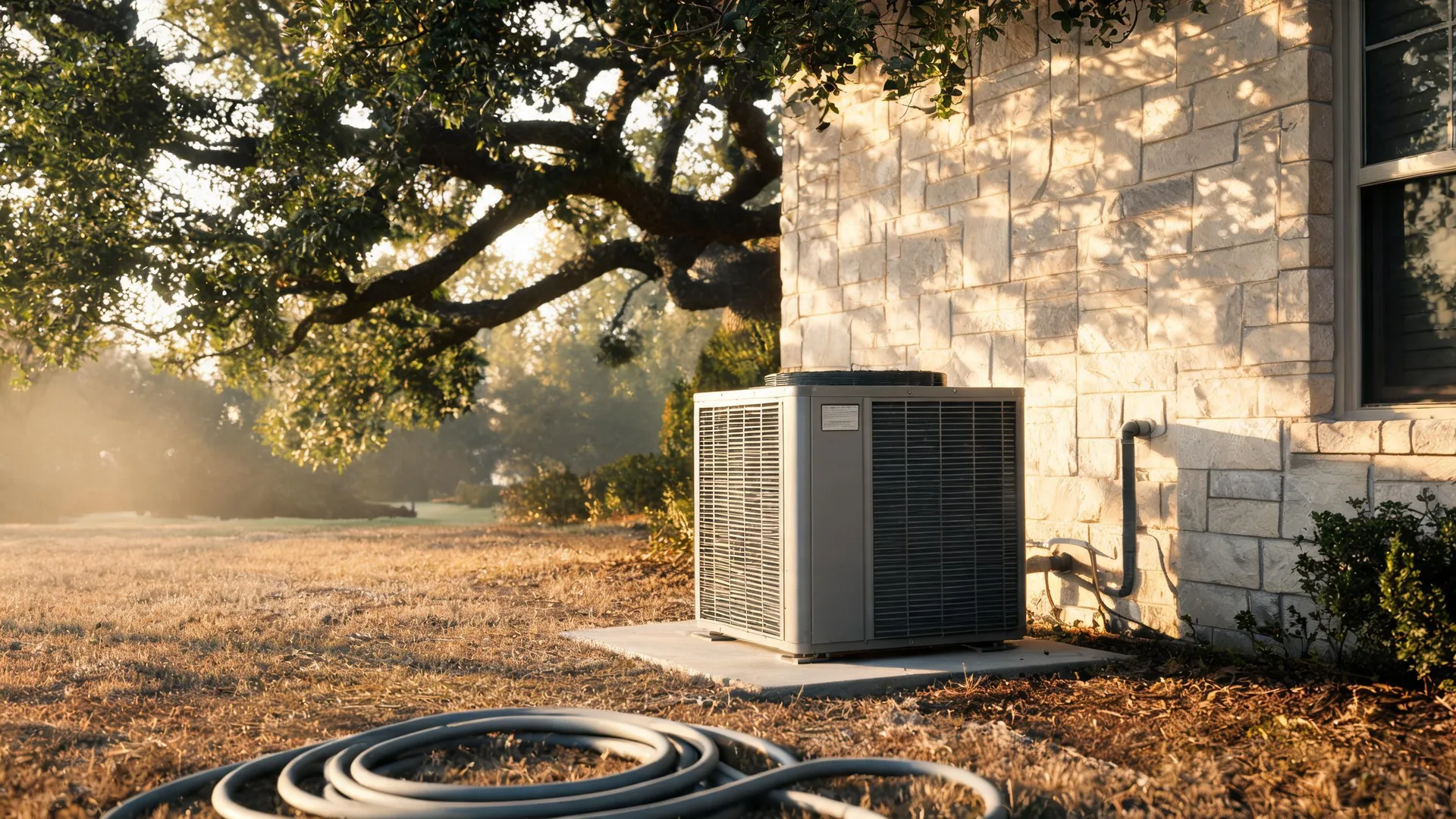
An outdoor air conditioning condenser unit positioned beside a blue-sided house at sunset.

Book your AC tune-up in May, before homes here start needing cooling in June.

  1. Jan
  2. Feb
  3. Mar
  4. Apr
  5. May
  6. Jun
  7. Jul
  8. Aug
  9. Sep
  10. Oct
  11. Nov
  12. Dec

A tune-up checks the refrigerant charge, cleans the coils, tests the capacitor and tightens the electrical connections.

A tune-up also covers the airflow side, not just the refrigerant side. The blower motor gets checked for the right speed, because a motor running slow moves less air across the coil no matter how clean that coil is. The fan blades on the outdoor unit get looked at for bends, since a bent blade throws the airflow off and makes the motor work unevenly. A tech checks the ductwork connections near the unit for gaps where cooled air can escape before it ever reaches a room. The thermostat gets checked too, not just read, confirming it's calling for cooling at the right temperature and not drifting off from where it's set. A tune-up that skips any of this can still pass a capacitor test and a refrigerant check and send a system back out that won't cool the way it should.