







A low-angle view across a mown lawn and trimmed hedge toward a dark two-story house with a covered porch, framed by large leafy trees under an overcast sky.

AC Maintenance in Mankato, MN

Tell us about the job

Takes about a minute. No obligation.

Tune-up, service, or cleaningCentral ACBlue Earth County, MN
Step 1 of 2

What ZIP code is the job in?

A few things usually show up before a system fails outright. Warm air out of the vents when the thermostat is set right is one. Short cycling, where the unit kicks on and off every few minutes instead of running a full cycle, is another, and it puts more wear on the compressor than normal operation does. Listen for a hiss near the indoor coil, a sign of refrigerant leaking out, or a grinding or squealing from the outdoor unit, which usually points to a failing motor bearing. Water pooling near the indoor unit means the condensate drain is clogged or the pan is cracked. Any of these mean something is already wrong, not something about to go wrong, and a maintenance visit before they show up is what keeps them from happening at all.

3 months
June through August, your air conditioner is on duty
80°F
the average summer afternoon it cools against
44 hail events
in ten years, and hail bends the fins on outdoor coils
50 wind events
in ten years, and wind drives debris into outdoor units
Isometric grayscale illustration of a cutaway house with the roof lifted, showing interior rooms, ductwork, an indoor air handler, and an outdoor condenser unit beside the building.
Your air conditioner works hardest from June through August.

NOAA nClimDiv, 1991–2020 normals

Three months of real cooling load a year is not much to ask of a system.

Less strain means a yearly check is usually enough to keep it running.

Nothing about Mankato pushes this machine harder, so once a year covers it

Half the homes here were built by 1978
Climate zone 6A
Power costs 15.45 cents a kWh statewide
Nothing unusual hereMankato doesn't work this machine any harder than the next town over.

Hail and wind are the other side of easy duty here. The county's seen 44 hail events and 50 damaging wind storms in the years on record, and the outdoor unit sits outside through all of it. A dented cabinet or bent fin usually doesn't stop the system from running, but it changes how air moves across the coil, and that's exactly what a yearly check catches before it turns into a bigger repair. Low strain from the weather doesn't mean the weather leaves the unit alone. The same visit that checks the capacitor and the charge is also when a tech notices the fins that got bent last storm season.

Keep up the yearly check

Easy duty still wears parts. A yearly check keeps it going a long time.

Find a contractor
A man in a tan jacket, cap, and work boots carries a canvas tool bag up wooden porch steps toward a dark green front door of a house with light horizontal siding and a potted shrub.
An outdoor air conditioning condenser unit mounted on a concrete pad beside a house, with electrical conduit running to a wall-mounted disconnect box.

What you can do yourself, and where that ends

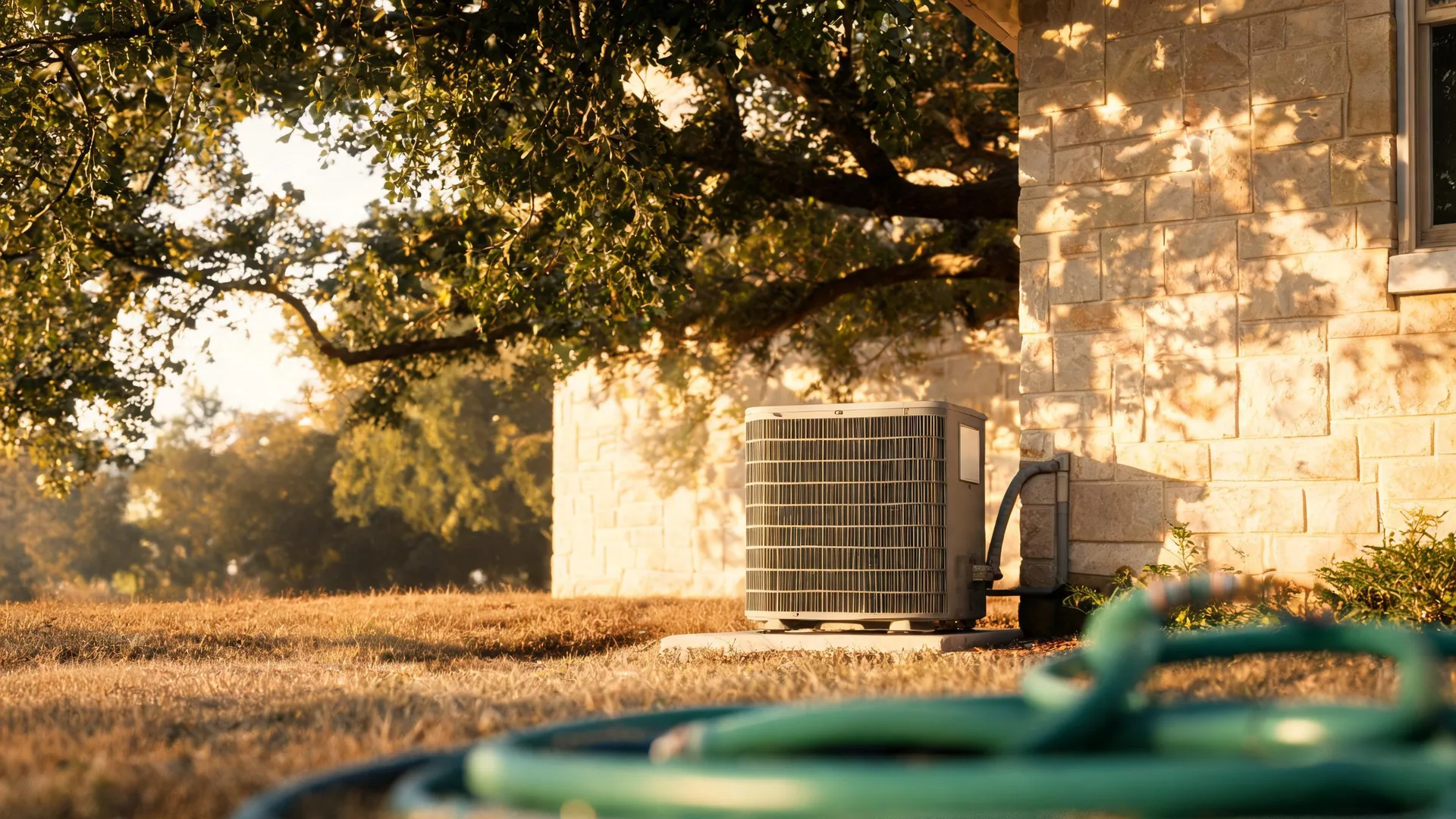
The filter is the one thing worth checking without waiting for a scheduled visit. Pull it out, hold it up to a light. If you can't see light through it, it needs changing. A clogged filter starves the system of airflow, and the coil behind it can freeze over, which shows up as weak or no cold air even though the unit is running fine otherwise. Outside, keep the area around the condenser clear. Grass clippings, leaves, a stray branch leaning against the cabinet all block airflow the unit needs to shed heat. A hose rinse on the outdoor coil fins knocks off dust and pollen buildup between visits. Past that, leave the refrigerant lines, the electrical connections and anything behind an access panel alone. That part is a job for a visit, not a Saturday afternoon.

The filter is doing more than cleaning air

A dirty filter chokes airflow across the indoor coil. Once that coil can't shed heat fast enough, frost builds on it, and ice on a coil blocks air the same way a dirty filter does, only worse. By the time you notice warm air at the vents, the coil's already frozen over and the system needs to thaw before it can tell you anything else.

The drain line fails quietly until it doesn't

Condensate drains rely on gravity and a clear path, nothing more. Algae and dust build up inside that line the same way they would in any drain that stays wet, and once it's blocked the water backs up into the pan instead of outside. A float switch will shut the system down if the pan gets too full, or if there's no switch, the pan just overflows onto the floor.

An outdoor air conditioning condenser unit installed beside the exterior wall of a blue vinyl-sided house at sunset.

Book your AC tune-up in May, before homes here start needing cooling in June.

  1. Jan
  2. Feb
  3. Mar
  4. Apr
  5. May
  6. Jun
  7. Jul
  8. Aug
  9. Sep
  10. Oct
  11. Nov
  12. Dec

A tune-up checks the refrigerant charge, cleans the coils, tests the capacitor and tightens the electrical connections.

A tune-up starts with the capacitor and contactor, since those are what fail most often and the easiest to catch early. The tech checks the capacitor's charge against its rating, because a weak one still lets the unit run but makes the compressor work harder to start. Refrigerant charge gets checked against what the system calls for, not topped off by guess, since too much or too little both cause problems. The condenser coil gets cleaned if it's caked with dust or pollen, since a dirty coil can't shed heat the way it needs to. Electrical connections get tightened, because a loose one generates heat and that heat damages the wire over time. The blower wheel gets checked too, since dust buildup there cuts airflow the same way a clogged filter does.