Why your heat pump is leaking water in Minnesota

RepairHeat PumpMinnesota
Step 1 of 2

What ZIP code is the job in?

Why is my heat pump leaking water?

You went out to check the outdoor unit, or maybe you noticed water pooling near the indoor air handler, and now you're wondering if something is broken. A heat pump running normally does produce some water, so the question is whether what you're seeing is expected or a sign of trouble. In Minnesota, where the unit works through hot, sticky-free summers and cold winters both, the answer depends partly on which season you're in.

Some water is normal, but a puddle usually means a clogged drain or a frozen coil

A heat pump pulls moisture out of the air when it cools your home, and that water is supposed to drip into a pan and drain outside through a condensate line. When that line clogs with dirt or algae, the water backs up and spills out where you see it. In winter, a different problem can cause the same leak. If the outdoor unit ices over and the coil doesn't defrost properly, the ice melts and runs off faster than it can drain, and you'll find water or ice around the base of the unit. Minnesota summers are mild enough that the drain line rarely works hard, so a clog there often means it's been building for a while unnoticed.

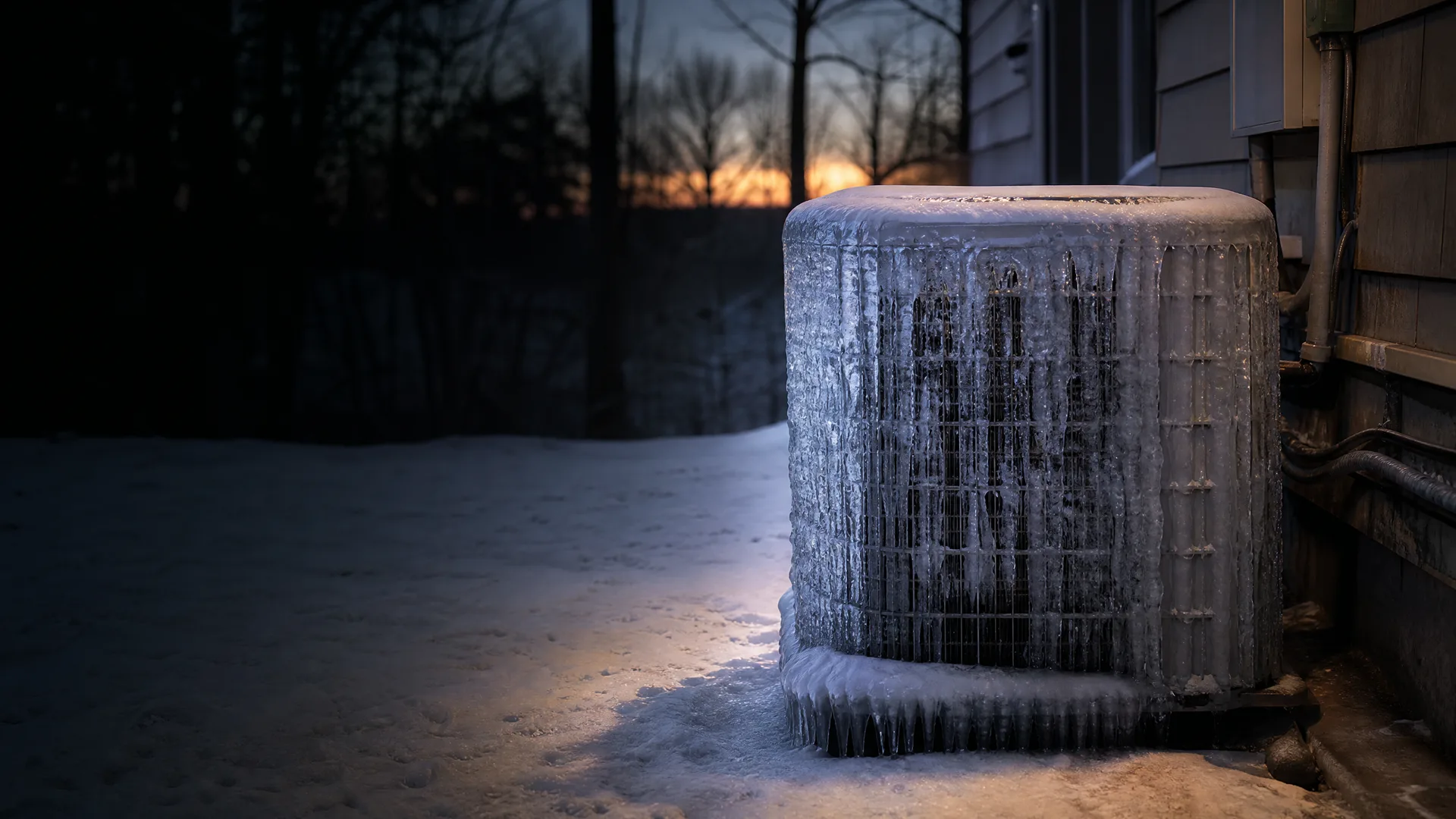
An outdoor condenser unit encased in thick ice stands on snow beside a house with horizontal siding and exterior pipes, with bare trees and a sunset glow in the background.

You're up before the sun, pulling on boots to get the paper or start the car, and you see it in the side yard: the outdoor unit wearing a thick coat of ice, top to bottom, in the gray January light. No steam, no hum, just frost piled on frost. You crouch down and there's water underneath it too, already going slick on the frozen ground. You know a little frost on the coil is normal this time of year. This isn't that. You stand there a second, breath fogging, trying to decide if it'll clear on its own by the time you're back from the driveway, or if it's still sitting there tonight.

Is this water normal, or should you be worried?

Look at where the water is and what it's doing. A little moisture dripping from the outdoor unit while it defrosts, or a small puddle near it after a thaw cycle, is normal. What's not normal is water tracking across the floor near the indoor air handler, a stain spreading on the ceiling below it, or the unit icing over and then dumping water everywhere once it finally thaws. That water has to be coming from somewhere it shouldn't, usually a clogged condensate line or a drain pan that's cracked or overflowing. Left alone, that water sits against wood framing and drywall, and a slow leak you ignore for a season can mean a moldy subfloor or a stained ceiling by the time you notice the smell.

A woman in a gray turtleneck sweater stands by a window looking outside at snowy ground, with a dimly lit living room containing a sofa, shelves, lamp and a lit candle behind her.
A woman in a cream cable-knit turtleneck sweater stands in a warmly lit living room with a fireplace and shelves behind her, looking out a window toward snow-covered trees and a railed deck.
A woman in a cream knit turtleneck sweater stands by a window looking out at snow, with a lit fireplace, sofa and lamp in the room behind her.
A woman in a gray knit sweater sits by a window looking out at falling snow, with a dimly lit living room containing a sectional sofa, pillows, a lamp and houseplants behind her.
A man in a dark blue shirt stands in an open front doorway of a stucco and wood-clad house, facing a blond woman seen from behind in the foreground on a stone walkway.

Where the water is supposed to go

Inside your indoor air handler, a coil pulls moisture out of the house air as it runs. That water drips into a pan under the coil, then down a drain line, usually PVC pipe, to a floor drain or outside. In the winter, the outdoor unit melts frost off its coil during defrost cycles and that water runs down and out through its base pan. Either path can get blocked. The indoor drain line grows algae or catches dust and clogs, so the pan backs up and overflows instead of draining. Outside, a base pan drain hole can ice over on a bitter night, so the melt has nowhere to go and it backs up into the cabinet instead.

A contractor who gets a look at where the water is actually showing up, and when, can usually tell which of these it is before taking anything apart. That matters here, because a clogged indoor drain and an iced-over outdoor pan call for different fixes, and guessing wrong means a second visit. Once you send in what you're seeing, that part isn't on you anymore. You'll hear from someone who works on heat pumps in Minnesota and knows what a January defrost cycle is supposed to look like versus what it isn't.

Interior corner of a living room with a beige upholstered sofa and dark cushion in the foreground, a ceramic vase of leafy branches on a dark side table by a curtained window, a framed picture on the wall, and a wood-surround fireplace at right.
A light gray outdoor heat pump unit mounted on a concrete pad beside a house with horizontal lap siding, with refrigerant lines and conduit running to a wall-mounted electrical box, gravel and a leafy shrub nearby.

Normal operation, outdoor unit

The unit sits clean on its pad, lines and conduit running to the disconnect on the wall. During a defrost cycle in winter, you'll see some water or a little steam come off it, then it stops once the coil clears. That's the system doing its job.

An outdoor air conditioner condenser unit on a concrete pad beside a house with horizontal siding, with conduit, cables and an electrical box on the wall and mulch beds at either side.

Grime buildup, drainage trouble

Dust and grime coat the cabinet and fins here. A dirty coil can't shed frost evenly during defrost, so melt runs where it shouldn't instead of draining clear. If you're seeing water tracking away from the pad or pooling under a grimy unit like this, it's worth having someone look at it.

Ignore It or Call Someone

Leave it for now

  • A few drops under the outdoor unit during a defrost cycle in winter will stop once the coil clears, usually within minutes.
  • Light condensation on the indoor refrigerant line or a damp spot that dries within a day isn't feeding a bigger problem.
  • If the water stays in one small area and the pan or drain line looks dry otherwise, there's nothing pulling moisture where it shouldn't go.
  • A puddle that only shows up after a thaw and is gone by afternoon is just melt, not a sign the drain is blocked.

Get it looked at

  • Water tracking across the floor near the indoor air handler usually means the condensate pan or drain line has backed up.
  • Ice building up anywhere other than the coil during a normal defrost points to a cycle that isn't completing the way it should.
  • A drain line that gushes water instead of a steady trickle, or one that's gone dry when it used to run, both mean something changed inside the line.
  • Water showing up on a ceiling or wall below the air handler means the pan has already overflowed once and will again.
  • Staining, warped flooring, or a musty smell near the unit tells you the leak's been going on longer than today.
  1. Refrigerant runs low or airflow drops, so the indoor coil gets too cold.

  2. The coil's surface drops below freezing and ice builds across it.

  3. Ice blocks airflow, so the coil can't pull heat from the air anymore.

  4. Frozen moisture on the coil thaws once the system defrosts or shuts off.

A gray outdoor condenser unit on a concrete pad beside a house with horizontal lap siding, with an electrical disconnect box and insulated refrigerant lines on the wall, gravel in the foreground and a planting bed at left.
Clean fins, clear pad, water only during a winter defrost cycle, then it stops.
A weathered gray outdoor condenser unit sits on a concrete pad beside a house with horizontal siding, with refrigerant lines entering the wall at left and a mulched shrub bed at right.
Grime packed into the fins blocks airflow, so the coil ices up and keeps dripping.
A bearded man in a plaid flannel shirt stands in a kitchen looking out a window toward snow-covered shrubs, with a steaming mug on the windowsill and potted plants on a shelf behind him.
A smiling man with dark curly hair in a navy t-shirt sits on a gray couch indoors, with a large-leafed plant and a window in the background.

A pro who works on heat pumps

A clogged drain line or a coil that's icing up from low refrigerant won't clear itself, and a puddle that keeps coming back near your air handler can reach drywall or flooring the longer it sits. Minnesota winters put real demand on a heat pump, running defrost cycles over and over through the cold months, and that's exactly when a small drainage problem turns into water where you don't want it. Figuring out whether it's the drain, the coil, or something else takes someone who can actually look at the line, the trap, and the refrigerant charge, not just guess from what you can see in the side yard. Once you send the request, you're done chasing it down. One contractor who works on heat pumps in your area gets your information and reaches out, and you can get back to the rest of your day instead of checking that puddle every morning before the sun's up.

A two-story house with light beige horizontal siding, a gabled roof, a small covered front porch with dark door, and shrubs along the foundation, set behind a mown lawn and wet sidewalk with large leafy trees on both sides.

Summer air here isn't the problem. Minnesota's summer dew point averages 59°F, according to NOAA climate data, which is on the dry side as these things go, so your indoor coil isn't working overtime to wring moisture out of the house air the way it would somewhere muggier. That's good news for the drain line and pan, since less condensate means less chance of a clog backing water up into the air handler. It also means if you're seeing a steady drip or a puddle in July, low humidity isn't the cause. Look instead at the drain line itself or the coil. Winter defrost cycles are still the bigger factor for water around your heat pump in this state.

NASA POWER T2MDEW county cells weighted by homes

An outdoor air conditioning condenser unit sits on a concrete pad beside a white horizontal-siding house, with a gray electrical disconnect box and insulated refrigerant lines on the wall, mulch and green shrubs to the right, and a concrete slab in the foreground.
Before you get your heat pump repair
A gray outdoor air conditioner condenser unit on a concrete pad beside a house with horizontal lap siding and a stone veneer base, with a conduit running to a wall-mounted disconnect box and shrubs and evergreen trees to the left.
After you get your heat pump repair

What a clogged drain line does

The condensate drain line slopes down from the pan so water keeps moving by gravity alone. Algae and dust settle along the inside of that pipe over months, and the opening narrows until a trickle of water can't get through fast enough. The pan fills, then overflows at whatever point sits lowest, often the seam where the pan meets the cabinet. That's why the puddle shows up at the air handler itself rather than farther along the duct work. A line that's draining fine moves water as fast as the coil sheds it, no backup, no standing water in the pan to find later.

Why ice makes more water than normal

A coil running at normal operating temperature sheds water about as fast as it collects it. Once ice builds across the coil, that balance breaks. The ice itself holds moisture that would otherwise have drained off gradually, and when the system defrosts or you shut it off, all of that stored water lets go at once instead of trickling out over the pan's drain. A pan and drain line sized for steady dripping can get overwhelmed by that sudden volume, which is part of why ice on the coil shows up later as a puddle on the floor rather than water in the pan where it belongs.

Power costs 15.83 cents per kilowatt-hour statewide

At 15.83 cents a kilowatt-hour, running the heat pump through a repair it doesn't need costs you more than fixing the leak would. A coil icing up from low refrigerant makes the system work harder and draw more power just to produce less heat, so that puddle is adding to your bill, not just your cleanup list.

EIA-861 2025 statewide residential average

A heat pump dripping a little water during a winter defrost cycle is doing what it's built to do. One that's pooling water by the indoor air handler, or icing up outside when it shouldn't be, is telling you something needs attention before it reaches your drywall or flooring. You've already done the part that matters, which is checking instead of ignoring it. The rest is matching the problem to the right fix: a drain line that needs clearing, a coil that's low on refrigerant, or airflow that's blocked somewhere it shouldn't be. Send the form and that search becomes someone else's job, not yours. A contractor who knows Minnesota winters and what they do to a heat pump will reach out, look at what you're seeing, and tell you plainly what's going on. You don't have to figure out which of these it is on your own, and you don't have to keep checking on that puddle every morning wondering if today's the day it gets worse.

Interior room corner with sunlight from a window, showing peeling paint and damaged plaster on the wall above a white baseboard, a wooden cabinet with a pale bowl on top, hardwood floor and a patterned rug.
Interior corner of a room with tan walls, white profiled baseboard and window trim, a wood-plank floor in sunlight, and green foliage visible through the window.
An empty room corner with cream walls, white baseboard, two windows with deep sills showing green foliage outside, and a wood plank floor lit by sunlight.
Empty room corner with beige walls, white beadboard wainscoting, chair rail and baseboard, a window with green foliage outside, and sunlight casting leaf shadows on the wall above a wood floor.
Sunlit room corner with a multi-pane window, beige walls, white baseboard, wood floor with a woven rug, and a dark wooden cabinet holding a ceramic table lamp below a framed picture.

Get your heat pump to the right pro

After you send the request, you're done searching.

Send it today

Asking costs nothing, and the choice to hire stays yours.